HIMCM數(shù)學(xué)建模競(jìng)賽真題獲取,備戰(zhàn)2023-2024年HIMCM比賽

數(shù)學(xué)建模是一門將數(shù)學(xué)知識(shí)應(yīng)用于實(shí)際問題解決的重要領(lǐng)域。對(duì)于參加即將舉行的HiMCM比賽的同學(xué)們來說,競(jìng)爭(zhēng)激烈,想要在比賽中取得優(yōu)異成績就需要在最后關(guān)頭進(jìn)行強(qiáng)化訓(xùn)練。而對(duì)于那些著眼未來的同學(xué)來說,更需要提前準(zhǔn)備,通過學(xué)習(xí)歷年比賽的經(jīng)典真題來增強(qiáng)自己的能力。
相信經(jīng)過數(shù)模學(xué)術(shù)活動(dòng)的“洗禮”,對(duì)于你挑戰(zhàn)高層次的學(xué)術(shù)科研也必然打下堅(jiān)實(shí)基礎(chǔ)。
2021年HiMCM賽題
問題A:儲(chǔ)存太陽
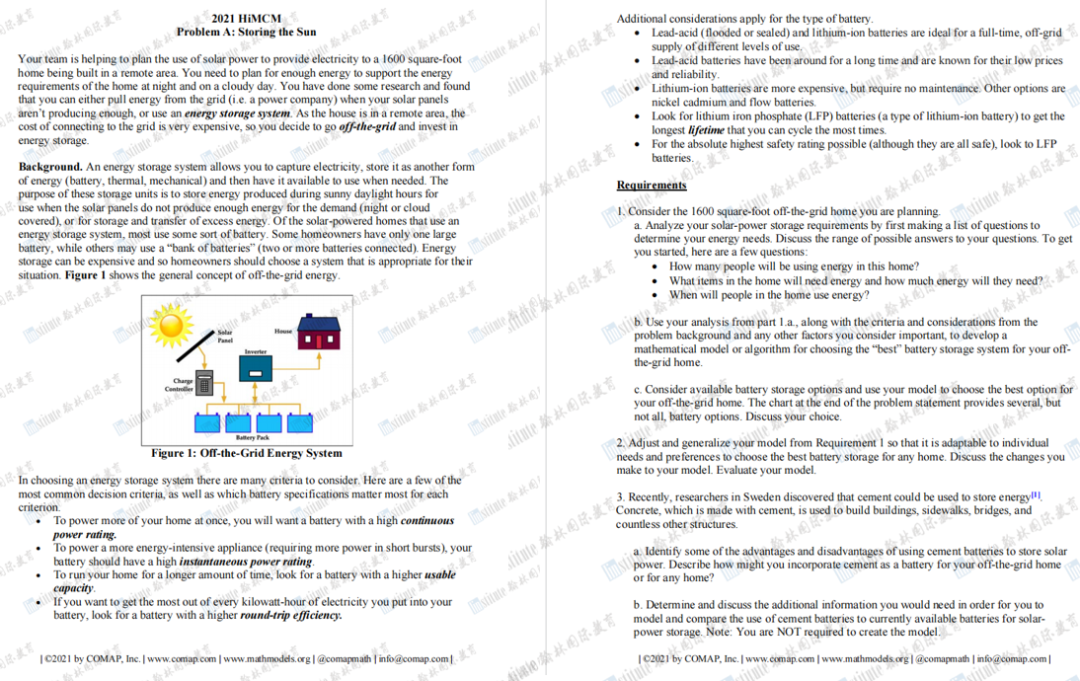
你的團(tuán)隊(duì)需要為一個(gè)偏遠(yuǎn)地區(qū)的1600平方英尺的住宅提供太陽能電力,滿足家庭在晚上和陰天的能源需求。由于房子偏遠(yuǎn),連接到電網(wǎng)的成本非常昂貴,所以你決定投資于能源存儲(chǔ)。
對(duì)于儲(chǔ)能系統(tǒng)和相關(guān)電池規(guī)格標(biāo)準(zhǔn),題目中都給出了詳細(xì)的介紹,學(xué)生需要為1600平方英尺的家庭做好能源需求規(guī)劃,并給出合適的模型。同時(shí)討論水泥電池的優(yōu)缺點(diǎn),并與太陽能電池進(jìn)行比較,給出可行性建議。
問題B:應(yīng)對(duì)干旱
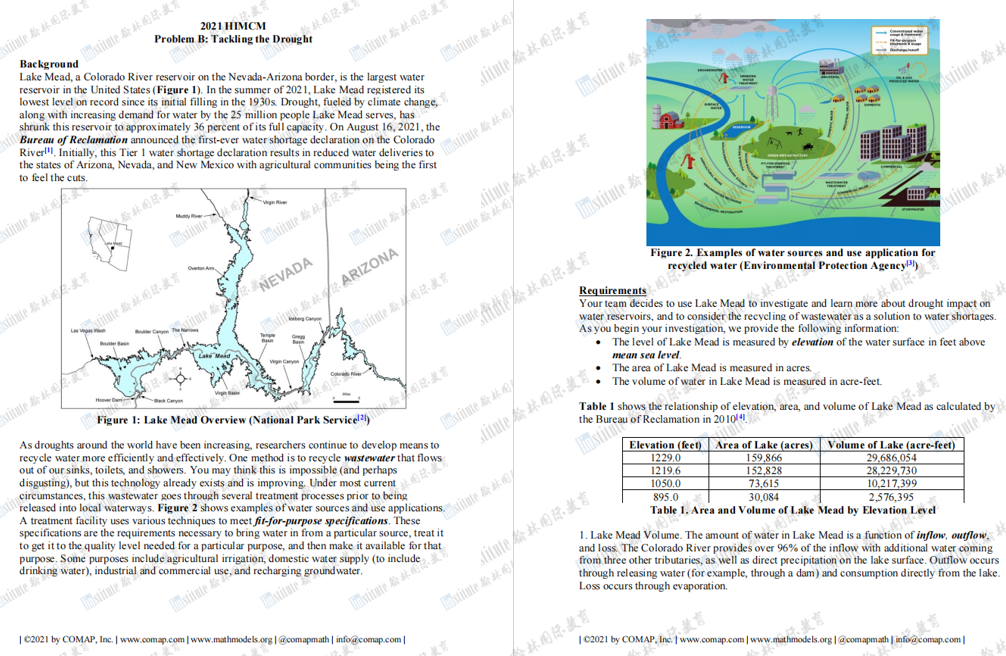
米德湖是美國最大的水庫,但2021年的夏天米德湖達(dá)到了它自20世紀(jì)30年代初次蓄水以來的最低水平。由于氣候變化引發(fā)的干旱,同時(shí)隨著米德湖所服務(wù)的2500萬人對(duì)水的需求的增加,
水庫容量已經(jīng)縮小到36%。
你的團(tuán)隊(duì)決定用米德湖案例來調(diào)查和了解更多關(guān)于干旱對(duì)水庫的影響。學(xué)生需要討論不同因素對(duì)米德湖體積和水位的影響,根據(jù)提供的歷史數(shù)據(jù)簡(jiǎn)單討論總體模型,對(duì)比不同時(shí)期的干旱,并開發(fā)兩個(gè)模型分別預(yù)測(cè)2025、2030年和2050年的米德湖水位。根據(jù)模型和預(yù)測(cè),考慮廢水循環(huán)的可行性計(jì)劃。
HiMCM2022年真題參考
Problem A: The Need for Bees
(and not just for honey)
Honeybees, along with a few other key animals, are critical to human existence on our planet. Along with honey production, these insects provide the vital role of pollination of many trees and plants that provide food for our survival. In 2007, the term Colony Collapse Disorder (CCD) was created to describe the decline of honeybee populations around the world. Bee decline can be attributed to factors such as viruses, pesticides, predators, habitat destruction, and environmental conditions.
Some information to consider (but you may find other helpful information online):
· Honeybees can travel up to 20 km, but typically stay within 6 km of their hive.
· A typical honeybee hive contains between 20,000 and 80,000 honeybees.
· A single honeybee can visit approximately 2,000 flowers or more in a single day.
· Because of the high workload during summertime, most honeybees work themselves to death, resulting in a shorter lifespan.
· During autumn and wintertime, honeybees may live a bit longer (four to six months).
· A honeybee’s level of activity, pollen consumption, and protein abundance impacts its lifespan.
Requirements
1. Develop a model to determine the population of a honeybee colony over time.
2. Conduct sensitivity analysis on your model to determine which factors (e.g., lifespans, egg laying rates, fertilized/unfertilized egg ratios, or other factors) have the greatest impact on honeybee colony size.
3. Model and predict how many honeybee hives you will need to support pollination of a 20-acre
(81,000 square meters) parcel of land containing crops that benefit from pollination.
4. Create a non-technical, one-page blog or infographic for a website that provides the information you developed.
Your PDF solution of no more than 25 total pages should include:
· One-page Summary Sheet.
· Table of Contents.
· Your complete solution.
· One-page blog or infographic.
· References list.
Note: The HiMCM Contest has a 25-page limit to your PDF solution submission. All aspects of your submission count toward the 25-page limit (Summary Sheet, Table of Contents, Reference List, and any Appendices).
Problem B: CO2 and Global Warming
Prior to the Industrial Revolution, carbon dioxide (CO2) in the atmosphere was consistently around 280 parts per million (ppm). The concentration of CO2 in the atmosphere reached 377.7 ppm in March of 2004, resulting in the largest 10-year average increase up to that time. According to scientists from National Oceanographic and Atmospheric Administration (NOAA) and Scripps Institution of Oceanography (SIO) the monthly mean CO2 concentration level peaked at 421 ppm in May 2022. An Organisation for Economic Co-Operations and Development (OECD) report predicts a CO2 level of 685 ppm by 2050.
The editors of Scientific Today magazine have asked your team to address these claims of the current reported and future predictions of CO2 concentration levels. They provided two data sets (CO2 Data Set 1 & Temps Data Set 2) to assist in your research.
Requirements
1. Do you agree with CO2 level claims? Use CO2 Data Set 1 to analyze CO2 changes.
a. Do you agree that the March 2004 increase of CO2 resulted in a larger increase than observed over any previous 10-year period? Why or why not?
b. Fit various (more than one) mathematical models to the data to describe past, and predict future, concentration levels of CO2 in the atmosphere.
c. Use each of your models to predict the CO2 concentrations in the atmosphere in the year 2100. Do any of your models agree with claims and predictions that the CO2 concentration level will reach 685 ppm by 2050? If not by 2050, when do your models predict the concentration of CO2 reaching 685 ppm?
d. Which model do you consider most accurate? Why?
2. What’s the relationship between temperature and CO2? Many scientists think that there is a relationship between warming global temperatures and the concentration of CO2 in the atmosphere.
Use your work in part 1 and Temps Data Set 2 to assist in your comparison of land-ocean temperatures and CO2 concentration levels.
a. Build a model to predict future land-ocean temperatures changes. When does your model predict the average land-ocean temperature will change by 1.25°C, 1.50°C, and 2°C compared to the base period of 1951-1980?
b. Build a model to analyze the relationship (if any) between CO2 concentrations and landocean temperatures since 1959. Explain the relationship or justify that there is no relationship.
c. Extend your model from part 2.b. into the future. How far into the future is your model reliable? What concerns, if any, do you have with your model’s ability to predict future CO2 concentration levels and/or land-ocean temperatures?
3. Prepare a non-technical article
(1 page maximum) for Scientific Today to explain in your team’s findings and possible recommendations for the future.
Your PDF solution of no more than 25 total pages should include:
· One-page Summary Sheet.
· Table of Contents.
· Your complete solution.
· One-page blog or infographic.
· References list.
Note: The HiMCM Contest has a 25-page limit to your PDF solution submission. All aspects of your submission count toward the 25-page limit (Summary Sheet, Table of Contents, Reference List, and any Appendices).
掃碼免費(fèi)獲取HiMCM學(xué)術(shù)活動(dòng)真題,暑期備考請(qǐng)咨詢

關(guān)于選擇比賽題目
HiMCM高中生團(tuán)隊(duì)從2個(gè)建模問題中二選一。所有問題都涉及為開放式的解決并且不會(huì)只有一個(gè)解決方案。
團(tuán)隊(duì)在提供解決方案時(shí),可以使用:互聯(lián)網(wǎng)、圖書館資源、軟件、電腦,計(jì)算器等工具。在形成解決方案文書時(shí),應(yīng)注重清晰度、分析過程和解決方案的設(shè)計(jì)問題。
所有最終獲得“杰出方案”的正式論文都會(huì)被發(fā)表在Mathmodels.org中。
以上就是關(guān)于【HIMCM數(shù)學(xué)建模競(jìng)賽真題獲取,備戰(zhàn)2023-2024年HIMCM比賽】的解答,如需了解學(xué)校/賽事/課程動(dòng)態(tài),可至翰林教育官網(wǎng)獲取更多信息。
往期文章閱讀推薦:
AMC/BPhO/UKChO…下半年20+賽事集中開考!抓住競(jìng)賽"黃金備賽期"!
2026五大奧賽中國隊(duì)斬獲四個(gè)世界第一,全員金牌收官!


翰林AMC8視頻課重磅上線!

國際競(jìng)賽真題資源免費(fèi)領(lǐng)取






