CIE A Level Biology復習筆記8.3.4 Heart Action

Heart Action: Initiation & Control
- Control of the basic heartbeat is?myogenic, which means the heart will beat without any external stimulus
- This intrinsic rhythm means the heart beats at around 60 times per minute
- The?sinoatrial node (SAN)?is a group of cells in the wall of the right atrium. The SAN initiates a wave of?depolarisation?that causes the?atria to contract
- The?Annulus fibrosus?is a region of non-conducting tissue which prevents the depolarisation spreading straight to the ventricles
- Instead, the depolarisation is carried to the?atrioventricular node (AVN)
- This is a region of conducting tissue between atria and ventricles
- After a slight delay, the AVN is stimulated and passes the stimulation along the?bundle of His
- This delay means that the ventricles contract after the atria
- The bundle of His is a collection of conducting tissue in the?septum?(middle) of the heart. The bundle of His divides into two conducting fibres, called?Purkyne?tissue, and carries the wave of excitation along them
- The Purkyne fibres spread around the ventricles and initiate the?depolarization of the ventricles?from the apex (bottom) of the heart
- This makes the?ventricles contract?and blood is forced out of the pulmonary artery and aorta
Stages in the cardiac cycle table
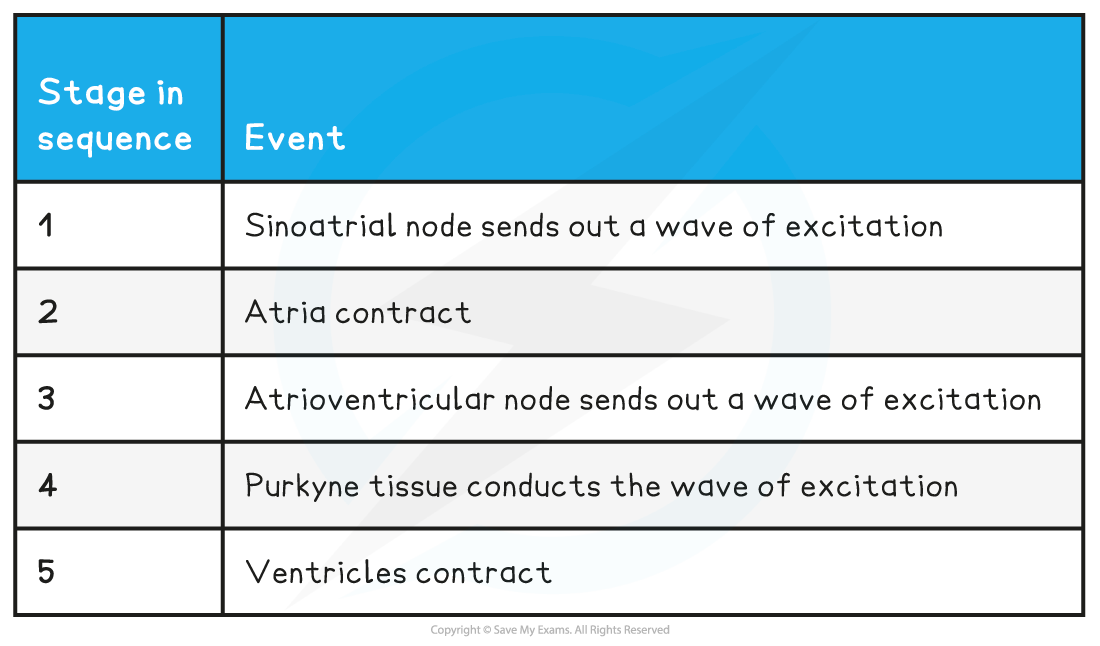
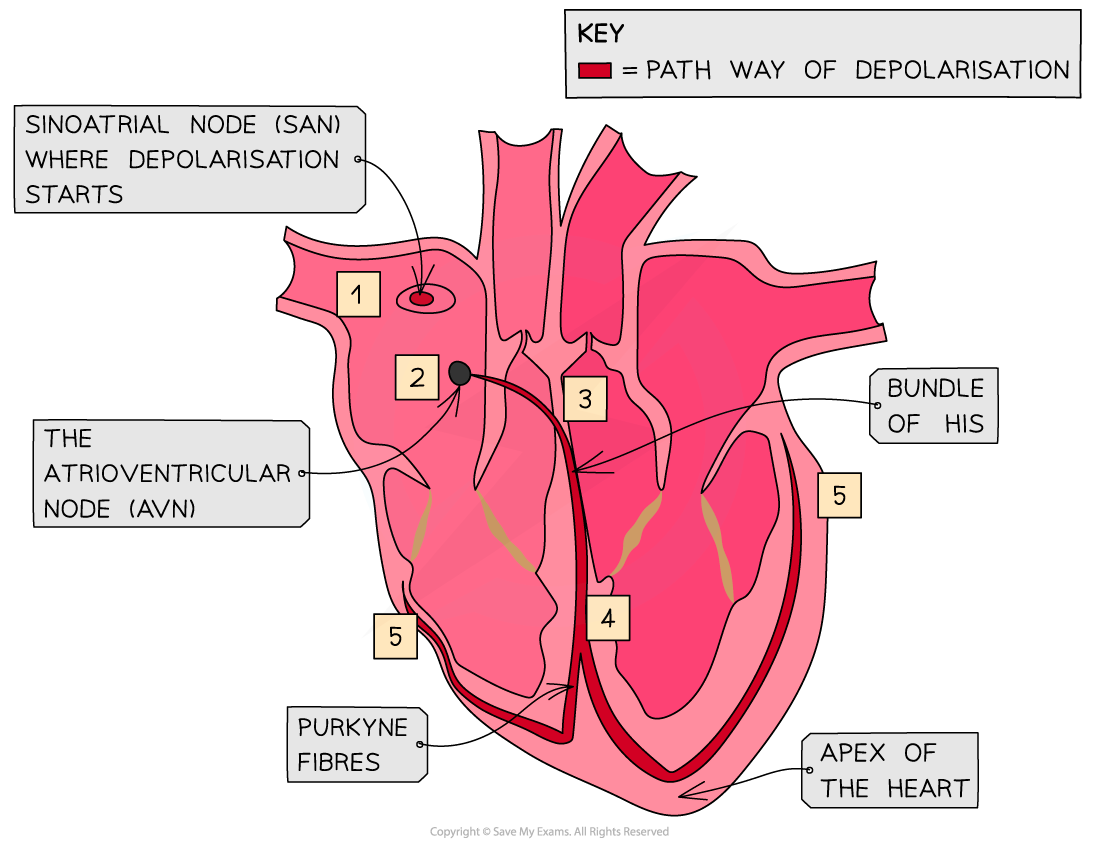
The wave of depolarisation spreads across the heart in a coordinated manner
Worked Example
Explain the roles of the sinoatrial node, the atrioventricular node and the Purkyne fibres in a heartbeat.
The Sinoatrial node sends out a wave of excitation and this spreads across both atria, causing atrial systole. Non-conducting tissue called the Annulus fibrosus prevents the excitation from spreading to the ventricles and so this ensures that atria and ventricles don’t contract at the same time. The Atrioventricular node then sends the wave of excitation to the ventricles after a short delay of around 0.1 - 0.2 seconds, ensuring that the atria have time to empty their blood into the ventricles. The Purkyne fibres conduct the excitation down the septum of the heart and to the apex, before the excitation is carried upwards in the walls of the ventricles. This means that during ventricular systole, the blood contracts from its base and blood is pushed upwards and outwards.
Exam Tip
Remember that the heart is myogenic, which means that the heart will generate a heartbeat by itself and without any other stimulation. Instead, the electrical activity of the heart regulates the heart rate.Be aware that you may sometimes see an alternative spelling of "Purkyne" as "Purkinje" they mean the exact same thing!
轉載自savemyexams
以上就是關于【CIE A Level Biology復習筆記8.3.4 Heart Action】的解答,如需了解學校/賽事/課程動態,可至翰林教育官網獲取更多信息。
往期文章閱讀推薦:
MIT官方發布【2026年夏季推薦閱讀書單】!橫跨科學/人文/經濟...
全網破防!ALevel CIE數學M1疑似錯題?經濟P2難度飆升?5月6日大考考情分析必看!


翰林AMC8視頻課重磅上線!

國際競賽真題資源免費領取






