OCR A Level Biology:復(fù)習(xí)筆記2.5.8 Osmosis in Animal & Plant Cells

Osmosis in Animal & Plant Cells
Osmosis in animal cells
- Animal cells?can?lose?and?gain water?as a result of?osmosis
- As animal cells?do not have a supporting cell wall?(unlike plant cells), the results of this loss or gain of water on the cell are?severe
Animal cells losing water
- If an animal cell is placed in a solution with a?lower water potential?than the cell (such as a?concentrated sucrose solution)
- Water will?leave?the cell through its partially permeable cell surface membrane by?osmosis?and the cell will?shrink?and?shrivel up
- This is?crenation?(the cell has become?crenated), which is usually?fatal?for the cell
- Crenation occurs when the cell is in a?hypertonic environment?(the solution outside of the cell has a?higher solute concentration?than the inside of the cell)
Animal cells gaining water
- If an animal cell is placed in?pure water?or a?dilute solution, water will?enter?the cell through its partially permeable cell surface membrane by?osmosis, as the pure water or dilute solution has a?higher water potential
- The cell will continue to?gain?water by osmosis until the cell membrane is stretched too far and the cell?bursts?(cytolysis), as it has no cell wall to withstand the increased pressure created
- This is?fatal?for the cell
- Lysis occurs when the cell is in a?hypotonic environment?(the solution outside of the cell has a?lower solute concentration?than the inside of the cell)
- This is why a constant water potential?must?be maintained inside the bodies of animals
Animal cells in isotonic environments
- If an animal cell is in an?isotonic environment?(the solution outside of the cell has the?same solute concentration?as the inside of the cell)
- The movement of water molecules into and out of the cell occurs at the?same rate?(no net movement of water) and there is?no change to the cells
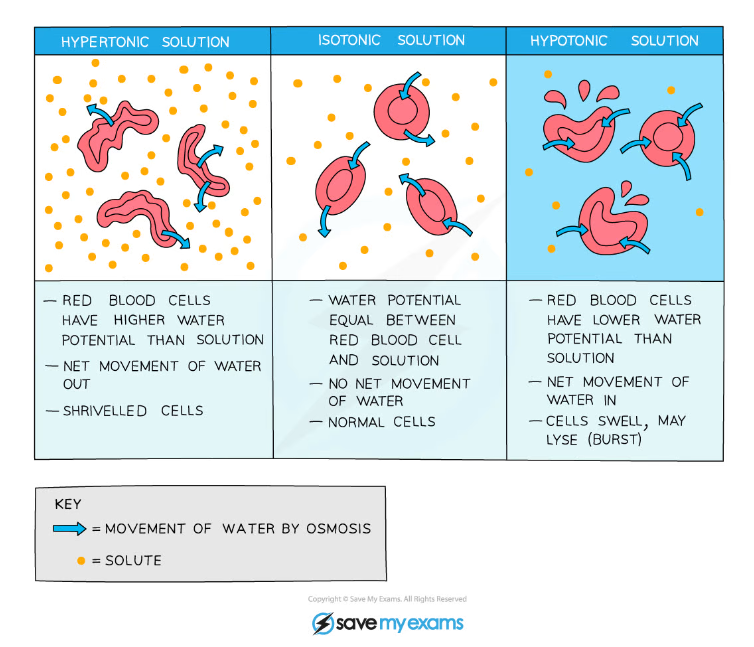
Effect of osmosis on animal cells
Osmosis in plant cells
- Like animal cells,?plants cells?can also?lose?and?gain water?as a result of?osmosis
- As plant cells?have a supporting cell wall, the results of this loss or gain of water on the cell are?less?severe?than in animal cells
Plant cells losing water
- If a plant cell is placed in a solution with a?lower water potential?than the plant cell (such as a concentrated sucrose solution), water will?leave?the plant cell through its partially permeable cell surface membrane by?osmosis
- As water leaves the?vacuole?of the plant cell, the volume of the plant cell?decreases
- The?protoplast?gradually shrinks and no longer exerts pressure on the cell wall
- As the protoplast continues to shrink, it begins to pull away from the cell wall
- This process is known as?plasmolysis?– the plant cell is?plasmolysed
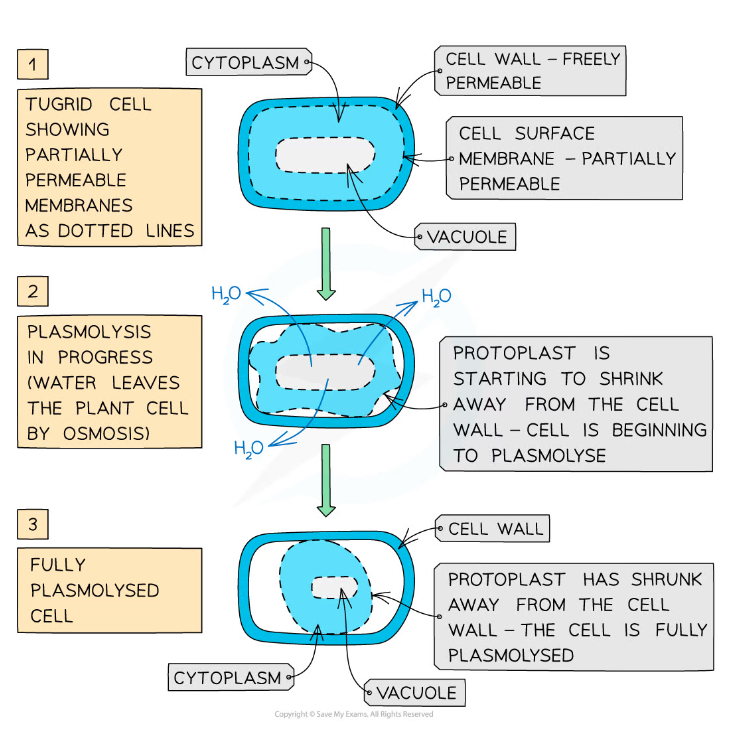
Plasmolysis of a plant cell that has been placed in a solution with a lower water potential than the cell itself
Plant cells gaining water
- If a plant cell is placed in?pure water?or a?dilute solution, water will?enter?the plant cell through its partially permeable cell surface membrane by?osmosis, as the pure water or dilute solution has a?higher water potential?than the plant cell
- As water enters the?vacuole?of the plant cell, the?volume?of the plant cell?increases
- The expanding?protoplast?(living part of the cell inside the cell wall) pushes against the cell wall and?pressure builds up?inside the cell – the inelastic cell wall prevents the cell from bursting
- The pressure created by the cell wall also stops too much water from entering and this also helps to prevent the cell from bursting
- When a plant cell is fully inflated with water and has become rigid and firm, it is described as fully?turgid
- This turgidity is important for plants as the effect of all the cells in a plant being firm is to provide?support?and?strength?for the plant – making the plant stand upright with its leaves held out to catch sunlight
- If plants do not receive enough water the cells cannot remain rigid and firm (turgid) and the plant?wilts
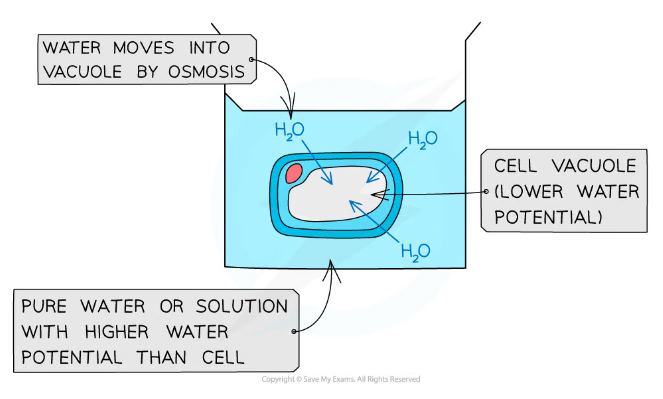
Osmosis of water into a plant cell
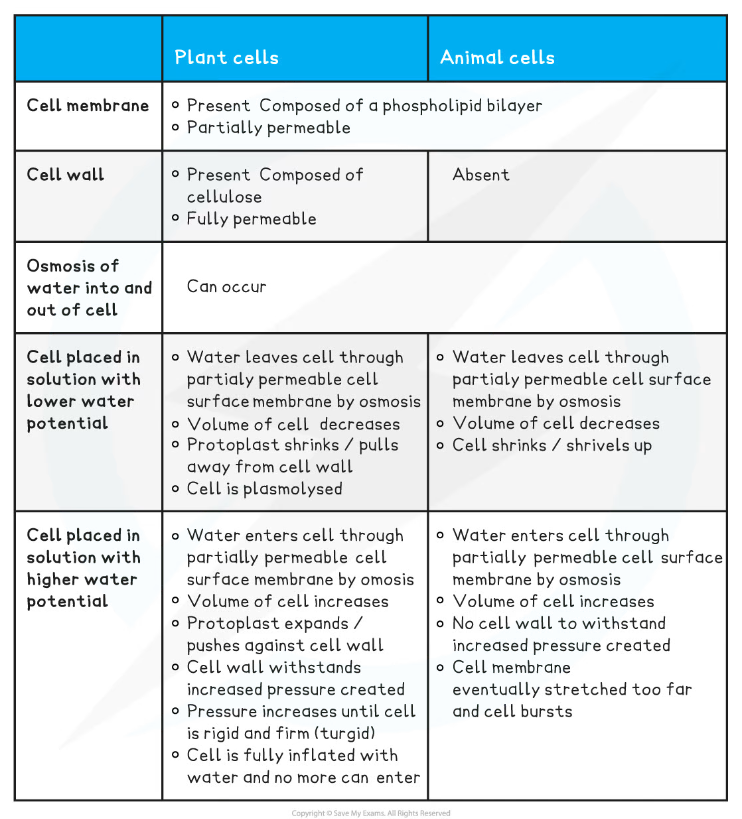
Comparing & Contrasting the Movement of Water by Osmosis in Plant & Animal Cells Table
Exam Tip
Be careful with your scientific terminology – animal cells?do not?plasmolyse?because they do not have a cell wall. In a solution with a lower water potential than the cell itself, animal cells will?shrink. Plasmolysis only occurs in plant cells.Remember – plant?cell?membranes?are composed of a phospholipid bilayer and are?partially permeable?(only certain molecules can cross), whereas plant?cell walls?are made of cellulose and are?freely (fully) permeable. Thus, in a plasmolysed cell, the external solution will be exerting pressure on the?protoplast?(there is not an empty space between the cell wall and protoplast).
轉(zhuǎn)載自savemyexams
以上就是關(guān)于【OCR A Level Biology:復(fù)習(xí)筆記2.5.8 Osmosis in Animal & Plant Cells】的解答,如需了解學(xué)校/賽事/課程動(dòng)態(tài),可至翰林教育官網(wǎng)獲取更多信息。
往期文章閱讀推薦:
翰林獨(dú)家 | 經(jīng)濟(jì)學(xué)競(jìng)賽核心精講,一冊(cè)打通NEC/IEO/USAEBO!
2026 ALEVEL 夏考A率出爐!愛德思vs牛津AQA,哪些科目真的“好出分”?


翰林AMC8視頻課重磅上線!

國(guó)際競(jìng)賽真題資源免費(fèi)領(lǐng)取






