Edexcel IGCSE Physics: Double Science 復習筆記: 3.2.2 Reflection & Refraction

Reflection & Refraction
- All waves, whether transverse or longitudinal, can be?reflected?and?refracted
- Reflection occurs when:
A wave hits a boundary between two media and does not pass through, but instead stays in the original medium
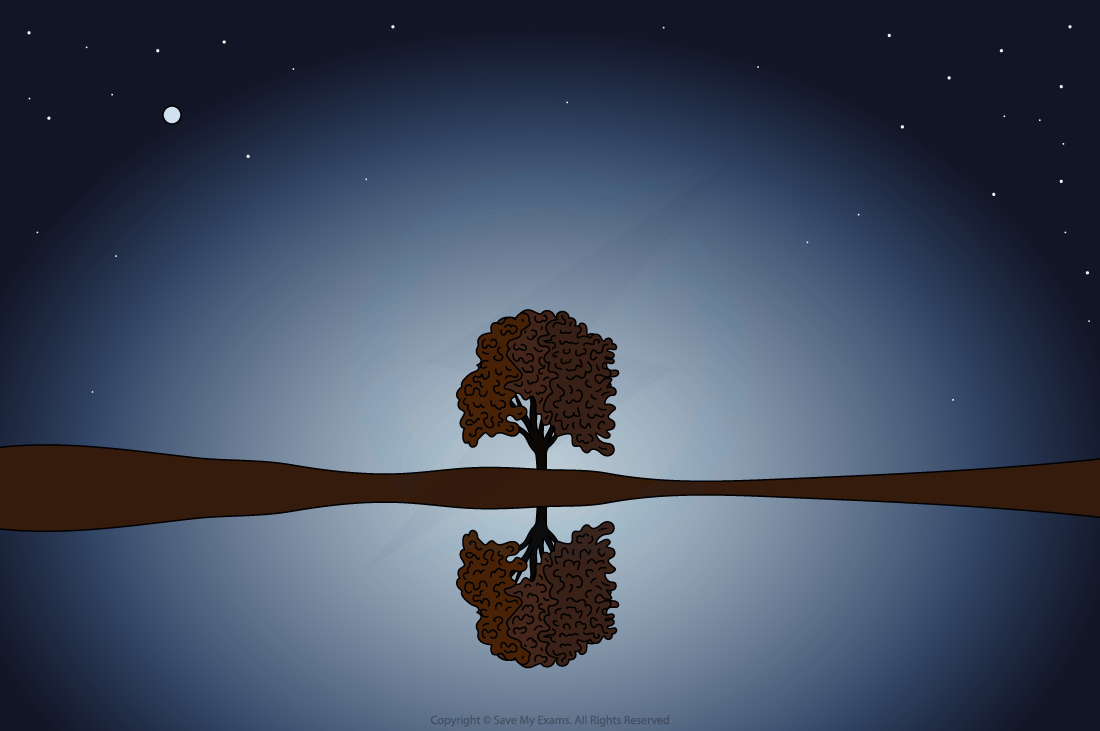
An identical image of the tree is seen in the water due to reflection
- Refraction occurs when:
A wave passes a boundary between two different transparent media and undergoes a change in direction
Waves can change direction when moving between materials with different densities
The Law of Reflection
- Angles are measured between the wave direction (ray) and a line at 90 degrees to the boundary
- The angle of the wave approaching the boundary is called the?angle of incidence (i)
- The angle of the wave leaving the boundary is called the?angle of reflection (r)
- The angles are the?same, so the law of reflection can be written:
Angle of incidence (i) = Angle of reflection (r)
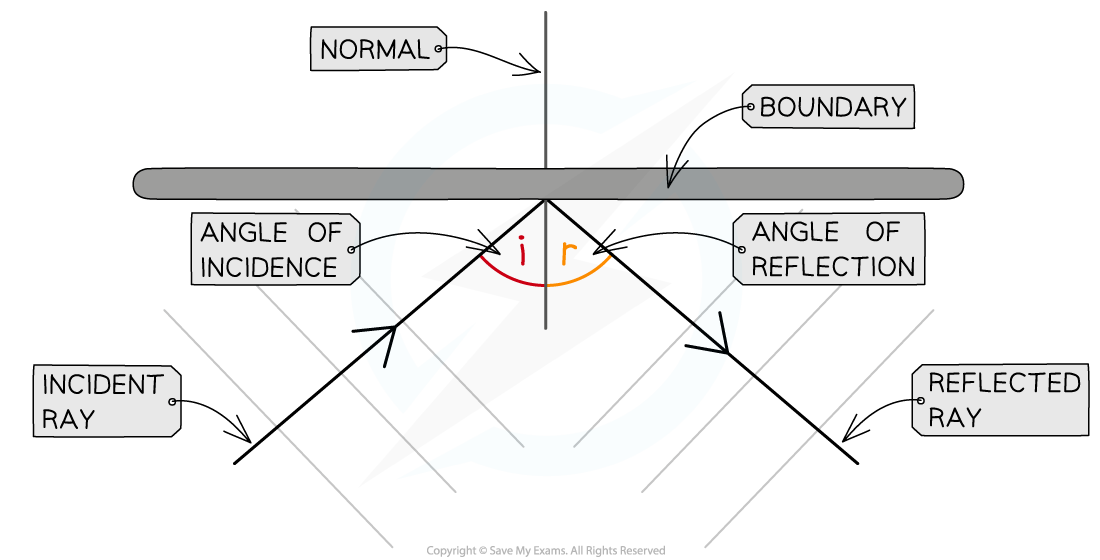
Angle of incidence and angle of reflection
Ray Diagrams
Reflection Ray Diagrams
- Angles are measured between the wave direction (ray) and a line at 90 degrees to the boundary
- The angle of the wave approaching the boundary is called the?angle of incidence (i)
- The angle of the wave leaving the boundary is called the?angle of reflection (r)
- The?law of reflection?states that these angles are the same
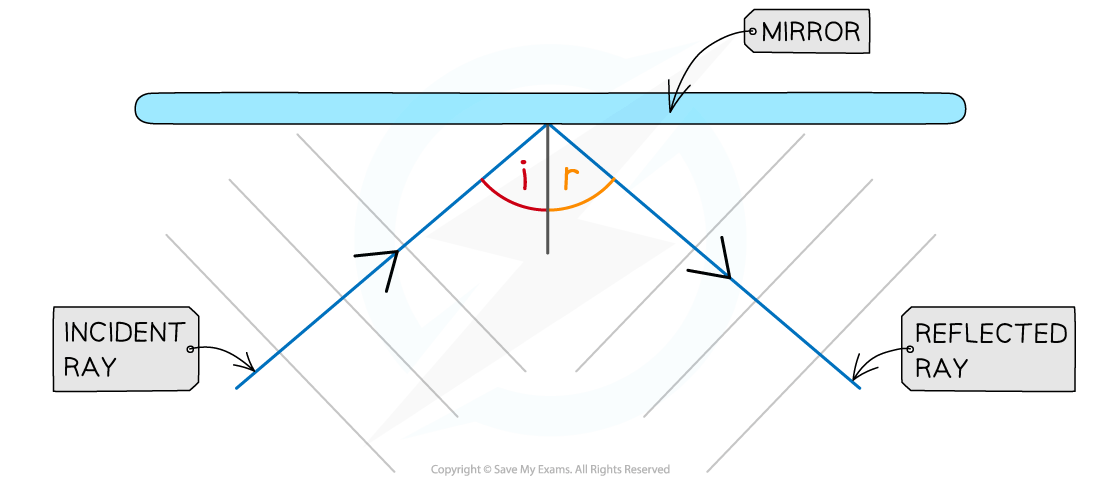
Ray diagram of reflection of a wave at a mirror
- When drawing a ray diagram an arrow is used to show the direction the wave is travelling
- An?incident?ray has an arrow pointing?towards?the boundary
- A?reflected?ray has an arrow pointing?away?from the boundary
- The?angles?of?incidence?and?reflection?are usually labelled?i?and?r?respectively and measured from the?normal
Refraction Ray Diagrams
- Refraction occurs when light passes a boundary between two different transparent media
- At the boundary, the rays of light undergo a?change in direction
- The direction is taken as the angle from a hypothetical line called the normal
- This line is perpendicular to the surface of the boundaries and is usually represented by a straight dashed or dotted line
- The change in direction depends on the difference in density between the two media:
- From less dense to more dense (e.g air to glass), light bends?towards?the normal
- From more dense to less dense (e.g. glass to air), light bends?away?from the normal
- When passing along the normal (perpendicular) the light?does not bend?at all
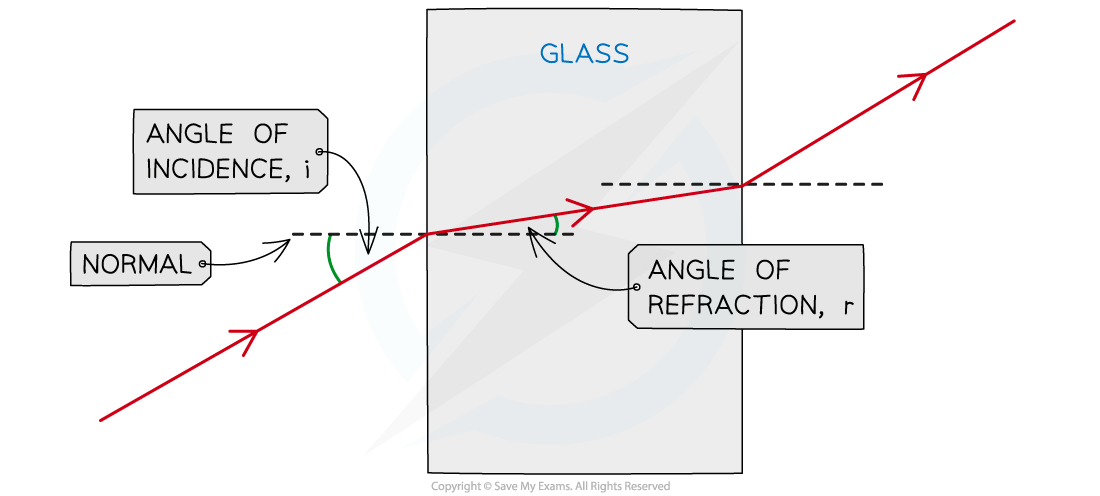
How to construct a ray diagram showing the refraction of light as it passes through a rectangular block
- The change in direction occurs due to the change in speed when travelling in different substances
- When light passes into a?denser?substance the rays will?slow down, hence they bend towards the normal
- The only properties that change during refraction are speed and wavelength – the?frequency?of waves?does not change
- Different frequencies account for different?colours?of light (red has a low frequency, whilst blue has a high frequency)
- When light refracts,?it does not change colour?(think of a pencil in a glass of water), therefore, the frequency does not change
Worked Example
Two parallel rays of light entering and passing through prism?A?and prism?C.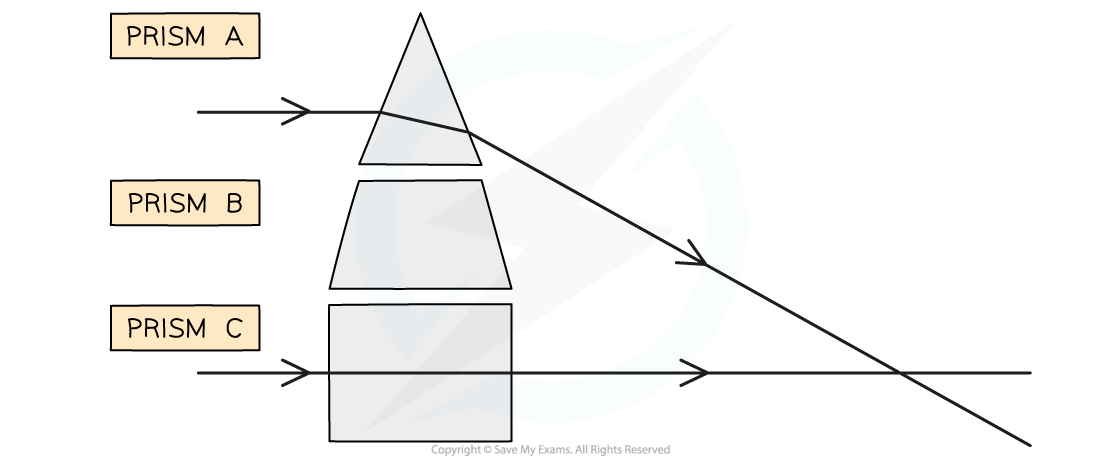 Draw a third parallel ray entering and passing through prism?B.
Step 1: Draw a parallel ray on the left
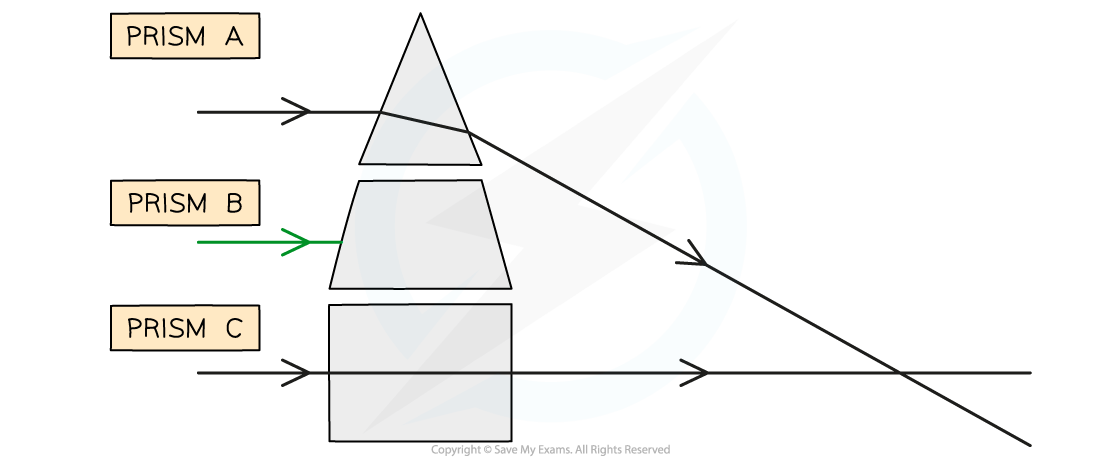
Step 2: Draw the refracted ray at the first surface
-
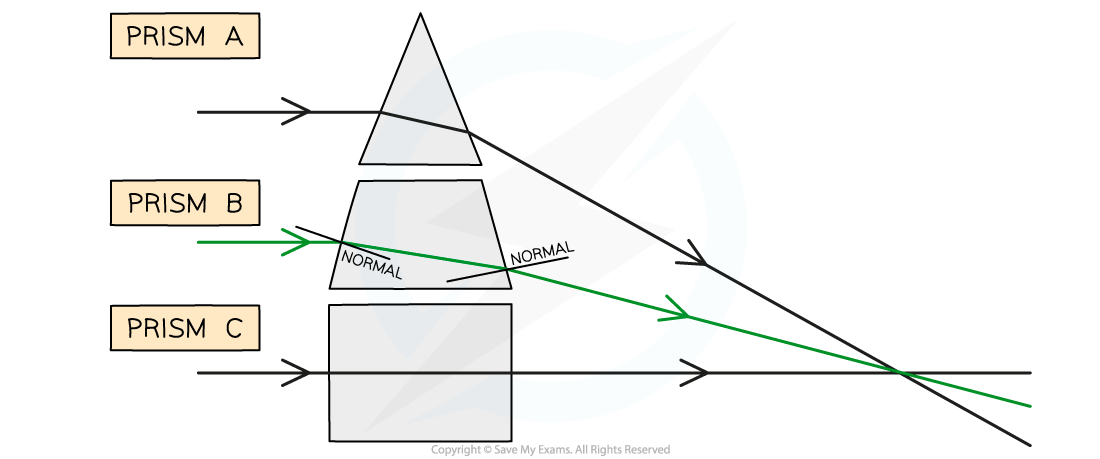
- As the ray?enters?the block it bends?towards?the normal since it is going into a denser material
- In this case, the angle of refraction is?smaller?than the angle of incidence
Step 3: Draw the refracted ray at the second surface
-
- As the ray?leaves?the block it bends?away?from the normal
- In this case, the angle of refraction is?larger?than the angle of incidence
Exam Tip
When drawing ray diagrams for reflection:
- A simple straight line?with an arrow?is enough to represent the wave
- You do not need to draw the wavefronts unless asked to do so!
- Take care to draw the angle correctly
- If it is slightly out it won’t be a problem, but if there is an obvious difference between the angle of incidence and the angle of reflection then you will probably lose a mark!
Practice drawing refraction diagrams as much as you can! It's very important to remember which way the light bends when it crosses a boundary:
As the light?enters?the block it bends?towards?the normal line
Remember: Enters Towards
When it?leaves?the block it bends?away?from the normal line
Remember: Leaves Away
Don't forget to draw the arrows for the direction of the light rays and make sure they are drawn with a ruler and a sharp pointed pencil
以上就是關于【Edexcel IGCSE Physics: Double Science 復習筆記: 3.2.2 Reflection & Refraction】的解答,如需了解學校/賽事/課程動態,可至翰林教育官網獲取更多信息。
往期文章閱讀推薦:
翰林獨家 | 經濟學競賽核心精講,一冊打通NEC/IEO/USAEBO!
IGCSE全A*,A-Level階段卻崩了?別忽視IGCSE選課的重要性!


翰林AMC8視頻課重磅上線!

國際競賽真題資源免費領取






