IB DP Physics: SL復(fù)習(xí)筆記4.4.2 Reflection

Reflection
- When light hits a smooth plane surface, most of it gets?reflected
- Very smooth reflective surfaces (e.g. mirrors) are known as?specular?plane reflectors
- For these surfaces, the?law of reflection?applies:
The angle of reflection is equal to the angle of incidence
i?=?r
- Where:
- The?angle of incidence?(i) is the angle between the?incident ray?and the?normal
- The?angle of reflection?(r) is the angle between the?reflected ray?and the normal
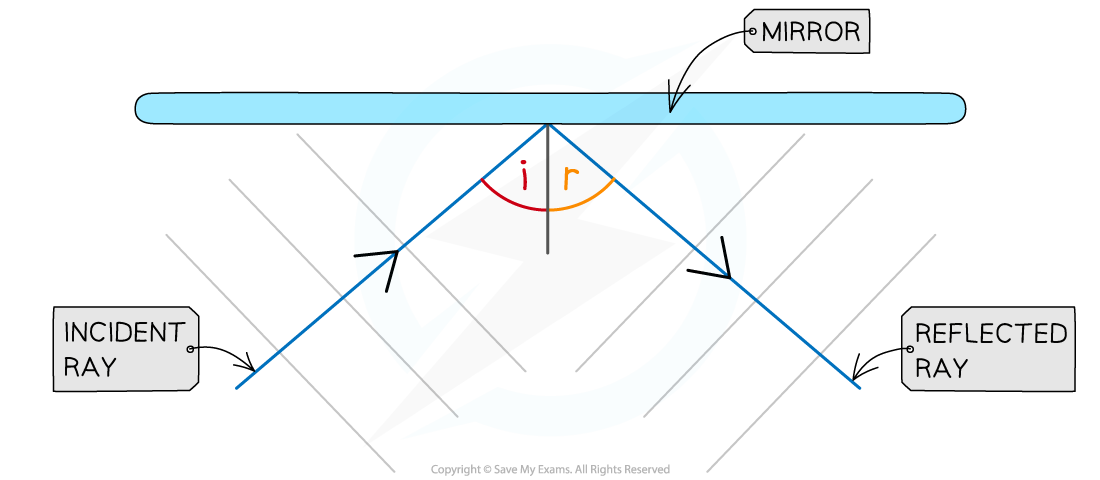
A light ray being reflected by a mirror
- The wavelength of the reflected ray is the same as that of the incident ray
Worked Example
A light ray is reflected by a mirror as shown in the diagram below.
a) State the angle of reflection
b) Add the incident and reflected wavefronts to the diagram
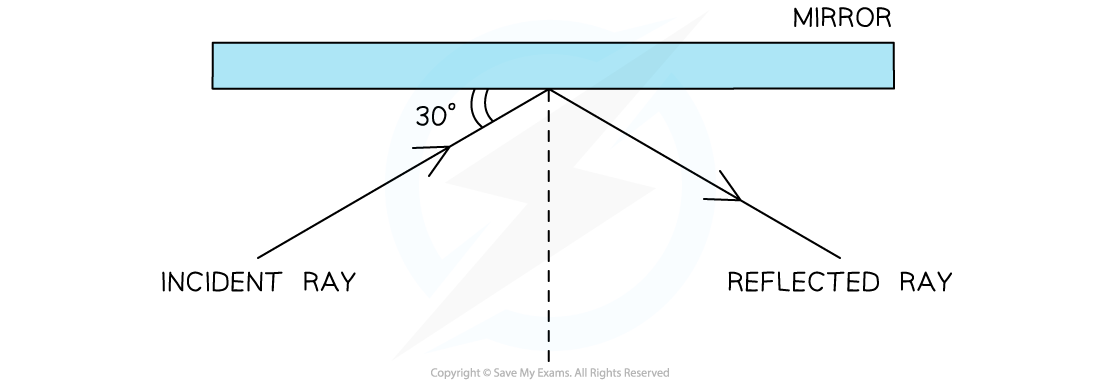
a) State the angle of reflection
Step 1: Recall the definition of the angle of incidence?(i)
-
- The angle of incidence is the angle between the incident ray and the normal
- This is not the 30° angle marked in the diagram
i?= 90° – 30°
i?= 60°
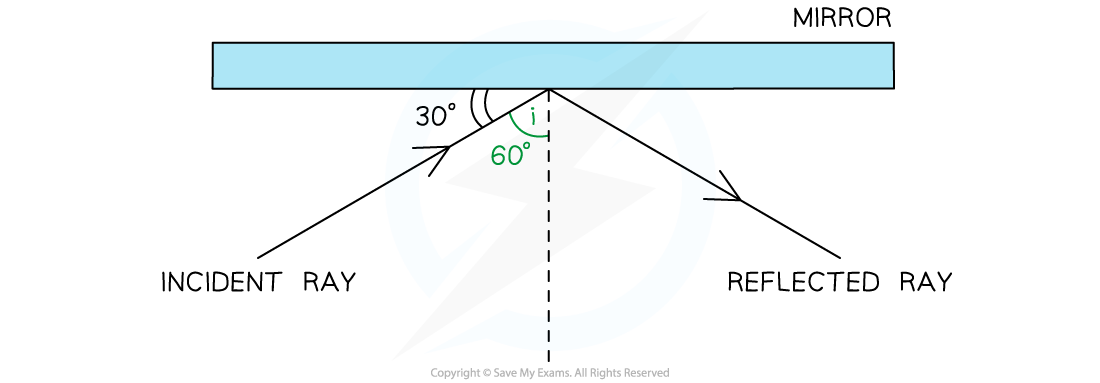
Step 2: Recall the law of reflection
The angle of reflection is equal to the angle of incidence
Step 3: State the angle of reflection (r)
r?= 60°
b)? Add the incident and reflected wavefronts to the diagram
Step 1: Recall that wavefronts and rays are perpendicular to each other
-
- Add at least three equally spaced wavefronts all perpendicular to the incident ray
- Add at least three equally spaced wavefronts all perpendicular to the reflected ray
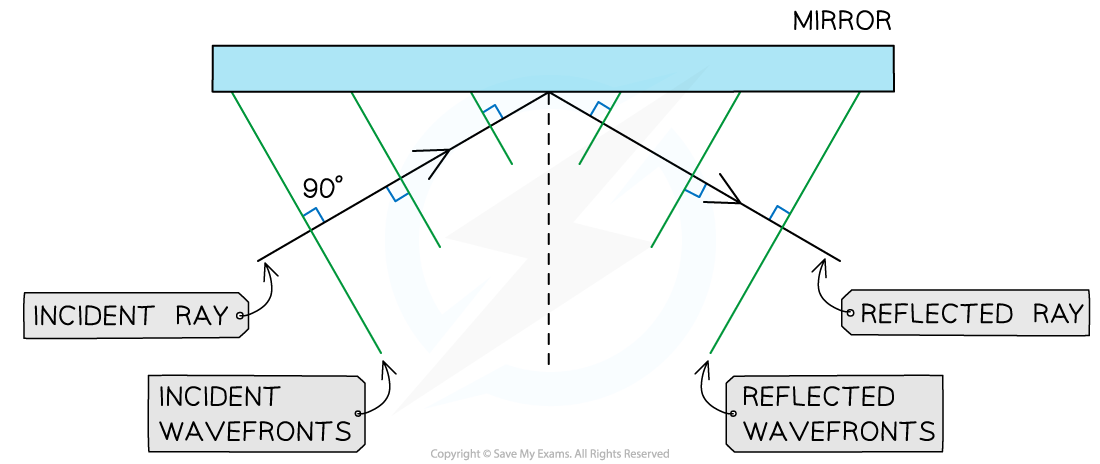
Exam Tip
When asked to complete or construct reflection ray diagrams, remember to add:
- arrows on rays to distinguish between incident and reflected rays
- labels to distinguish between incident and reflected wavefronts
In most cases, when dealing with light, you will just need to draw rays. However, you might still be required to draw wavefronts sometimes. Always use a ruler or a straight edge and a shape pencil for the ray diagrams.
Remember that the distance between each wavefront represents the wavelength of the wave. If you intend on the ray not changing wavelength (like in reflection) then make sure the incident?and?reflected wavefronts are all equally spaced by the same amount.
轉(zhuǎn)載自savemyexams
以上就是關(guān)于【IB DP Physics: SL復(fù)習(xí)筆記4.4.2 Reflection】的解答,如需了解學(xué)校/賽事/課程動(dòng)態(tài),可至翰林教育官網(wǎng)獲取更多信息。
往期文章閱讀推薦:
翰林獨(dú)家 | 經(jīng)濟(jì)學(xué)競賽核心精講,一冊(cè)打通NEC/IEO/USAEBO!
2026 AMC10/12美國數(shù)學(xué)競賽新賽季!【翰林教育 × 清華大學(xué)出版社】獨(dú)家教材全面發(fā)售!


翰林AMC8視頻課重磅上線!

國際競賽真題資源免費(fèi)領(lǐng)取






