IB DP Physics: HL復習筆記10.2.3 Potential Gradient & Difference

Potential Gradient
Electric?Potential Gradient
- An electric field can be defined in terms of the variation of?electric potential?at different points in the field:
The electric field at a particular point is equal to the negative gradient of a potential-distance graph at that point
- The potential gradient is defined by the?equipotential lines
- These demonstrate the electric potential in an electric field and are always drawn?perpendicular?to the field lines
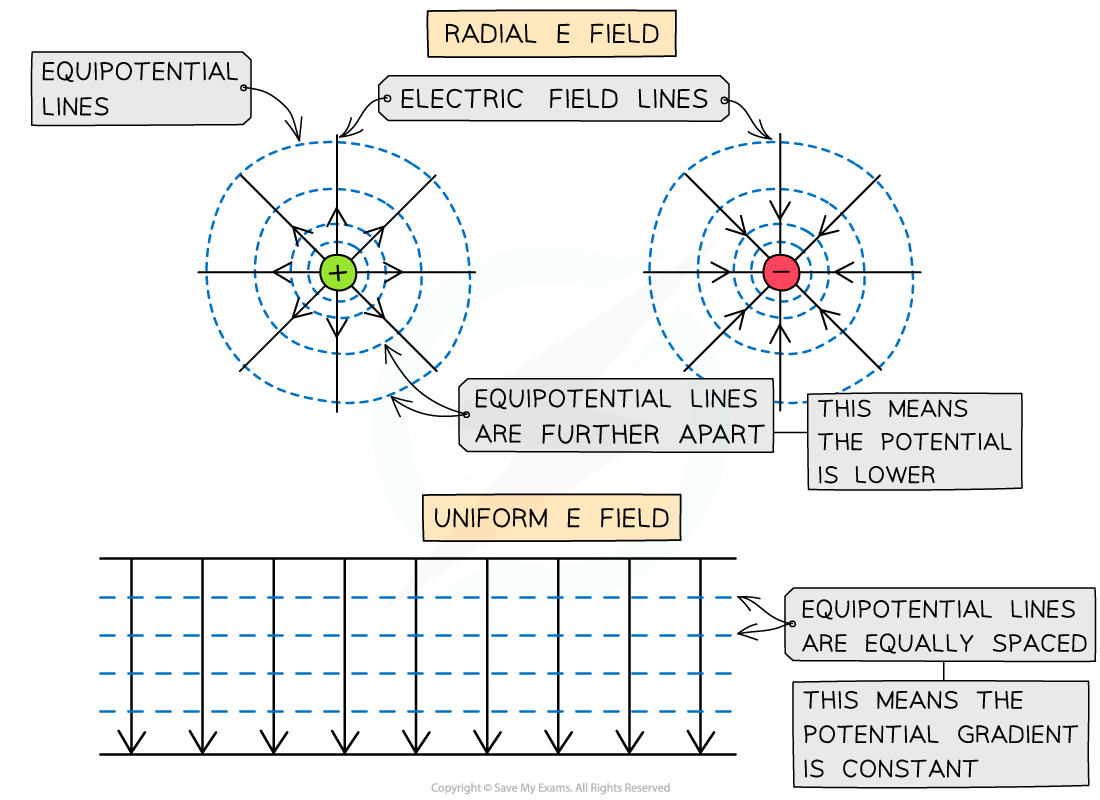
Equipotential lines around a radial field or uniform field are perpendicular to the electric field lines
- Equipotential lines are lines of?equal electric potential
- Around a radial field, the equipotential lines are represented by concentric circles around the charge with increasing radius
- The equipotential lines become further away from each other
- In a uniform electric field, the equipotential lines are equally spaced
- The potential gradient in an electric field is defined as:
The rate of change of electric potential with respect to displacement in the direction of the field
- The electric field strength is equivalent to this, except with a negative sign:
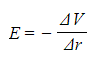 Where:
- E?= electric field strength (V m-1)
- ΔV?= change in potential (V)
- Δr?= displacement in the direction of the field (m)
- The minus sign is important to obtain an?attractive field?around a?negative charge?and a?repulsive field?around a?positive charge
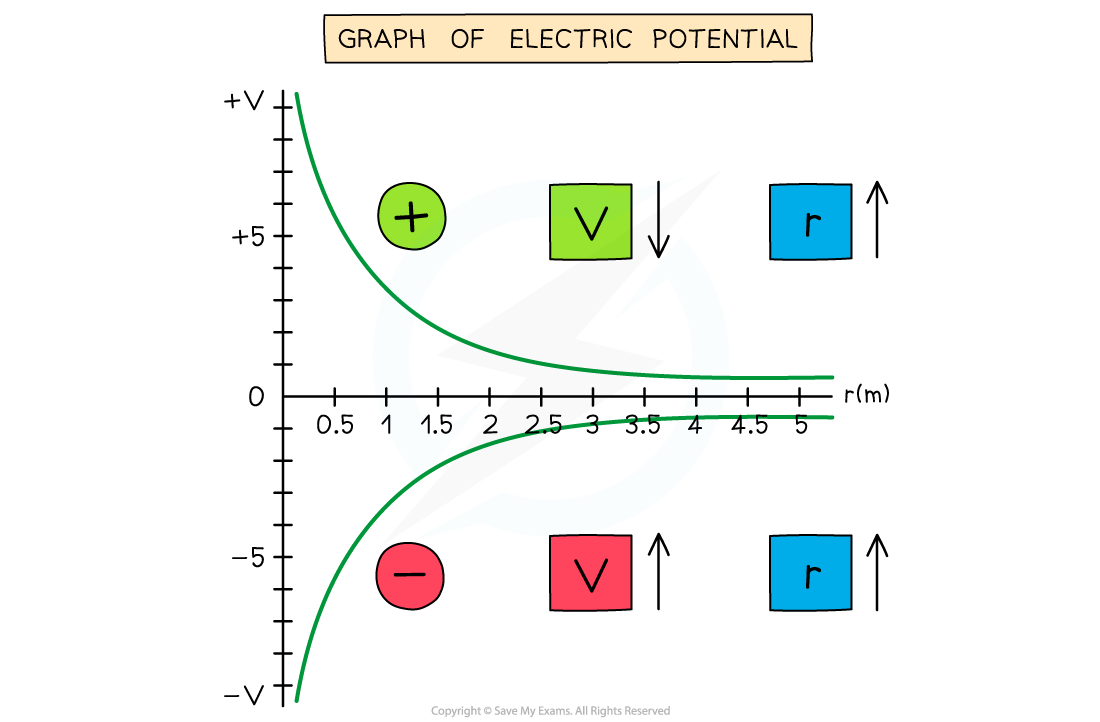
The electric potential around a positive charge decreases with distance and increases with distance around a negative charge
- The electric potential changes according to the charge creating the potential as the distance?r?increases from the centre:
- If the charge is?positive, the potential?decreases?with distance
- If the charge is?negative, the potential?increases?with distance
- This is because the?test charge?is positive
Gravitational?Potential Gradient
- A gravitational field can be defined in terms of the variation of?gravitational potential?at different points in the field:
The?gravitational?field at a particular point is equal to the negative gradient of a potential-distance graph at that point
- The potential gradient is defined by the?equipotential lines
- These demonstrate the gravitational potential in a gravitational field and are always drawn?perpendicular?to the field lines
- The potential gradient in a gravitational field is defined as:
The rate of change of?gravitational?potential with respect to displacement in the direction of the field
- Gravitational field strength,?g?and the gravitational potential,?V?can be graphically represented against the distance from the centre of a planet,?r
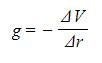 Where:
- g?= gravitational field strength (N kg-1)
- ΔV?= change in gravitational potential (J kg-1)
- Δr =?distance from the centre of a?point mass?(m)
- The graph of?V?against?r?for a planet is:
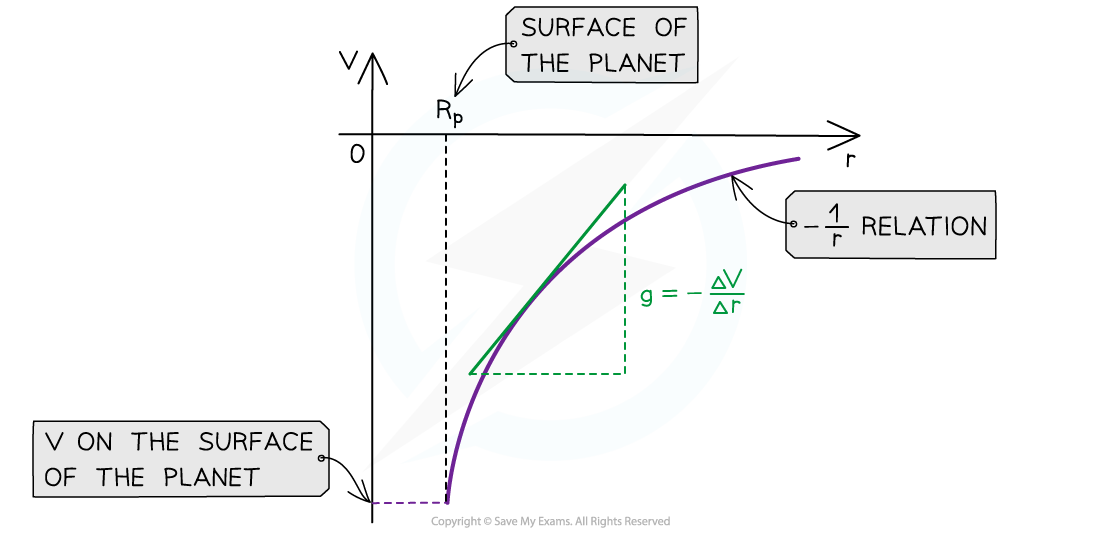
- The key features of this graph are:
- The values for?V?are all negative
- As?r?increases,?V?against?r?follows a -1/r relation
- The?gradient?of the graph at any particular point is the value of?g?at that point
- The graph has a shallow increase as?r?increases
- To calculate?g, draw a tangent to the graph at that point and calculate the gradient of the tangent
- This is a graphical representation of the equation:
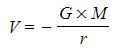 where?G?and?M?are constant
Worked Example
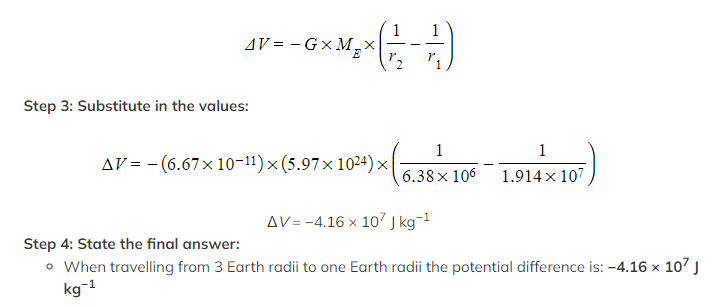
Determine the change in gravitational potential when travelling from 3 Earth radii (from Earth’s centre) to the surface of the Earth.
Assume that the mass of the Earth is?5.97 × 1024?kg and the radius of the Earth is 6.38 × 10⁶?m
-
- Earth’s mass,?ME?= 5.97 × 1024?kg
- Radius of the Earth,?rE?= 6.38 × 10⁶?m
- Initial distance,?r1?= 3 ×?rE?= 3 × (6.38 × 106) m = 1.914 × 10⁷?m
- Final distance,?r2?= 1 ×?rE?= 6.38 × 10⁶?m
- Gravitational constant,?G?= 6.67?× 10?11?m3?kg?1?s?2
 Exam Tip
Potential Difference
- The potential difference is defined as:
The work done by moving a positive test charge from one point to another in an electric field
- The units for potential difference are:
- Joules per Coulomb?for electrostatic potential difference
- Joules per Kilogram?for gravitational potential difference
- This can be related to the concept of equipotentials where the movement of a small test mass or positive test charge from one equipotential to another visually represents a potential difference
- Further, potential difference?also occurs?across electrical components which is?also?known as?voltage
Uniform Electric Field Strength
- The magnitude of the electric field strength in a?uniform?field between two charged parallel plates is defined as:
 Where:
- E?= electric field strength?(V m-1)
- V?= potential difference between the plates (V)
- d?= separation between the plates (m)
- Note:?the electric field strength is now also defined by the units?V m-1
- The equation shows:
- The greater the?voltage?between the plates, the?stronger?the field
- The greater the?separation?between the plates, the?weaker?the field
- This equation cannot be used to find the electric field strength around a?point charge?(since this would be a radial field)
- The direction of the electric field is from the plate connected to the?positive?terminal of the cell to the plate connected to the?negative?terminal
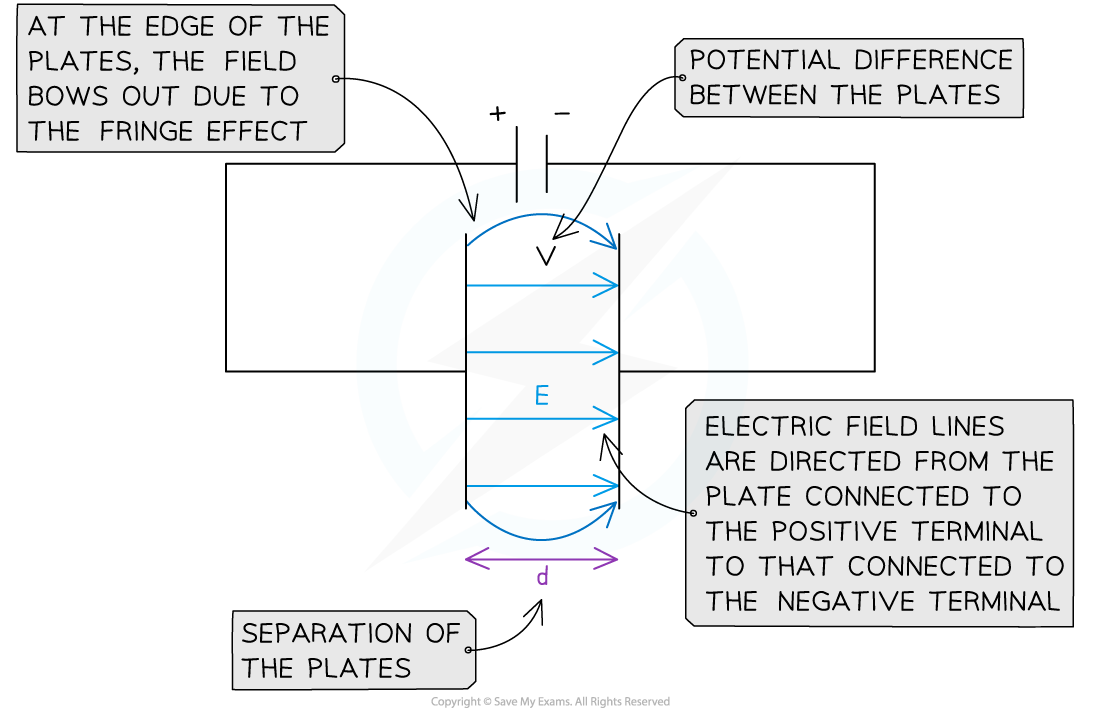
The E field strength between two charged parallel plates is the ratio of the potential difference and separation of the plates
- Note:?if one of the parallel plates is?earthed, it has a voltage of 0 V
Derivation of Electric Field Strength Between Plates
- When two points in an electric field have a different potential, there is a?potential difference?between them
- To move a charge across that potential difference,?work?needs to be done
- Two parallel plates with a potential difference ΔV?across them create a uniform electric field
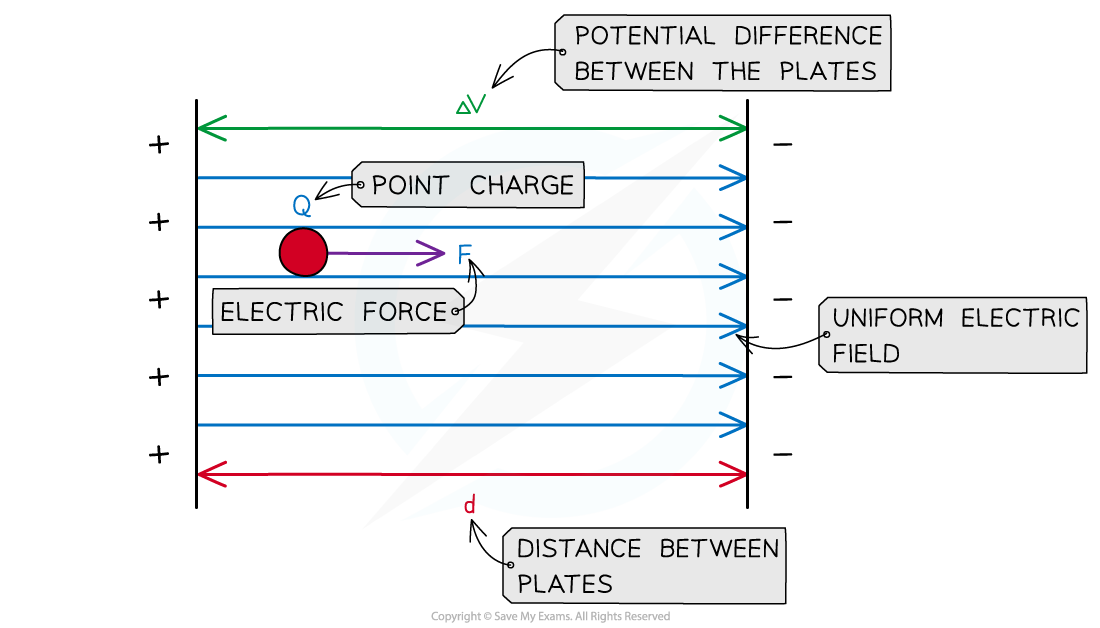
The work done on the charge depends on the electric force and the distance between the plates
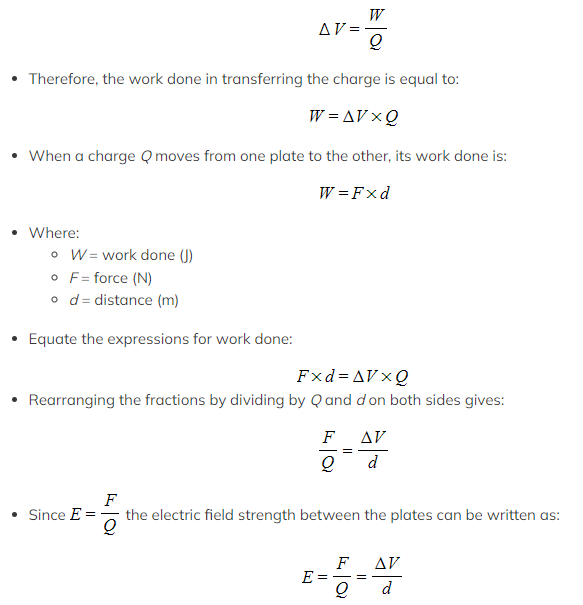
- Potential difference is defined as the energy,?W, transferred per unit charge,?Q, this can also be written as:
 Worked Example
Two parallel metal plates are separated by 3.5 cm and have a potential difference of 7.9 kV.
Calculate the magnitude of the electric force acting on a stationary charged particle between the plates that has a charge of 2.6 × 10⁻¹⁵?C.
-
- Potential difference,?V?= 7.9 kV = 7.9 × 10³?V
- Distance between plates,?d?= 3.5 cm = 3.5 × 10?2?m
- Charge,?Q?= 2.6 × 10?15?C
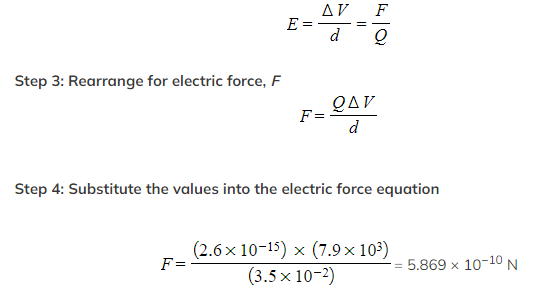 Step 5: State the final answer
-
-
The magnitude of the electric force acting on this charged particle is?5.9?× 10?10?N
-
Exam Tip

轉載自savemyexams
以上就是關于【IB DP Physics: HL復習筆記10.2.3 Potential Gradient & Difference】的解答,如需了解學校/賽事/課程動態,可至翰林教育官網獲取更多信息。
往期文章閱讀推薦:
翰林獨家 | 經濟學競賽核心精講,一冊打通NEC/IEO/USAEBO!
2026 AMC10/12美國數學競賽新賽季!【翰林教育 × 清華大學出版社】獨家教材全面發售!


翰林AMC8視頻課重磅上線!

國際競賽真題資源免費領取






