IB DP Physics: HL復習筆記10.2.1 Potential & Potential Energy

Potential & Potential Energy
Work Done on a Mass
- When a mass is moved against the force of gravity, work is done
- The work done in moving a mass?m?is given by:
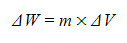
- Where:
- ?W?= change in work done (J)
- m?= mass (kg)
- ?V?=?change in?gravitational potential?(J kg-1)
- This change in work done is equal to the change in?gravitational potential energy?(G.P.E)
-
- When?V?= 0, then the G.P.E = 0
- The change in G.P.E, or work done, for an object of mass?m?at a distance?r1?from the centre of a larger mass?M, to a distance of?r2?further away can be written as:
-
 Where:
- M?= mass that is producing the gravitational field (eg. a planet) (kg)
- m?= mass that is moving in the gravitational field (eg. a satellite) (kg)
- r1?=?first distance of?m?from the centre of?M?(m)
- r2?= second distance of?m?from the centre of?M?(m)
- Work is done when an object in a planet's gravitational field moves?against?the gravitational field lines i.e.: away from the planet
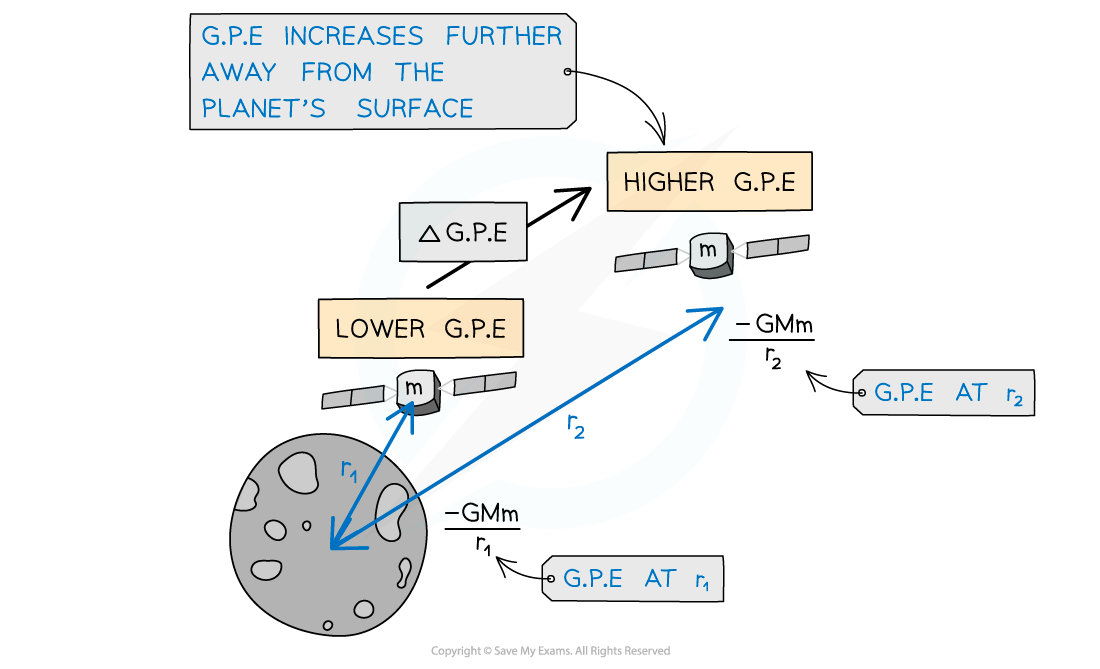
Gravitational potential energy increases as a satellite leaves the surface of the Moon
Worked Example
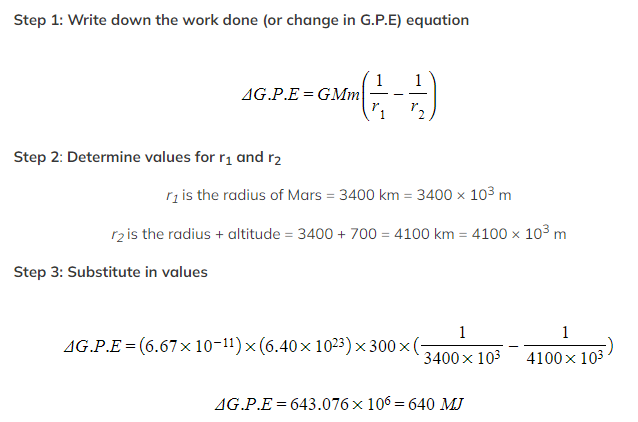
A spacecraft of mass 300 kg leaves the surface of Mars to an altitude of 700 km. Calculate the work done by the spacecraft. The radius of Mars = 3400 km,?Mass of Mars = 6.40 × 10²³?kg
 Work Done on a Charge
- When a mass with charge moves through an electric field, work is done
- The work done in moving a charge q is given by:
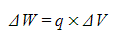 Where:
- ?W?= change in work done (J)
- q?= charge (C)
- ?V?=?change in?electric potential?(J C-1)
- This change in work done is equal to the change in?electric potential energy?(E.P.E)
- When?V?= 0, then the E.P.E = 0
- The change in E.P.E, or work done, for a point charge?q?at a distance?r1?from the centre of a larger charge?Q,?to a distance of?r2?further away can be written as:
-
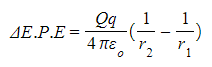 Where:
- Q?= charge that is producing the electric field (C)
- q?= charge that is moving in the electric field (C)
- r1?=?first distance of?q?from the centre of?Q?(m)
- r2?= second distance of?q?from the centre of?Q?(m)
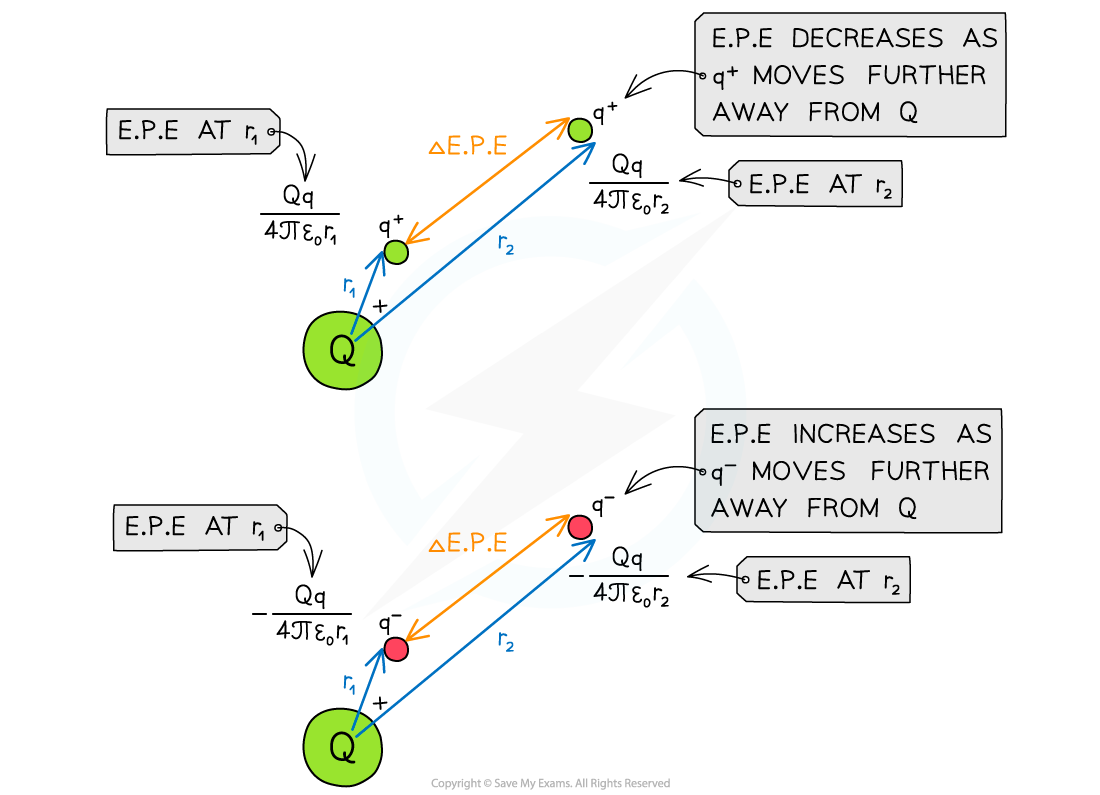
Work is done when moving a point charge away from another charge
- Work is done when a positive charge in an electric field moves?against?the electric field lines or when a negative charge moves?with?the electric field lines
Worked Example
The potentials at points?R?and?S?due to the +7.0 nC charge are 675 V and 850 V respectively.
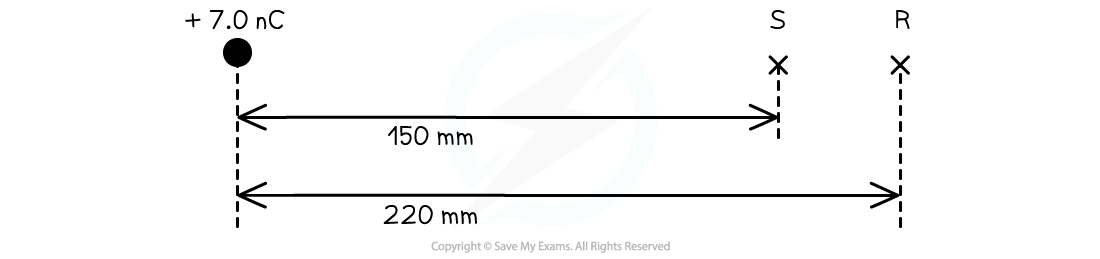
Calculate how much work is done when a +3.0 nC charge is moved from?R?to?S.
Step 1: Write down the known quantities
-
- p.d. at?R,?V1?= 675 V
- p.d. at?S,?V2?= 850 V
- Charge,?q?= +3.0 nC = +3.0 × 10⁻⁹?C
Step 2: Write down the work done equation
W?=?q ×?ΔV
Step 3: Substitute in the values into the equation
W = (3.0 × 10-9) × (850 - 675) = 5.3 × 10⁻⁷?J
Exam Tip
Make sure to not confuse the ΔG.P.E equation with ΔG.P.E = mgΔh, they look similar but refer to quite different situations.
The more familiar equation is only relevant for an object lifted in a uniform gravitational field, meaning very close to the Earth’s surface, where we can model the field as uniform.
The new equation for G.P.E does not include g. The gravitational field strength, which is different on different planets, does not remain constant as the distance from the surface increases. Gravitational field strength falls away according to the inverse square law.
Remember that?q?in the work done equation is the charge that is being moved, whilst?Q?is the charge which is producing the potential. Make sure not to get these two mixed up. It is common for both to be given in the question, as in our worked example. You are expected to choose the correct one.
轉載自savemyexams
以上就是關于【IB DP Physics: HL復習筆記10.2.1 Potential & Potential Energy】的解答,如需了解學校/賽事/課程動態,可至翰林教育官網獲取更多信息。
往期文章閱讀推薦:
翰林獨家 | 經濟學競賽核心精講,一冊打通NEC/IEO/USAEBO!
2026 AMC10/12美國數學競賽新賽季!【翰林教育 × 清華大學出版社】獨家教材全面發售!


翰林AMC8視頻課重磅上線!

國際競賽真題資源免費領取






