AQA A Level Biology復(fù)習(xí)筆記 1.5.5 Ribosomes

Ribosomes
- Ribosomes are?small organelles?that are either?free?in the cytoplasm (of all cells) or are attached to the?rough endoplasmic reticulum?(only in eukaryotic cells)
- Ribosomes are the site of?protein synthesis?(where proteins are made)
- They ‘read’ RNA to make polypeptides (proteins) in a process known as?translation
- Ribosomes are themselves?formed from RNA and proteins
- The RNA that forms part of the structure of ribosomes is a specific type of RNA known as?ribosomal RNA?(rRNA)
- The?rRNA?in ribosomes has?enzymatic properties?that catalyse the formation of peptide bonds between amino acids
- Each ribosome is a?mixture?of?ribosomal RNA?and?proteins
- Ribosomes in eukaryotic cells are?larger?than those in prokaryotic cells. In?both cell types, ribosomes are composed of a?small subunit?and a?large subunit
- 80S?ribosomes (composed of 60S and 40S subunits) are found in?eukaryotic cells
- 70S? ribosomes (composed of 50S and 30S subunits) are found in?prokaryotic cells, as well as in the?mitochondria?and?chloroplasts?of eukaryotic cells
- The?large subunit?is the?site of translation
- The rRNA and proteins of the large subunit hold tRNA molecules (with their attached amino acids) in place
- rRNA can then catalyse the condensation reactions between amino acids
- mRNA sits between the two subunits?and the ribosome moves along it as it translates it into a polypeptide
- Unlike some organelles, ribosomes are?not surrounded by a membrane
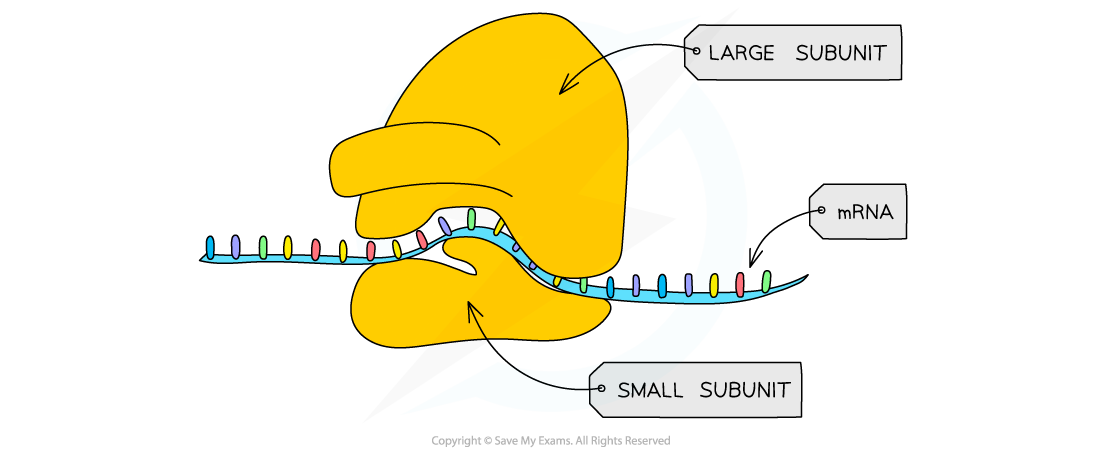
A diagram of a ribosome, showing the small and large subunits
轉(zhuǎn)載自savemyexam
以上就是關(guān)于【AQA A Level Biology復(fù)習(xí)筆記 1.5.5 Ribosomes】的解答,如需了解學(xué)校/賽事/課程動(dòng)態(tài),可至翰林教育官網(wǎng)獲取更多信息。
往期文章閱讀推薦:
翰林獨(dú)家 | 經(jīng)濟(jì)學(xué)競(jìng)賽核心精講,一冊(cè)打通NEC/IEO/USAEBO!
2026 ALEVEL 夏考A率出爐!愛(ài)德思vs牛津AQA,哪些科目真的“好出分”?


翰林AMC8視頻課重磅上線!

國(guó)際競(jìng)賽真題資源免費(fèi)領(lǐng)取






