AP宏觀經(jīng)濟(jì)| 知識(shí)點(diǎn)全面梳理

經(jīng)濟(jì)學(xué)的基礎(chǔ)是經(jīng)濟(jì)現(xiàn)象,首先它是描述現(xiàn)象,然后再通過抽象這些現(xiàn)象以找出它們的共同點(diǎn),進(jìn)而解釋它們產(chǎn)生的原因。因此,經(jīng)濟(jì)學(xué)入門的第一步就是要知道這個(gè)學(xué)科是如何來描述它所要研究的現(xiàn)象的。以下文字摘自AP宏觀經(jīng)濟(jì)學(xué)大綱,這是大綱的第一部分,標(biāo)紅處就是最基本的經(jīng)濟(jì)現(xiàn)象抽象成一個(gè)個(gè)學(xué)科術(shù)語,我們就從這里入手。
I. Basic economic ConceptsI.Basic economic concepts (8–12%)
A. Scarcity, choice and opportunity costs 稀缺性、選擇和機(jī)會(huì)成本
B. Production possibilities curve 生產(chǎn)可能性曲線
C. Comparative advantage, absolute advantage,specialization and exchange 比較優(yōu)勢(shì),分工,交換
D.Demand, supply and market equilibrium 需求,供給,市場(chǎng)均衡
E. Macroeconomic issues: business cycle,unemployment, inflation, growth 經(jīng)濟(jì)周期,失業(yè),通貨膨脹,增長(zhǎng)
A macroeconomics course introducesstudents to fundamental economic concepts such as scarcity and opportunity costs. Students understandthe distinction between absolute and comparativeadvantage and apply the principle of comparative advantage to determinethe basis on which mutually advantageous trade can take place betweenindividuals and/or countries and to identify comparative advantage fromdifferences in opportunity costs. Other basic concepts that are exploredinclude the functions performed by an economic system and the way the tools of supplyand demand are used to analyze the workings of a free-market economy. The course shouldalso introduce the concept of the business cycle to give students an overview of economic fluctuations and to highlight the dynamics of unemployment,inflation and economic growth. Coverage of these concepts providesstudents with the foundation for a thorough understanding of macroeconomicconcepts and issues.
這一章是宏觀經(jīng)濟(jì)學(xué)的基礎(chǔ),opportunity cost、production possibilitiescurve、advantage是必考點(diǎn),每年至少一道選擇題。Demand,supply and market equilibrium也是必考,而且它的分量要比前面三個(gè)知識(shí)點(diǎn)更重。
scarcity稀缺性稀缺性是用來描述資源的,這里的資源包括很多內(nèi)容,比如生產(chǎn)商品的原材料、勞動(dòng)力、時(shí)間等等,一個(gè)廣泛流傳的關(guān)于經(jīng)濟(jì)學(xué)的定義就是——經(jīng)濟(jì)學(xué)是研究稀缺資源配置的學(xué)問。可以說如果沒有資源的稀缺性,就沒有經(jīng)濟(jì)學(xué)這個(gè)學(xué)科。
那么,為什么資源是稀缺的?這里可以給出很多種解釋,常見的解釋是地球上可獲得的資源量是有限的,從木材到土地、從蘋果到電腦,這些東西都是有限的。這是一個(gè)絕對(duì)意義上的解釋,但稀缺性還包含另外一方面的意思,即資源的有限性是相對(duì)于人類欲望的無限性來說的,意思就是,不論資源有多少,人類的欲望總要比這個(gè)有限的資源多。?opportunity costs
機(jī)會(huì)成本稀缺性是經(jīng)濟(jì)學(xué)的基礎(chǔ),由稀缺性衍生出一系列經(jīng)濟(jì)學(xué)的概念,機(jī)會(huì)成本是第一個(gè)。
機(jī)會(huì)成本是說,當(dāng)一種資源用在一個(gè)地方之后,它就不能用在另一個(gè)地方(為什么?因?yàn)橘Y源是稀缺的,你只有這么一點(diǎn)點(diǎn)資源,所以只能用在一個(gè)地方,如果資源不是稀缺的,意味著你擁有很多很多,那么就不會(huì)在乎用在這里或那里了,因?yàn)橛肋h(yuǎn)用不完!),這樣就會(huì)有一個(gè)損失,失去了用在其他地方的機(jī)會(huì)(獲益的機(jī)會(huì)),機(jī)會(huì)成本正是由此而來,它表示你所放棄的最高的價(jià)值。舉個(gè)例子,你有100元錢,存到銀行會(huì)得到利息5元,去投資買房子,會(huì)獲利20元,放高利貸,獲利50元,對(duì)比一下,你自然會(huì)選擇去放高利貸,那么,放高利貸的機(jī)會(huì)成本是多少呢?100元放了高利貸,就不能存銀行,也不能買房子,它們倆的利潤(rùn)是5和20,選擇其中最高的20(因?yàn)?和20并不能同時(shí)獲得,所以不可以相加得到25),因此,放高利貸的機(jī)會(huì)成本是20元。
absolute and comparativeadvantage
絕對(duì)比較優(yōu)勢(shì)和相對(duì)比較優(yōu)勢(shì)我們用一個(gè)例子來說明這個(gè)概念。現(xiàn)在有三個(gè)人,甲、乙、丙,甲一天能煮出100鍋飯、100件衣服,乙一天能煮出80鍋飯、做出20件衣服,丙一天能做出20件衣服、煮出10鍋飯。這樣,在煮飯和做衣服這兩個(gè)項(xiàng)目上,甲強(qiáng)勢(shì)壓過乙和丙,具有絕對(duì)比較優(yōu)勢(shì)(因?yàn)橹箫?00>80>20,做衣服100>20>10),去掉甲,乙又超丙,乙又具有絕對(duì)比較優(yōu)勢(shì)。
但是我們能不能說丙就一無是處了呢?不是,我們?cè)倏矗字箫埡妥鲆路?shù)量比是1:1,乙是4:1,丙是2:1,比較乙和丙,同樣做一件衣服,乙的成本是4鍋飯,丙是2鍋飯,雖然在絕對(duì)數(shù)量上丙落后,但是在相對(duì)意義上(比例上),丙做衣服的成本要低于乙,因此,丙在做衣服上與乙相比具有相對(duì)比較優(yōu)勢(shì)。如果乙和丙相互不認(rèn)識(shí),那么他們所能夠生產(chǎn)的最大值(假設(shè)他們各用半天時(shí)間煮飯和做衣服)40 +5=45鍋飯,10+10=20件衣服,但是如果兩個(gè)人認(rèn)識(shí),決定共同生產(chǎn),甲專門煮飯,乙專門做衣服,那么就變成80鍋飯和20件衣服。
在這里,生產(chǎn)資源并沒有發(fā)生變化,僅僅由于兩個(gè)人合作,使產(chǎn)量從45提高到80,這就是分工的好處,也是交易的好處,即是市場(chǎng)的好處。有了市場(chǎng),人們可以專注于自己擅長(zhǎng)的,然后在市場(chǎng)上交易,獲得自己想要的東西,雖然資源量沒有增加,但是產(chǎn)出量增加了,經(jīng)濟(jì)學(xué)也因此獲得了關(guān)注。
Production possibilities curve
生產(chǎn)可能性曲線有一種資源,可以生產(chǎn)兩種不同的產(chǎn)品,各種產(chǎn)品不同的組合所構(gòu)成的曲線,就稱為生產(chǎn)可能性曲線。沿用上面乙的情形,給乙100天的時(shí)間,他用x天煮飯,y天做衣服,那他能夠提供的商品量是:飯rice=80x,衣服clothes=20y,但是x+y=100,代入后得到:rice/80+clothes/20=100,以橫坐標(biāo)為rice,縱坐標(biāo)為clothes,畫出這條曲線,就是乙的生產(chǎn)可能性曲線。
supply?and?demand
供給和需求在一個(gè)市場(chǎng)上,需要有商品的存在,提供商品的就是供給者,買走商品的就是需求者。一個(gè)人不可能生產(chǎn)所有自己所需要的東西,專業(yè)化分工可以提高福利,所以社會(huì)產(chǎn)生分工,由于分工的存在,商品分散在不同人的手中,這樣他就需要用自己生產(chǎn)的去交換自己需求的,從而產(chǎn)生了市場(chǎng),有了供給和需求。
在市場(chǎng)上,各種商品用價(jià)格標(biāo)注,供給這種商品的人付出商品獲得貨幣、需要這種商品的人付出貨幣獲得商品。我們猜想,如果一種商品的價(jià)格很高很高,那么買它的人就會(huì)少,如果價(jià)格低,買的人就會(huì)多;同理,高價(jià)的東西也會(huì)有更多人去生產(chǎn)它,低價(jià)則不然。
給定一個(gè)價(jià)格,供給量和需求量不一定相等,但是,我們可以假定有這樣一個(gè)價(jià)格的存在——它恰好是供給量等于需求量。這樣市場(chǎng)上既不會(huì)有多余的商品賣不出去,也不會(huì)有人買不到他所需要的商品,此時(shí)供需相等,稱市場(chǎng)達(dá)到均衡,這個(gè)價(jià)格稱為均衡價(jià)格。business cycle, economicfluctuations
商業(yè)周期(經(jīng)濟(jì)周期),經(jīng)濟(jì)波動(dòng)均衡的市場(chǎng)是美好的,但是美好的東西不一定存在的。
價(jià)格很可能高,那么就是供過于求,供過于求商品積壓、滯銷,這樣價(jià)格就會(huì)下降,價(jià)格下降需求量就會(huì)增加,積壓的商品一點(diǎn)點(diǎn)清空。價(jià)格低了,供不應(yīng)求,就會(huì)有好多人搶著買,這樣就會(huì)有人加入到這種商品的生產(chǎn)中來,從而供給量增加,商品多了,搶購(gòu)的現(xiàn)象一點(diǎn)點(diǎn)消失,價(jià)格一點(diǎn)點(diǎn)下降。
因此,市場(chǎng)總會(huì)將價(jià)格拉到均衡的價(jià)格上來。經(jīng)濟(jì)就在這繁榮與蕭條之間轉(zhuǎn)換,交替出現(xiàn),是一種周期現(xiàn)象,所以稱為經(jīng)濟(jì)周期。供給和需求不停地變動(dòng),稱作經(jīng)濟(jì)波動(dòng)。?unemployment, inflationand economic growth
失業(yè)、通貨膨脹、經(jīng)濟(jì)增長(zhǎng)。首先,一個(gè)國(guó)家中并不是所有人都具備勞動(dòng)能力,按照這個(gè)標(biāo)準(zhǔn)把一國(guó)的人口分成勞動(dòng)人口和非勞動(dòng)人口。
在勞動(dòng)人口中,那些想工作但是沒有工作的人就是失業(yè)者,失業(yè)人數(shù)占總勞動(dòng)人口的比例就是失業(yè)率,它可以衡量社會(huì)中閑置勞動(dòng)的比率。通貨膨脹是說在某一段時(shí)期內(nèi),社會(huì)整體物價(jià)水平飆升,與通貨膨脹相反的概念是通貨緊縮,它是指在某一段時(shí)期內(nèi)價(jià)格持續(xù)地下降。經(jīng)濟(jì)增長(zhǎng),指收入增加、生產(chǎn)的商品數(shù)量增多、人民生活水平提高。
II. Measurement of economic PerformanceII.Measurement of Economic Performance (12–16%)A. National income accounts 國(guó)民收入賬戶
1. Circular flow 循環(huán)
2. Gross domestic product 國(guó)民生產(chǎn)總值(GDP)
3. Components of gross domestic product 國(guó)民生產(chǎn)總值的構(gòu)成
4. Real versus nominal gross domestic product 實(shí)際與名義GDPB. Inflation measurement and adjustment 通貨膨脹
1. Price indices 價(jià)格指數(shù)
2. Nominal and real values 名義價(jià)格與實(shí)際價(jià)格
3. Costs of inflation 通貨膨脹的(社會(huì))成本
C. Unemployment 失業(yè)
1. Definition and measurement 定義和度量指標(biāo)
2. Types of unemployment 失業(yè)的類型
3. Natural rate of unemployment 自然失業(yè)率
To provide an overview of how theeconomy works, the course should start with a model of the circular flow of income and products that contain the foursectors: households, businesses, government and international. It is importantto identify and examine the key measures of economic performance: gross domestic product, unemployment and inflation.
In studying the concept of gross domestic product, it is also importantthat students learn how gross domestic product is measured, have a clearunderstanding of its components and be able to distinguish between real and nominal gross domestic product.
The course should examine the nature and causes of unemployment, the costs of unemployment and how the unemployment rate is measured, including thecriticisms associated with the measurement of the unemployment rate. It is alsoimportant to understand the concept of the natural rateof unemployment and the factors that affect it. Students should alsohave an understanding of inflation and how it ismeasured. In this section, the course should cover the costs of inflation andthe main price indices, such as the consumer priceindex (CPI) and the gross domestic productdeflator. Students should learn how these indices are constructed andused to convert nominal values into real values, as well as to convert dollarvalues in the past to dollar values in the present. It is also important tohighlight the differences between the two price indices as a measure ofinflation, as well as the problems associated with each measure.
A
1.經(jīng)濟(jì)循環(huán)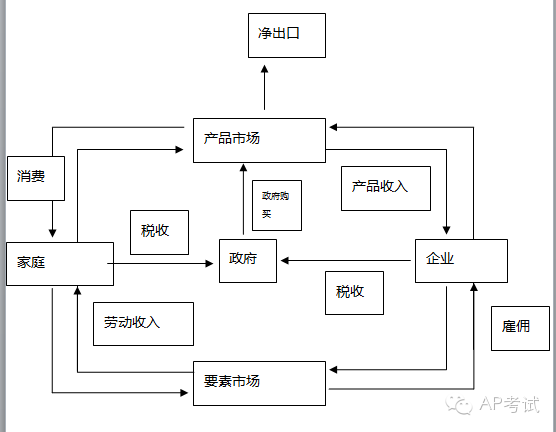
2、GrossDomestic Product(GDP)國(guó)內(nèi)生產(chǎn)總值,它指在一定時(shí)期內(nèi)(一個(gè)季度或一年),一個(gè)國(guó)家或地區(qū)的經(jīng)濟(jì)中所生產(chǎn)出的全部最終產(chǎn)品和勞務(wù)的價(jià)值。有以下幾點(diǎn)需要注意,第一,GDP是一個(gè)時(shí)間段內(nèi)的概念,談GDP首先必須指明一個(gè)時(shí)間跨度,比如從去年的今天到今年的今天,這是整整一年。
第二,GDP是在這一時(shí)間段中一個(gè)國(guó)家或地區(qū),所新生產(chǎn)出的最終產(chǎn)品和勞務(wù)的總和,只有最終的才計(jì)算在GDP里面,中間產(chǎn)品不算。用公式表示出來就是:GDP=ΣPX。
3、GDP的構(gòu)成由上面的經(jīng)濟(jì)循環(huán)流程圖我們看到,經(jīng)濟(jì)中一共有四個(gè)主要的部分:居民、企業(yè)、政府和國(guó)際貿(mào)易,對(duì)應(yīng)于此,GDP包括這四個(gè)經(jīng)濟(jì)指標(biāo),分別為:消費(fèi)、投資、政府購(gòu)買和凈出口,用公式表示Y=C+I+G+NX。
4、實(shí)際與名義GDP當(dāng)價(jià)格用規(guī)定的之前某一年的價(jià)格(稱為基期價(jià)格)時(shí),稱其為實(shí)際GDP;當(dāng)計(jì)算GDP中的價(jià)格P用現(xiàn)在的市場(chǎng)價(jià)格時(shí),所得到的GDP稱為名義GDP。
實(shí)際與名義的區(qū)別在于前者剔除了價(jià)格變動(dòng)的影響,后者則將其包括在內(nèi)。名義GDP與實(shí)際GDP的比值稱為GDP平減指數(shù)(GDP deflator)。
B
1、通貨膨脹當(dāng)價(jià)格呈現(xiàn)長(zhǎng)期、普遍上漲的時(shí)候,我們稱為通貨膨脹;當(dāng)價(jià)格呈現(xiàn)長(zhǎng)期、普遍下降的時(shí)候,我們稱為通貨緊縮。注意的地方是,通貨膨脹和通貨緊縮是描述價(jià)格長(zhǎng)期的、普遍的變化趨勢(shì),并不單單指某一產(chǎn)品。如果僅僅是某一產(chǎn)品,我們只能說它的價(jià)格上漲了,卻不能說發(fā)生通貨膨脹了。
2、消費(fèi)者價(jià)格指數(shù)(CPI)我們把產(chǎn)出中和我們?nèi)粘I钕⑾⑾嚓P(guān)的產(chǎn)品找出來,對(duì)他們的價(jià)格進(jìn)行記錄,即固定商品、改變價(jià)格,用后一年(或一個(gè)月、一個(gè)季度)的數(shù)值除以前一個(gè)數(shù)值,得到的比值稱為CPI。
與GDP平減指數(shù)不同,CPI反應(yīng)與居民生活密切相關(guān)的那些商品的價(jià)格變動(dòng),而GDP平減指數(shù)衡量經(jīng)濟(jì)中所有產(chǎn)品的價(jià)格變動(dòng)。
3、通貨膨脹的成本鞋底成本:shoe-leather cost,通貨膨脹使人們不愿持有貨幣,這樣,當(dāng)需要消費(fèi)的時(shí)候,人們就要一次又一次地去銀行取錢,如此損失掉的時(shí)間與便利稱為鞋底成本。當(dāng)然它不單單只磨壞鞋底所遭受的損失,更重要的是表示通貨膨脹使人們損失掉了時(shí)間與便利。
菜單成本:menu cost,這個(gè)詞源自餐館印刷新菜單的成本,它包括決定新價(jià)格的成本、印刷新清單和目錄的成本、把這些新價(jià)格表和目錄送給中間商和顧客的成本、為新價(jià)格做廣告的成本,甚至包括處理顧客對(duì)價(jià)格變動(dòng)惱怒的成本。
C
1、失業(yè)設(shè)L代表社會(huì)中所有的勞動(dòng)人口數(shù),E代表就業(yè)人數(shù),U代表失業(yè)人數(shù),則L=E+U,失業(yè)率為U/L。勞動(dòng)力市場(chǎng)均衡時(shí)的失業(yè)率稱為自然失業(yè)率,它總是存在的(即自然失業(yè)率大于零,經(jīng)濟(jì)中總會(huì)有人失業(yè))。
如下圖所示:勞動(dòng)力市場(chǎng)均衡時(shí),均衡工資是W0,均衡就業(yè)人數(shù)是Ne,經(jīng)濟(jì)中總的勞動(dòng)人口數(shù)是N,這樣就有N-Ne這么多人失業(yè),(N-Ne)/N就是自然失業(yè)率。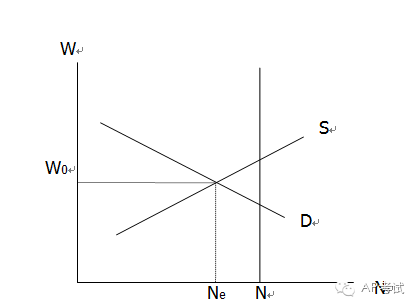
2、失業(yè)的分類結(jié)構(gòu)性失業(yè):指勞動(dòng)力的供給和需求不匹配所造成的失業(yè),其特點(diǎn)是既有失業(yè)又有職位空缺。失業(yè)的原因是失業(yè)者或者沒有合適的技能,或者居住地與工作地相距甚遠(yuǎn),導(dǎo)致其不愿意工作。季節(jié)性失業(yè):指某些生產(chǎn)活動(dòng)受季節(jié)性影響而導(dǎo)致的失業(yè),比如農(nóng)業(yè),當(dāng)冬季來臨時(shí),普遍都無事可做。
周期性失業(yè):指經(jīng)濟(jì)周期中的衰退或蕭條時(shí),因需求下降而造成的失業(yè)。摩擦性失業(yè):指在生產(chǎn)過程中由于難以避免的摩擦而造成的短期、局部性失業(yè),比如人們換工作時(shí),先辭職卻沒有找到新的工作,這樣就會(huì)有一段時(shí)間失業(yè),這個(gè)就是摩擦性失業(yè)。
III.National Income and Price determination?III. National Income and Price Determination (10–15%)
A. Aggregate demand 總需求
1.Determinants of aggregate demand 總需求的決定
2.Multiplier and crowding-out effects 乘數(shù)效應(yīng)與擠出效應(yīng)
B. Aggregate supply 總供給
1.Short-run and long-run analyses 短期與長(zhǎng)期分析
2.Sticky versus flexible wages and prices 工資與價(jià)格的黏性與自由伸縮性
3.Determinants of aggregate supply 總供給的決定
C.Macroeconomic equilibrium 宏觀經(jīng)濟(jì)均衡
1.Real output and price level 實(shí)際產(chǎn)出與價(jià)格水平
2.Short and long run 短期與長(zhǎng)期
3.Actual versus full-employment output 實(shí)際產(chǎn)出與充分就業(yè)產(chǎn)出
4.Economic fluctuations 經(jīng)濟(jì)波動(dòng)
This section introduces the aggregate supply and aggregatedemand model to explain the determination of equilibrium national output andthe general price level, as well as to analyze and evaluate the effects ofpublic policy. It is important to discuss the aggregatedemand and aggregate supply concepts individually to provide studentswith a firm understanding of the mechanics of the aggregate demand andaggregate supply model.
The aggregatedemand and aggregate supply analysis often begins with a general discussion ofthe nature and shape of the aggregate demand and aggregate supply curves andthe factors that affect them. A detailed study of aggregate demand may begin bydefining the four components of aggregate demand: consumption,investment, government spending and net exports. It also examines whythe aggregate demand curve slopes downward and how changes in the determinantsaffect the aggregate demand curve. The spending-multiplierconcept and its impact on aggregate demand, and how crowdingout lessens this impact, should be demonstrated as well. The course canthen present the definition and determinants of aggregate supply and thedifferent views about the shape of the aggregate supply curve in the short run and in the long runand highlight the importance of the shape in determining the effect of changesin aggregate demand on the economy. It is also important to understand thenotion of sticky-price and sticky-wage models and their implication for theaggregate supply curve in comparison to flexible pricesand wages.
Studentsshould be able to use the aggregate demand and aggregate supply model todetermine equilibrium income and price level and to analyze the impact of economicfluctuations on the economy’s output and price level, both in the short run andin the long run.
A
1.總需求總需求:它表示任何一種既定的物價(jià)水平下經(jīng)濟(jì)中所有物品和勞務(wù)的需求量。在現(xiàn)階段大家可以參照需求曲線來記憶,即價(jià)格與需求量之間反向變動(dòng)的關(guān)系。
總需求的構(gòu)成:Y=C+I+G+NX,總需求由消費(fèi)、投資、政府購(gòu)買和凈出口構(gòu)成。影響總需求的因素:總需求Y=C+I+G+NX,可見,影響C、I、G、NX的因素都能夠影響到總需求。消費(fèi)受居民收入、利率影響,投資受利率影響,G是政府政策,NX受貿(mào)易政策、匯率影響。
2.乘數(shù)效應(yīng)與擠出效應(yīng)乘數(shù)效應(yīng):乘數(shù)有很多種,投資乘數(shù)、政府購(gòu)買乘數(shù)、稅收乘數(shù)等等,它們都是指一個(gè)變量發(fā)生變化后引起收入的變動(dòng)與該變量變動(dòng)量的比值。敘述有點(diǎn)繞,看公式,乘數(shù)=ΔY/ΔX,這里X可以代表上面說的變量。
擠出效應(yīng):指政府支出增加所引起的消費(fèi)或投資降低這種現(xiàn)象。注意乘數(shù)效應(yīng)與擠出效應(yīng)的對(duì)比,同樣是政府支出增加,一個(gè)會(huì)引起收入的多倍增長(zhǎng),從而消費(fèi)增加,一個(gè)卻導(dǎo)致消費(fèi)下降。原因在于二者所基于的經(jīng)濟(jì)狀況不同,乘數(shù)效應(yīng)起作用時(shí),經(jīng)濟(jì)中有大量閑置資源,政府支出的增加不會(huì)抬高資本市場(chǎng)的利率,從而不會(huì)導(dǎo)致投資降低。
而擠出效應(yīng)是經(jīng)濟(jì)已經(jīng)沒有閑置資源,此時(shí)政府增加支出,必然會(huì)破壞資本市場(chǎng)的均衡,抬高利率,從而擠出投資。
B
總供給總供給:它表示任何一種既定的物價(jià)水平下經(jīng)濟(jì)中所有物品和勞務(wù)的供給量。短期和長(zhǎng)期的不同:短期:總供給曲線向右上方傾斜,產(chǎn)量隨價(jià)格變動(dòng)長(zhǎng)期:總供給曲線垂直,產(chǎn)量與價(jià)格無關(guān)工資與價(jià)格的黏性與自由伸縮性:對(duì)應(yīng)于短期和長(zhǎng)期,短期內(nèi)工資與價(jià)格黏性(即變動(dòng)緩慢甚至不變動(dòng)),長(zhǎng)期內(nèi)自由伸縮(自由變動(dòng))。但同時(shí),在短期內(nèi),凱恩斯學(xué)派認(rèn)為工資與價(jià)格是黏性的,而古典學(xué)派認(rèn)為它們是自由伸縮的,這是兩個(gè)學(xué)派爭(zhēng)論的焦點(diǎn)。總供給的決定
C
宏觀經(jīng)濟(jì)均衡用下面這個(gè)圖就可表示出C中提到的所有變量與現(xiàn)象。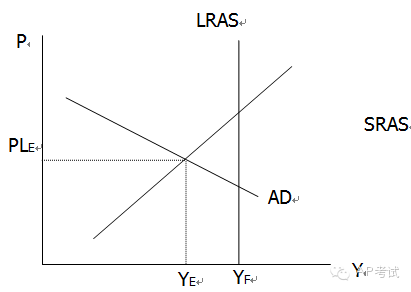 AD與SRAS相交處代表著短期均衡,所決定的產(chǎn)出YE就是短期實(shí)際產(chǎn)出和短期價(jià)格水平PLE;AD與LRAS相交處代表著長(zhǎng)期均衡,產(chǎn)出固定在YF處不變,價(jià)格隨意波動(dòng)。
當(dāng)AD或SRAS移動(dòng)的時(shí)候,短期內(nèi)會(huì)導(dǎo)致均衡產(chǎn)出的變動(dòng);LRAS的移動(dòng)會(huì)導(dǎo)致長(zhǎng)期均衡產(chǎn)出的變動(dòng),從而導(dǎo)致了經(jīng)濟(jì)增長(zhǎng)或蕭條。?IV.Financial sectorIV. Financial Sector (15–20%)A.Money, banking and financial markets 貨幣、銀行與資本市場(chǎng)
1.Definition of financial assets: money, stocks, bonds 貨幣、股票與債券的定義
2.Time value of money (present and future value) 貨幣的時(shí)間價(jià)值
3.Measures of money supply 貨幣供給的度量
4.Banks and creation of money 銀行與貨幣的創(chuàng)造
5.Money demand 貨幣需求
6.Money market 資本市場(chǎng)
7.Loanable funds market 可貸資金市場(chǎng)
B.Central bank and control of the money supply 中央銀行和控制貨幣供給
1.Tools of central bank policy 政策工具
2.Quantity theory of money 貨幣數(shù)量論
3.Real versus nominal interest rates 實(shí)際與名義利率
Tounderstand how monetary policy works, students must understand the definitionsof both the money supply and money demand and the factors that affect each of them.Here the course introduces students to the definition of money and otherfinancial assets such as bonds and stocks, the time value of money, measures ofthe money supply, fractional reserve banking and the Federal Reserve System. Inpresenting the money supply, it is important to introduce the process ofmultiple-deposit expansion and money creation using T-accounts and the use ofthe money multiplier. In learning about monetary policy, it is important todefine money demand and examine its determinants. Having completed the study ofmoney supply and money demand, the course should proceed to investigate howequilibrium in the money market determines the equilibrium interest rate, howthe investment demand curve provides the link between changes in the interestrate and changes in aggregate demand, and how changes in aggregate demandaffect real output and price level. Students should have an understanding offinancial markets and the working of the loanable funds market in determiningthe real interest rate. It is also important that students develop a clearunderstanding of the differences between the money market and the loanablefunds market.
Having an understanding of the financialmarkets, students should identify and examine the tools of central bank policyand their impact on the money supply and interest rate. Students shouldunderstand the distinction between nominal and real interest rate. Studentsshould also be introduced to the quantity theory of money and examine andunderstand the effect of monetary policy on real output growth and inflation.
A1.貨幣、股票、債券貨幣:一種交換媒介,通過它使得物物交換的弊端得到克服,從而活躍了經(jīng)濟(jì)。股票(stock):代表企業(yè)所有權(quán),進(jìn)而可以索取企業(yè)的利潤(rùn)。債券(bond):是規(guī)定借款人對(duì)債券持有人負(fù)有債務(wù)責(zé)任的證明。
貨幣的時(shí)間價(jià)值:由于利率和通貨膨脹的存在,貨幣即有收益又有成本。因?yàn)榘彦X存在銀行,至少可以得到利息,但得到利息的同時(shí)會(huì)遭遇通貨膨脹所導(dǎo)致的實(shí)際購(gòu)買力的降低。因此未來的貨幣拿到現(xiàn)在需要經(jīng)過換算——折現(xiàn),公式為P0=Pt/ 。貨幣供給的度量:貨幣供給指是指某國(guó)銀行系統(tǒng)向經(jīng)濟(jì)體中投入(或回籠)貨幣的過程。
一般來說,貨幣量=通貨+活期存款+小額定期儲(chǔ)蓄存款+大額定期存款。銀行與貨幣的創(chuàng)造:當(dāng)銀行只把部分存款作為準(zhǔn)備金時(shí),賬面數(shù)額加上貸款數(shù)額使得經(jīng)濟(jì)中貨幣的數(shù)額比原始發(fā)行的貨幣額多,此時(shí)稱銀行創(chuàng)造了貨幣,這個(gè)比值稱為貨幣乘數(shù)。貨幣需求:D=L(i,Y),貨幣需求與利率呈反比,與收入呈正比。因此,當(dāng)經(jīng)濟(jì)繁榮時(shí),貨幣的需求會(huì)增加,此時(shí)中央銀行需要發(fā)行貨幣,以滿足市場(chǎng)對(duì)貨幣的需求。
資本市場(chǎng):中央銀行作為貨幣的供給方,公眾及企業(yè)作為貨幣的需求方,由此形成的市場(chǎng)稱為貨幣市場(chǎng)或資本市場(chǎng)。
可貸資金市場(chǎng):以貨幣為商品交易的市場(chǎng)稱為可貸資金市場(chǎng)。考慮儲(chǔ)蓄和投資,居民儲(chǔ)蓄與利率呈正比,企業(yè)投資與利率呈反比,這樣可貸資金市場(chǎng)就可以用下圖來表示。 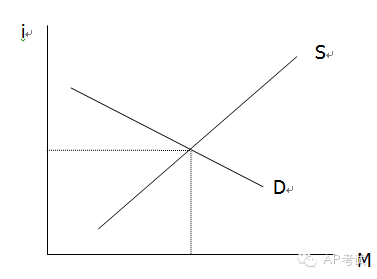
B1.政策工具中央銀行控制貨幣供給的政策工具主要有三種:公開市場(chǎng)業(yè)務(wù)、法定準(zhǔn)備率和貼現(xiàn)率。公開市場(chǎng)業(yè)務(wù)(open-marketoperations):指中央銀行通過買賣政府債券來調(diào)節(jié)貨幣供給。當(dāng)中央銀行從公眾手里購(gòu)入債券時(shí),公眾持有的債券變成了貨幣,從而貨幣供給增加;反向就是減少貨幣供給。
法定準(zhǔn)備金率(reserverequirements):指中央銀行對(duì)商業(yè)銀行存款準(zhǔn)備金的規(guī)定,存款準(zhǔn)備金比率上升會(huì)抑制可貸資金的數(shù)量,從而降低貨幣乘數(shù),進(jìn)而減少貨幣供給。再貼現(xiàn)率(discount rate):指中央銀行向商業(yè)銀行發(fā)放貸款時(shí)所收取的利率。貨幣數(shù)量論:MV=PY,貨幣數(shù)量M乘以貨幣流通速度V等于產(chǎn)品的價(jià)格P乘以產(chǎn)量,這個(gè)公式稱為數(shù)量方程式。
當(dāng)假設(shè)貨幣流通速度V不變時(shí),P=MV/Y,價(jià)格與貨幣數(shù)量成正比,與產(chǎn)出Y成反比。實(shí)際與名義利率:把貨幣儲(chǔ)存在銀行里,一段時(shí)間之后得到利息,同時(shí)由于通貨膨脹的存在,貨幣的實(shí)際購(gòu)買力減少。我們把銀行支付的利率稱為名義利率i,則實(shí)際獲得的利率是i-π,經(jīng)過通貨膨脹調(diào)整之后的利率稱為實(shí)際利率r,它衡量了貨幣實(shí)際購(gòu)買力的變動(dòng)。
V. Inflation, unemployment, stabilization PoliciesV.Inflation, Unemployment, and Stabilization Policies (20–30%) 通貨膨脹、失業(yè)與穩(wěn)定政策
A. Fiscal and monetary policies 財(cái)政政策與貨幣政策
1. Demand-side effects 需求方
2. Supply-side effects 供給方
3. Policy mix 混合政策
4. Government deficits and debt 財(cái)政赤字與政府債務(wù)
B. Inflation and unemployment 通貨膨脹與失業(yè)
1. Types of inflation 通貨膨脹的類型(成因)
a. Demand-pull inflation 需求拉動(dòng)型
b. Cost-push inflation 成本推動(dòng)型
3. Role of expectations 期望(預(yù)期)的影響
Public policy affects the economy’s output, price level andlevel of employment, both in the short run and in the long run. Students shouldlearn to analyze the impacts of fiscal policy and monetary policy on aggregatedemand and aggregate supply, as well as on the economy’s output and price levelboth in the short run and in the long run. It is also important to understand howan economy responds to a short-run shock and adjusts to long-run equilibrium inthe absence of any public policy actions.
With both monetaryand fiscal policies now incorporated in the analysis of aggregate demand andaggregate supply, an understanding of the interactions between the two isessential. Students should also examine the economic effects of governmentbudget deficits, including crowding out; consider the issues involved indetermining the burden of the national debt; and explore the relationshipsbetween deficits, interest rates and inflation. The course should distinguishbetween the short-run and long-run impacts of monetary and fiscal policies andtrace the short-run and long-run effects of supply shocks. Short-run andlong-run Phillips curves are introduced to help students gain an understandingof the inflation–unemployment trade-off and how this trade-off may differ inthe short and long run.
In this section, the course identifies the causes ofinflation and illustrates them by using the aggregate demand and aggregatesupply model. A well-rounded course also includes an examination of thesignificance of expectations, including inflationary expectations.
A
1.財(cái)政政策與貨幣政策財(cái)政政策:指政府通過改變稅收和政府支出來影響總需求,進(jìn)而影響就業(yè)和國(guó)民收入的政策;貨幣政策:指中央銀行通過調(diào)整經(jīng)濟(jì)中的貨幣量來影響就業(yè)和國(guó)民收入的政策,常用的是改變利率。
稅收政策的調(diào)整會(huì)影響到需求方和供給方,如對(duì)個(gè)人所得稅稅率的調(diào)整直接影響居民的可支配收入,從而改變居民的消費(fèi)支出,改變了總需求;對(duì)企業(yè)所得稅稅率的調(diào)整影響到企業(yè)收益,從而影響企業(yè)投資的積極性,改變了企業(yè)的投資。
利率的調(diào)整也是如此,對(duì)居民消費(fèi)方面利率會(huì)改變貨幣的時(shí)間價(jià)值,從而居民的消費(fèi)發(fā)生跨期替代,當(dāng)期的消費(fèi)會(huì)發(fā)生變化;對(duì)企業(yè)則是直接影響到企業(yè)投資成本,從而企業(yè)改變投資決策。
2.財(cái)政赤字與政府債務(wù)政府收益減去政府支出所得就是財(cái)政赤字(當(dāng)收益小于支出時(shí)),或財(cái)政盈余(當(dāng)收益大于支出時(shí))。
政府為了平衡預(yù)算,消除財(cái)政赤字,會(huì)向私人部門借款,這就是政府債務(wù)。
B1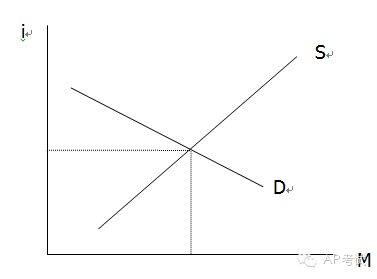 在總供給不變的情況下,當(dāng)總需求增加之后,會(huì)拉動(dòng)價(jià)格水平上升,這種方式導(dǎo)致的通貨膨脹稱為需求拉動(dòng)型通貨膨脹。
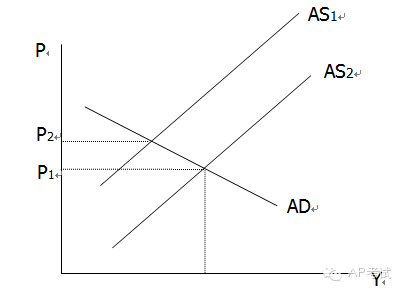 在總需求不變的情況下,當(dāng)生產(chǎn)成本上升,會(huì)導(dǎo)致總供給減少,此時(shí)會(huì)推動(dòng)價(jià)格水平上升,這種方式導(dǎo)致的通貨膨脹成為成本推動(dòng)型通貨膨脹。2.菲利普斯曲線
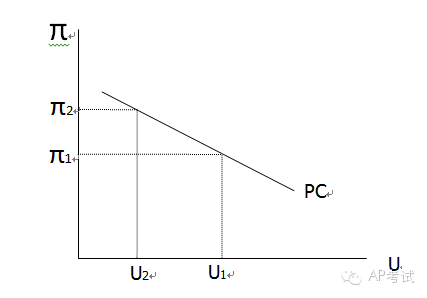
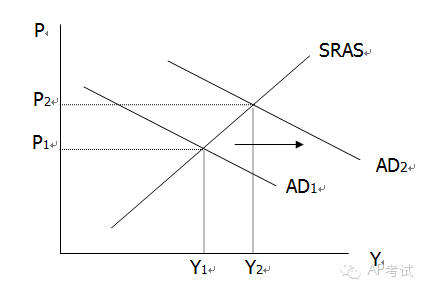 短期內(nèi),當(dāng)總需求從AD1增加到AD2時(shí),價(jià)格的上升伴隨著產(chǎn)出的增加,而從生產(chǎn)函數(shù)的角度來看,產(chǎn)出的增加意味著投入的增加,短期內(nèi)產(chǎn)出的增加只能靠勞動(dòng)投入的增加來實(shí)現(xiàn),這就意味著失業(yè)率的下降,通貨膨脹率與失業(yè)率的這種反向變動(dòng)的關(guān)系,就稱為短期菲利普斯曲線。
 長(zhǎng)期時(shí),當(dāng)總需求從AD1增加到AD2時(shí),僅僅是價(jià)格水平的上漲,而沒有產(chǎn)量的增加,這時(shí)通貨膨脹與失業(yè)率無關(guān),失業(yè)率固定在一個(gè)水平,這是長(zhǎng)期菲利普斯曲線。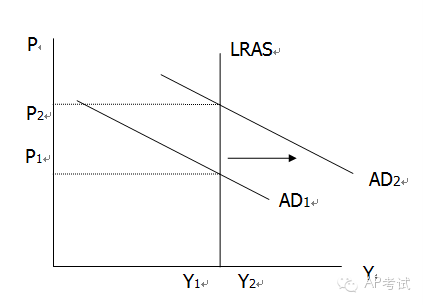
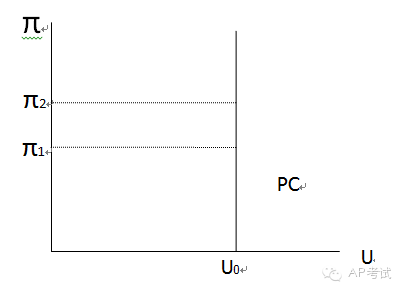 當(dāng)然,菲利普斯曲線也可以有總供給曲線推導(dǎo)出來,過程與上面相仿,只是去掉總需求曲線。
預(yù)期的影響:
帶有預(yù)期通貨膨脹的菲利普斯曲線為:π=πe-k(U-Un) 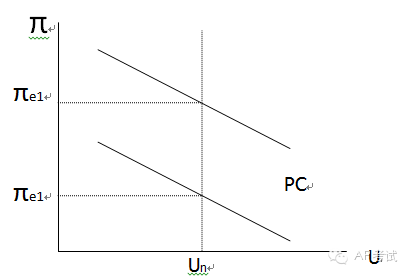 預(yù)期的不同,會(huì)導(dǎo)致菲利普斯曲線沿著自然失業(yè)率移動(dòng)。
VI. Economic Growth and Productivity (5–10%) 經(jīng)濟(jì)增長(zhǎng)與生產(chǎn)率
A. Investment in human capital 人力資本投資
B. Investment in physical capital 物質(zhì)資本投資
C. Research and development, and technological progress 研發(fā)與技術(shù)進(jìn)步
D. Growth policy
增長(zhǎng)政策
1.物質(zhì)資本用于生產(chǎn)物品與勞務(wù)的設(shè)備和建筑物的存量。簡(jiǎn)單理解,也就是生產(chǎn)中的機(jī)器設(shè)備,比如車床、斧子、錘子等等。
2.人力資本工人通過教育、培訓(xùn)和經(jīng)驗(yàn)而獲得的知識(shí)與技能。主要指教育對(duì)勞動(dòng)力素質(zhì)的改進(jìn)。
3.研發(fā)與技術(shù)進(jìn)步經(jīng)濟(jì)的長(zhǎng)期增長(zhǎng)來源于技術(shù)進(jìn)步,這是制定長(zhǎng)期政策的出發(fā)點(diǎn),因此,各國(guó)經(jīng)濟(jì)學(xué)家都試圖說服政府將政策向研發(fā)部門傾斜,同時(shí),實(shí)力雄厚的大型公司也會(huì)將資金的一部分投向研發(fā)部門,這是競(jìng)爭(zhēng)導(dǎo)致的。市場(chǎng)會(huì)導(dǎo)致競(jìng)爭(zhēng)、競(jìng)爭(zhēng)會(huì)促使企業(yè)研發(fā)新技術(shù),進(jìn)而又會(huì)導(dǎo)致競(jìng)爭(zhēng)。
4.增長(zhǎng)政策對(duì)如何促進(jìn)經(jīng)濟(jì)長(zhǎng)期穩(wěn)定的增長(zhǎng),當(dāng)下并沒有一致的看法,但大體說來,有如下幾種:
一是通過改變儲(chǔ)蓄率來影響儲(chǔ)蓄,從而促進(jìn)資本積累;
二是政府應(yīng)該加強(qiáng)基礎(chǔ)設(shè)置建設(shè),降低市場(chǎng)運(yùn)行的成本;
三是鼓勵(lì)技術(shù)進(jìn)步。補(bǔ)充一個(gè)關(guān)于生產(chǎn)函數(shù)的知識(shí):Y=AF(K,L,H,N)Y代表產(chǎn)出,A代表技術(shù)水平,K代表物質(zhì)資本量,L代表勞動(dòng)力,H代表人力資本量,N代表自然資源。產(chǎn)出是這些變量的增函數(shù),該函數(shù)有個(gè)性質(zhì),就是K,L,H,N同時(shí)翻倍,那么產(chǎn)出Y也將翻倍,寫出來就是x Y=AF(xK,xL,xH,xN),這個(gè)性質(zhì)叫做規(guī)模收益不變,即投入同時(shí)擴(kuò)大x倍,產(chǎn)出也會(huì)擴(kuò)大x倍,依據(jù)是現(xiàn)實(shí)中企業(yè)可以通過復(fù)制現(xiàn)有的生產(chǎn)來達(dá)到擴(kuò)大產(chǎn)出的目的。
Open Economy: InternationalTrade and Finance?VII. Open Economy:International Trade and Finance (10–15%) 開放經(jīng)濟(jì),國(guó)際貿(mào)易與國(guó)際金融(資本)
A. Balance of payments accounts 國(guó)際貿(mào)易收支賬戶
1. Balance of trade 貿(mào)易平衡
2. Current account 經(jīng)常賬戶
3. Capital account 資本賬戶
B. Foreign exchange market 外匯市場(chǎng)
1. Demand for and supply of foreign exchange 外匯的供求
2. Exchange rate determination 匯率
3. Currency appreciation and depreciation 貨幣升值與貶值
C. Net exports and capital flows 凈出口與資本流動(dòng)
D. Links to financial and goods markets 資本市場(chǎng)與產(chǎn)品市場(chǎng)的關(guān)系
A
1.國(guó)際貿(mào)易收支賬戶國(guó)際貿(mào)易收支賬戶:指記錄、分類、整理一個(gè)國(guó)家或地區(qū)在一定時(shí)期里(通常為一年)所有的國(guó)際經(jīng)濟(jì)交易,用來表示這個(gè)國(guó)家對(duì)外經(jīng)濟(jì)的全部情況。包括經(jīng)常賬戶、資本(金融)賬戶、錯(cuò)誤和遺漏賬戶。
2.貿(mào)易平衡出口:在國(guó)內(nèi)生產(chǎn)而銷往國(guó)外的物品與勞務(wù)進(jìn)口:在國(guó)外生產(chǎn)而銷往國(guó)內(nèi)的物品與勞務(wù)凈出口=出口-進(jìn)口,當(dāng)這項(xiàng)為零時(shí),就稱為貿(mào)易平衡。
3.經(jīng)常賬戶經(jīng)常賬戶:是國(guó)際貿(mào)易收支賬戶中最基本的項(xiàng)目,凡是涉及經(jīng)濟(jì)價(jià)值以及居民和非居民之間的所有交易(不包括金融項(xiàng)目的交易)都包括在經(jīng)常項(xiàng)目下。
4.資本(金融)賬戶資本(金融)賬戶:它記錄的是資本所有權(quán)在國(guó)際間流動(dòng)的交易。
B
1、不同國(guó)家使用不同的貨幣,不同貨幣間交換的比率就稱為匯率。比如1美元兌換6人民幣,1人民幣兌換14日元。
匯率體現(xiàn)了一個(gè)國(guó)家貨幣的價(jià)格,當(dāng)1人民幣兌換10日元,變到14日元時(shí),我們說人民幣升值了,或日元貶值了。
2、當(dāng)凈出口為正時(shí),意味著出口大于進(jìn)口,這樣本國(guó)就持有更多的外國(guó)貨幣,即本國(guó)的貨物流出,國(guó)外的貨幣流入。
3、決定一個(gè)國(guó)家貨幣價(jià)值的主要因素是這個(gè)國(guó)家商品的受歡迎程度,當(dāng)一國(guó)的商品受歡迎時(shí),世界各國(guó)紛紛來該國(guó)采購(gòu),從而導(dǎo)致對(duì)該國(guó)貨幣的需求增加,從而貨幣升值,反之若該國(guó)商品不受歡迎則貨幣會(huì)相應(yīng)貶值。
翰林AP課程具備學(xué)校資質(zhì)? ?可提供AP成績(jī)認(rèn)證+學(xué)分認(rèn)證
掃碼添加翰林小助手 一對(duì)一咨詢

以上就是關(guān)于【AP宏觀經(jīng)濟(jì)| 知識(shí)點(diǎn)全面梳理】的解答,如需了解學(xué)校/賽事/課程動(dòng)態(tài),可至翰林教育官網(wǎng)獲取更多信息。
往期文章閱讀推薦:
全網(wǎng)破防!ALevel CIE數(shù)學(xué)M1疑似錯(cuò)題?經(jīng)濟(jì)P2難度飆升?5月6日大考考情分析必看!
A-Level CIE就大規(guī)模泄題發(fā)布最嚴(yán)處罰!哪些考生必須重考?你的成績(jī)?cè)趺崔k?

翰林AMC8視頻課重磅上線!

國(guó)際競(jìng)賽真題資源免費(fèi)領(lǐng)取