Edexcel A (SNAB) A Level Biology:復(fù)習(xí)筆記2.3.5 Levels of Protein Structure

Levels of Protein Structure
- There are?four?levels of structure in proteins
- Three are related to a single polypeptide chain
- The fourth level relates to a protein that has two or more polypeptide chains
- Polypeptide or protein molecules can have anywhere from 3 amino acids (Glutathione) to more than 34,000 amino acids (Titan) bonded together in chains
Primary structure
- The sequence of amino acids bonded by covalent peptide bonds is the?primary structure?of a protein
- The DNA?of a cell?determines?the primary structure of a protein by instructing the cell to add certain amino acids in specific quantities in a certain sequence. This affects the shape and therefore the function of the protein
- The primary structure is?specific?for each protein (one alteration in the sequence of amino acids can affect the function of the protein)
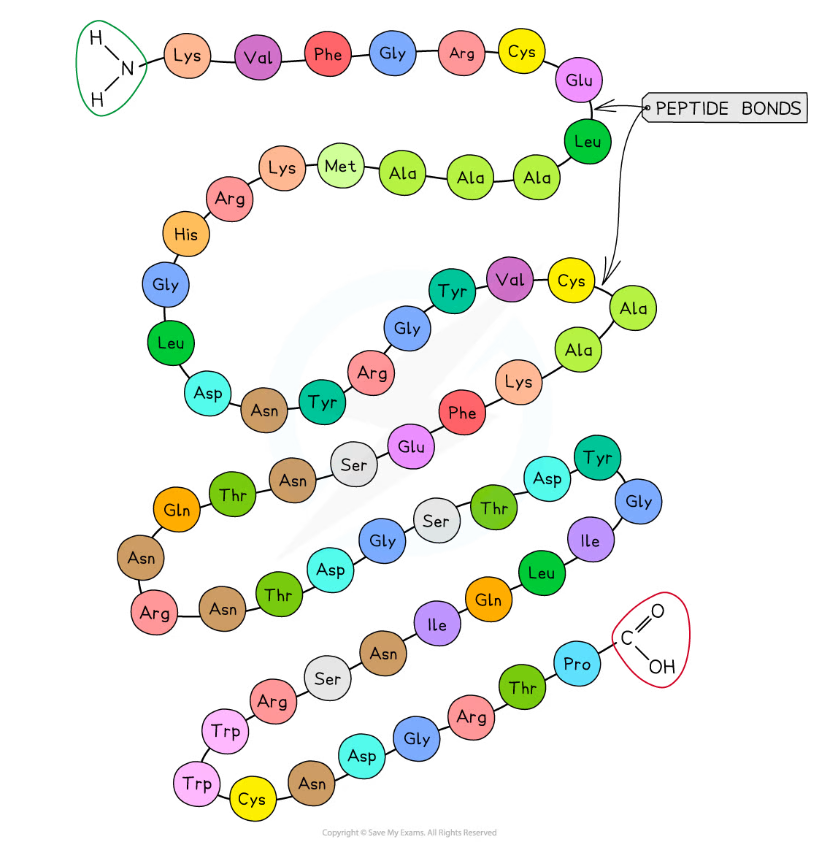
An example of the primary structure of proteins showing the three-letter abbreviation of specific amino acids
Secondary
- The?secondary structure?of a protein occurs when the weak negatively charged nitrogen and oxygen atoms interact with the weak positively charged hydrogen atoms to form?hydrogen bonds
- There are two shapes that can form within proteins due to the hydrogen bonds:
- α-helix
- β-pleated sheet
- The?α-helix?shape occurs when the hydrogen bonds form between every?fourth?peptide bond (between the oxygen of the carboxyl group and the hydrogen of the amine group)
- The?β-pleated sheet?shape forms when the protein folds so that?two parts of the polypeptide chain?are?parallel?to each other enabling hydrogen bonds to form between parallel peptide bonds
- Most?fibrous?proteins have secondary structures (e.g. collagen and keratin)
- The?secondary structure?only?relates to?hydrogen bonds?forming between the?amino group?and the?carboxyl group?(the ‘protein backbone’)
- The hydrogen bonds can be broken by high temperatures and pH changes
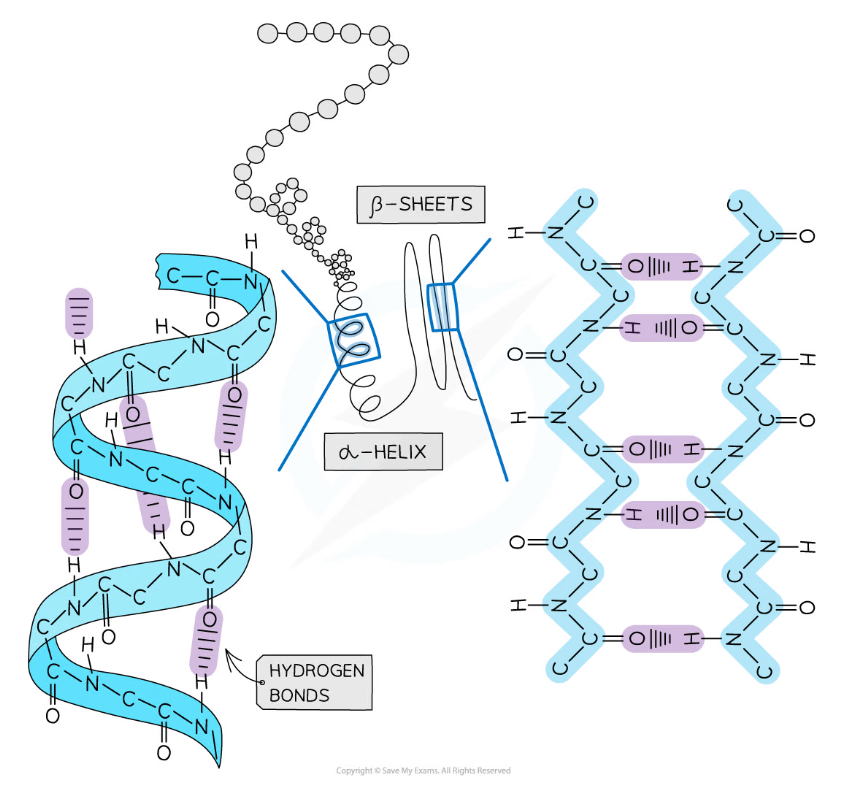
The secondary structure of a protein with the α-helix and β-pleated sheet shapes highlighted. The magnified regions illustrate how the hydrogen bonds form between the peptide bonds
Tertiary structure
- Further conformational change of the secondary structure leads to additional?bonds forming between the?R groups?(side chains)
- The additional bonds are:
- Hydrogen?(these are between R groups)
- Disulphide?(only occurs between cysteine amino acids)
- Ionic?(occurs between charged R groups)
- Weak?hydrophobic interactions?(between non-polar R groups)
- This structure is common in?3D?globular?proteins
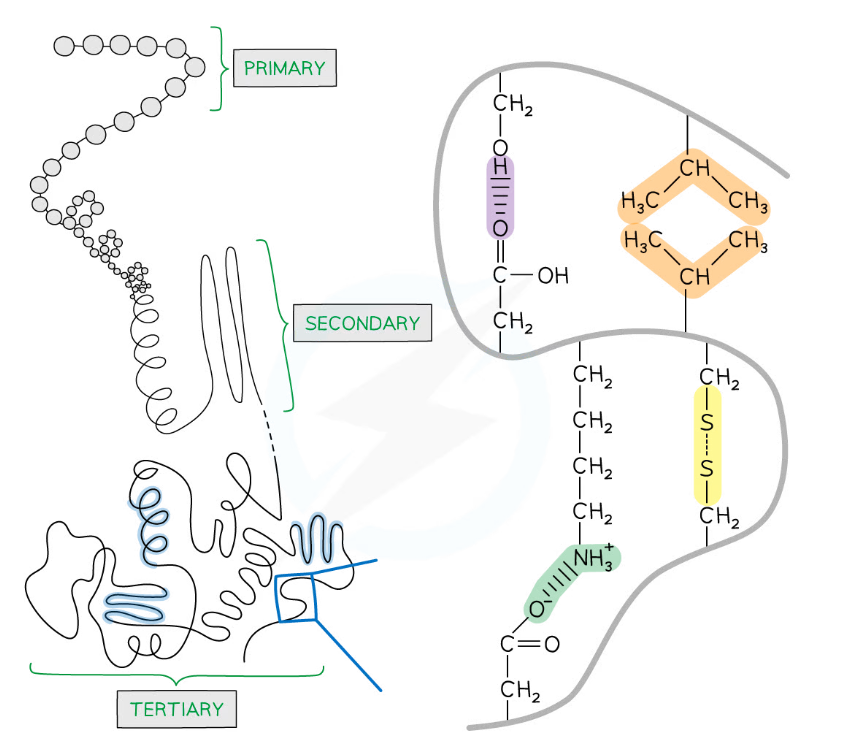

The 3D tertiary structure of proteins with hydrogen bonds, ionic bonds, disulphide bonds and hydrophobic interactions formed between the R groups of the amino acids
Quaternary
- Occurs in proteins that have?more than one?polypeptide chain working together as a functional macromolecule, for example, haemoglobin
- The same bonds responsible for maintaining the tertiary structure of a protein will also be involved in forming the quaternary structure
- Each polypeptide chain in the quaternary structure is referred to as a?subunit?of the protein
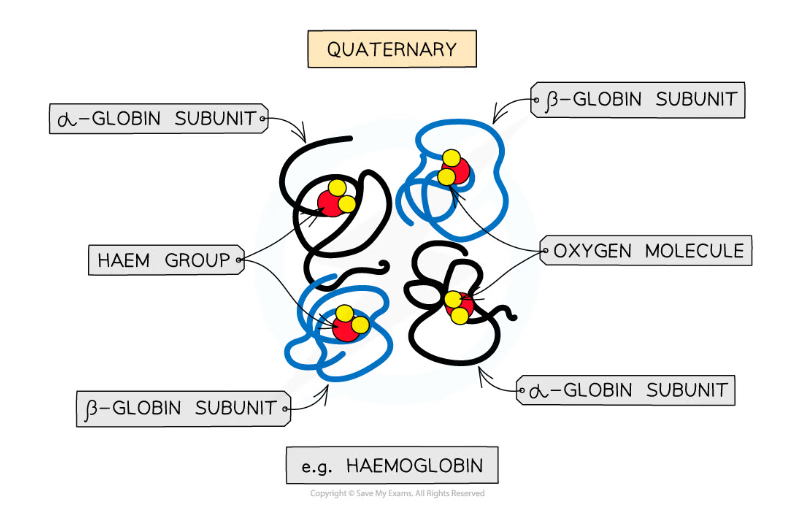
The quaternary structure of a protein. This is an example of haemoglobin which contains four subunits (polypeptide chains) working together to carry oxygen
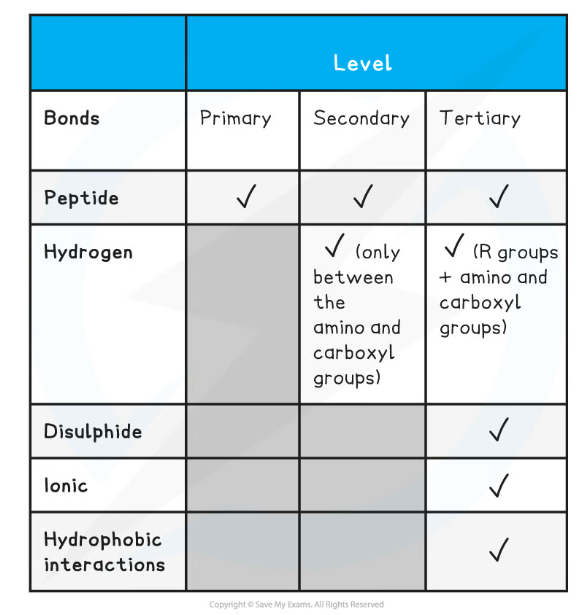
Summary of Bonds in Proteins Table
Exam Tip
Familiarise yourself with the difference between the four structural levels found in proteins, noting which bonds are found at which level. Remember that the hydrogen bonds in tertiary structures are between the R groups whereas in secondary structures the hydrogen bonds form between the amino and carboxyl groups.
轉(zhuǎn)載自savemyexams
以上就是關(guān)于【Edexcel A (SNAB) A Level Biology:復(fù)習(xí)筆記2.3.5 Levels of Protein Structure】的解答,如需了解學(xué)校/賽事/課程動態(tài),可至翰林教育官網(wǎng)獲取更多信息。
往期文章閱讀推薦:
翰林獨家 | 經(jīng)濟學(xué)競賽核心精講,一冊打通NEC/IEO/USAEBO!
2026 ALEVEL 夏考A率出爐!愛德思vs牛津AQA,哪些科目真的“好出分”?


翰林AMC8視頻課重磅上線!

國際競賽真題資源免費領(lǐng)取






