CIE A Level Chemistry復(fù)習(xí)筆記2.1.4 Period 3 Oxides & Hydroxides: Acid/Base Behaviour

Acid / Base Behaviour of Period 3 Oxides & Hydroxides
Period 3 oxides
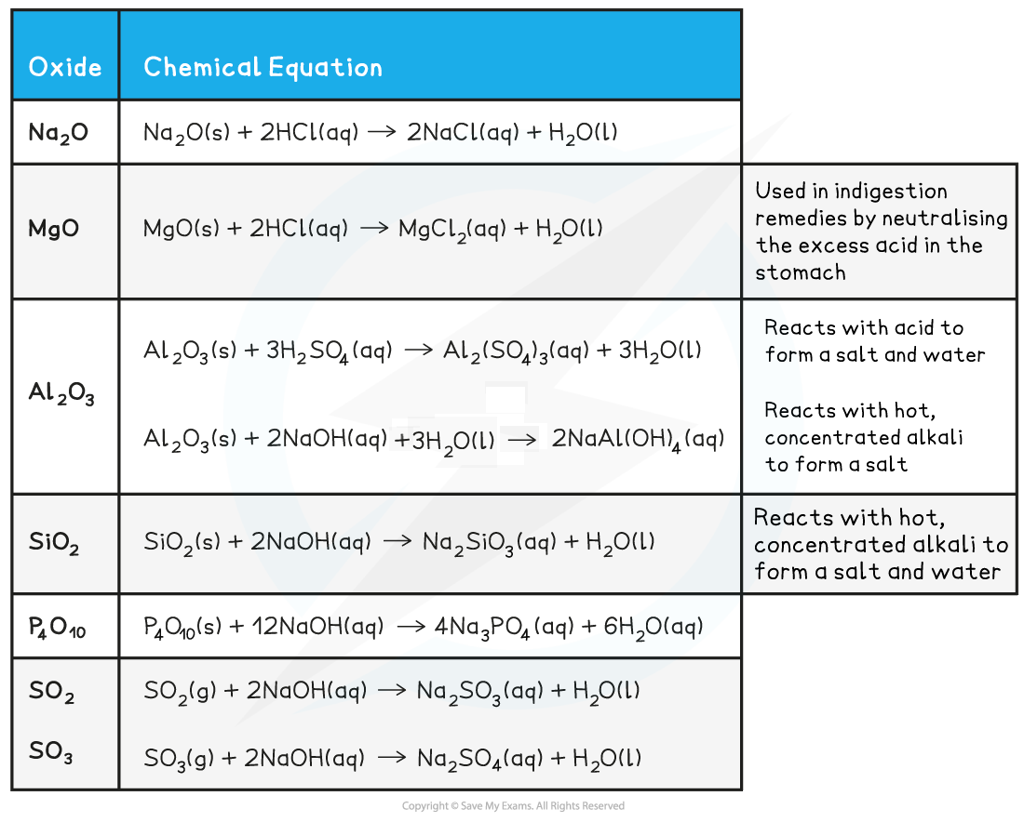
- Aluminium oxide is?amphoteric?which means that it can act both as a base (and react with an acid such as HCl) and an acid (and react with a base such as NaOH)
Acidic & basic nature of the Period 3 oxides
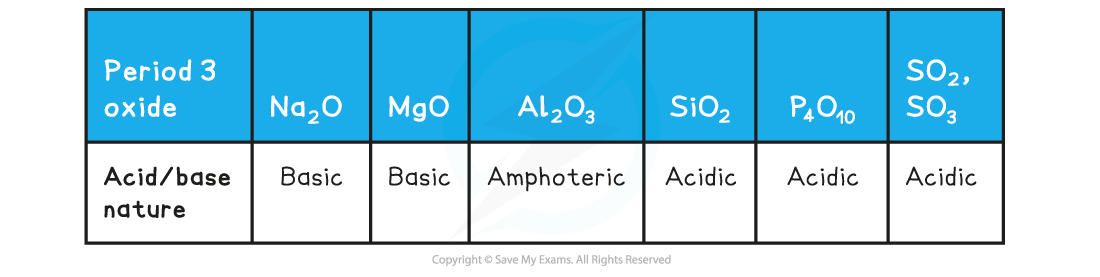
Reactions of the Period 3 oxides with acid/base table
- The acidic and basic nature of the Period 3 elements can be explained by looking at their?structure,?bonding?and the Period 3 elements’?electronegativity
Structure, bonding & electronegativity of the Period 3 elements table
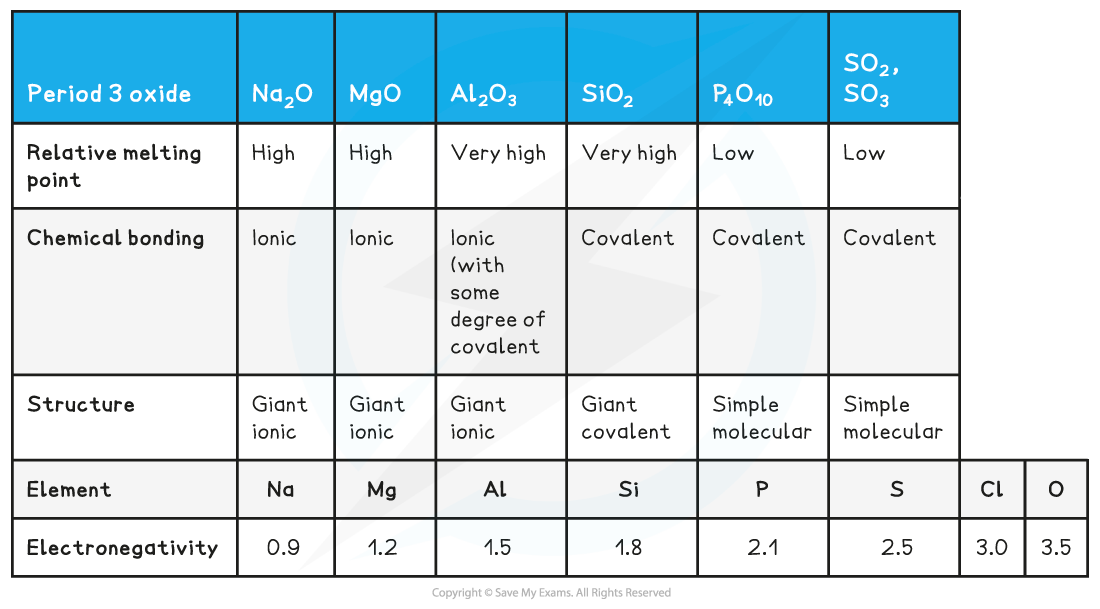
- The difference in electronegativity between oxygen and Na, Mg and Al is the largest
- Electrons will therefore be?transferred?to oxygen when forming oxides giving the oxide an?ionic binding
- The oxides of Si, P and S will?share?the electrons with the oxygen to form?covalently bonded?oxides
- The?giant ionic?and?giant covalent?structured oxides will have?high melting points?as it is difficult to break the structures apart
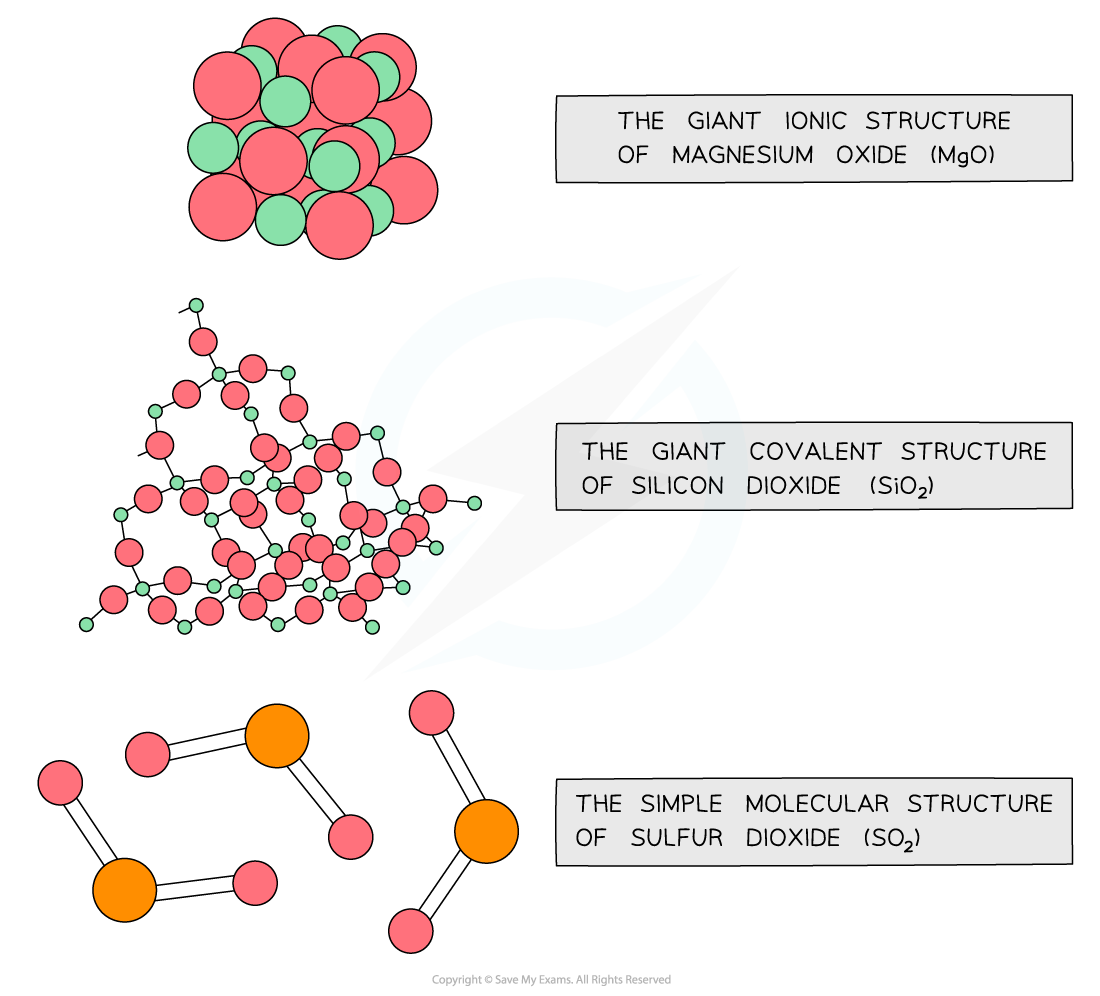 The diagram shows the structure of some Period 3 oxides
- The oxides of?Na and Mg?which show purely?ionic bonding?produce?alkaline?solutions with water as their?oxide?ions (O2-) become?hydroxide?ions (OH-):
O2-(aq) + H2O(l) → 2OH-(aq)
- The oxides of?P and S?which show purely?covalent bonding?produce?acidic?solutions with water because when these oxides react with water, they form an acid which donates?H+?ions to water
- Eg. SO3?reacts with water as follows:
SO3(g) + H2O(l) → H2SO4(aq)
-
- The H2SO4?is an acid which will donate a H+?to water:
H2SO4(aq) + H2O(l) → H3O+?(aq) + HSO4-(aq)
- Al?and?Si?are insoluble and when they react with?hot, concentrated alkaline solution?they act as a base and form a salt
- This behaviour is very typical of a?covalently bonded oxide
- Al?can also react with?acidic solutions?to form a salt and water
- This behaviour is very typical of an?ionic bonded metal oxide
- This behaviour of?Al?proves that the chemical bonding in aluminium oxide is not purely?ionic?nor?covalent: it is amphoteric
Period 3 hydroxide
- NaOH is a strong base and will react with acids to form a salt and water:
NaOH(aq) + HCl(aq) → NaCl(aq) + H2O(l)
- Mg(OH)2?is also a basic compound which is often used in indigestion remedies by neutralising the excess acid in the stomach to relieve pain:
Mg(OH)2(s) + 2HCl(aq) → MgCl2(aq) + 2H2O(l)
- Al(OH)3?is?amphoteric?and can acts both as an acid and base:
Al(OH)3(s) + 3HCl(aq) → AlCl3(s) + 3H2O(l)
Al(OH)3(s) + NaOH(aq) → NaAl(OH)4(aq)
Exam Tip
Electronegativity is the power of an element to draw the electrons towards itself in a covalent bond.For example, in Na2O the oxygen will draw the electrons more strongly towards itself than sodium does.
轉(zhuǎn)載自savemyexams
以上就是關(guān)于【CIE A Level Chemistry復(fù)習(xí)筆記2.1.4 Period 3 Oxides & Hydroxides: Acid/Base Behaviour】的解答,如需了解學(xué)校/賽事/課程動(dòng)態(tài),可至翰林教育官網(wǎng)獲取更多信息。
往期文章閱讀推薦:
MIT官方發(fā)布【2026年夏季推薦閱讀書單】!橫跨科學(xué)/人文/經(jīng)濟(jì)...
全網(wǎng)破防!ALevel CIE數(shù)學(xué)M1疑似錯(cuò)題?經(jīng)濟(jì)P2難度飆升?5月6日大考考情分析必看!


翰林AMC8視頻課重磅上線!

國(guó)際競(jìng)賽真題資源免費(fèi)領(lǐng)取






