CIE A Level Chemistry復習筆記1.3.9 Hybridisation

Covalent Bonding: Orbitals & Hybridisation
Bond overlap in covalent bonds
- A single?covalent?bond?is formed when two nonmetals combine
- Each atom that combines has an?atomic?orbital?containing a single unpaired electron
- When a covalent bond is formed, the?atomic orbitals?overlap to form a?combined orbital?containing two electrons
- This new orbital is called the?molecular orbital
- The?greater?the atomic orbital overlap, the?stronger?the bond
- Sigma?(σ) bonds are formed by?direct overlap?of orbitals between the bonding atoms
- Pi?(π) bonds are formed by the?sideways overlap?of?adjacent above and below?the σ bond
σ bonds
- Sigma?(σ) bonds are formed from the?end-on?overlap?of atomic orbitals
- S orbitals overlap this way as well as p orbitals
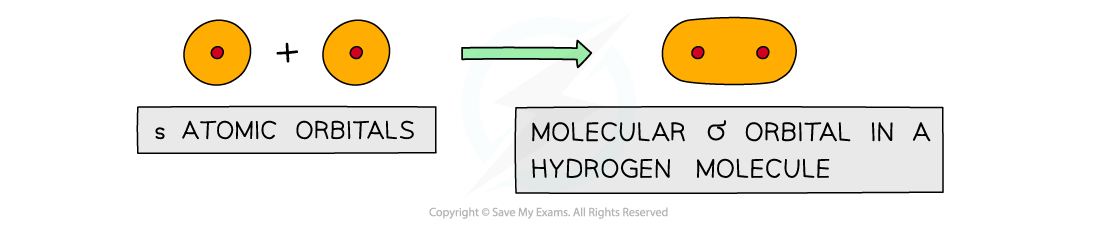
Sigma orbitals can be formed from the end-on overlap of s orbitals
- The electron density in a σ bond is symmetrical about a line joining the nuclei of the atoms forming the bond
- The pair of electrons is found between the nuclei of the two atoms
- The electrostatic attraction between the electrons and nuclei bonds the atoms to each other
π bonds
- Pi?(π) bonds are formed from the?sideways?overlap?of?adjacent?p orbitals
- The two lobes that make up the π bond lie?above?and?below?the?plane?of the σ bond
- This maximises overlap of the p orbitals
- A single π bond is drawn as?two electron clouds?one arising from each lobe of the p orbitals
- The two clouds of electrons in a π bond represent?one?bond containing?two electrons
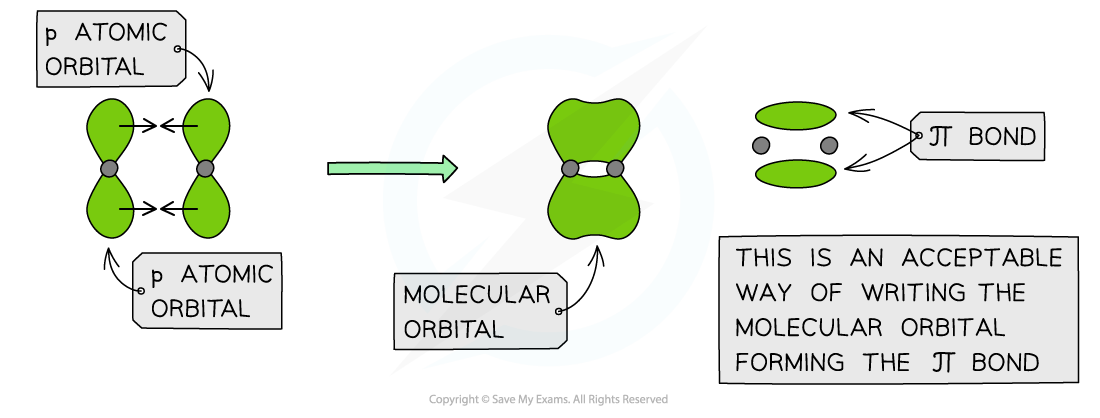 π orbitals can be formed from the end-on overlap of p orbitals
Examples of sigma & pi bonds
- Hydrogen
- The hydrogen atom has only one s orbital
- The s orbitals of the two hydrogen atoms will overlap to form a σ bond
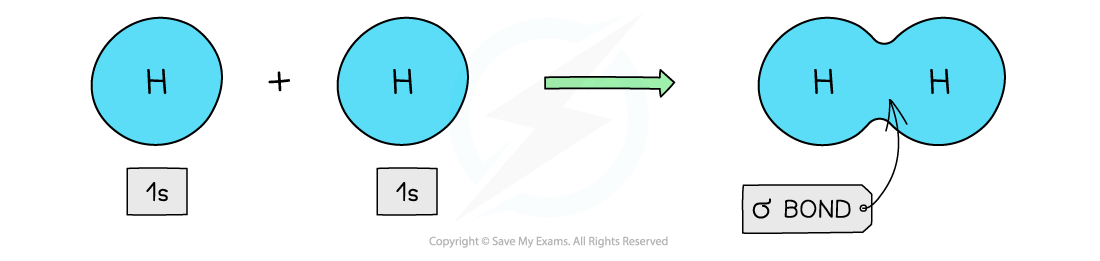
Direct overlap of the 1s orbitals of the hydrogen atoms results in the formation of a σ?bond
- Ethene
- Each carbon atom uses?three?of its?four?electrons to form σ bonds
- Two σ bonds are formed with the hydrogen atoms
- One σ bond is formed with the other carbon atom
- The fourth electron from each carbon atom occupies a p orbital which overlaps?sideways?with another p orbital on the other carbon atom to form a π bond
- This means that the C-C is a?double bond: one σ and one π bond
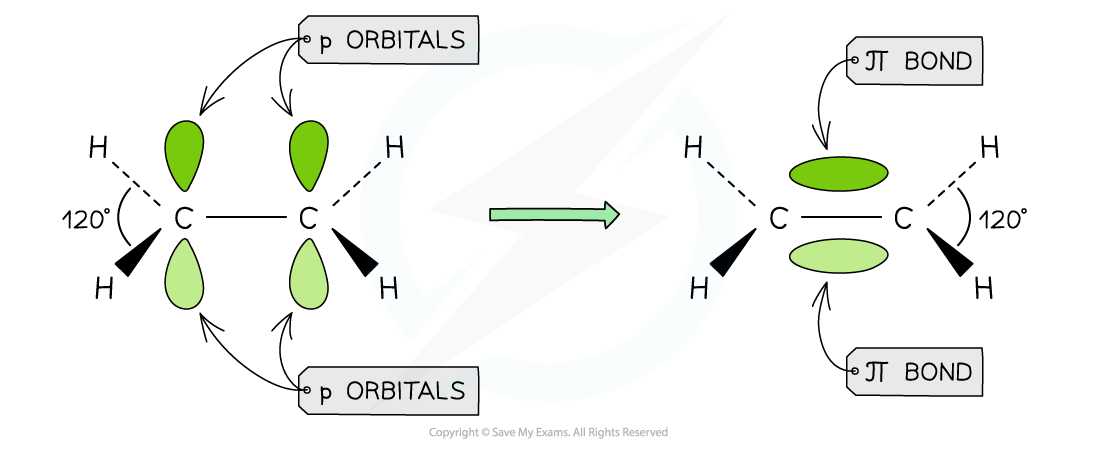
Overlap of the p orbitals results in the forming of a π bond in ethene
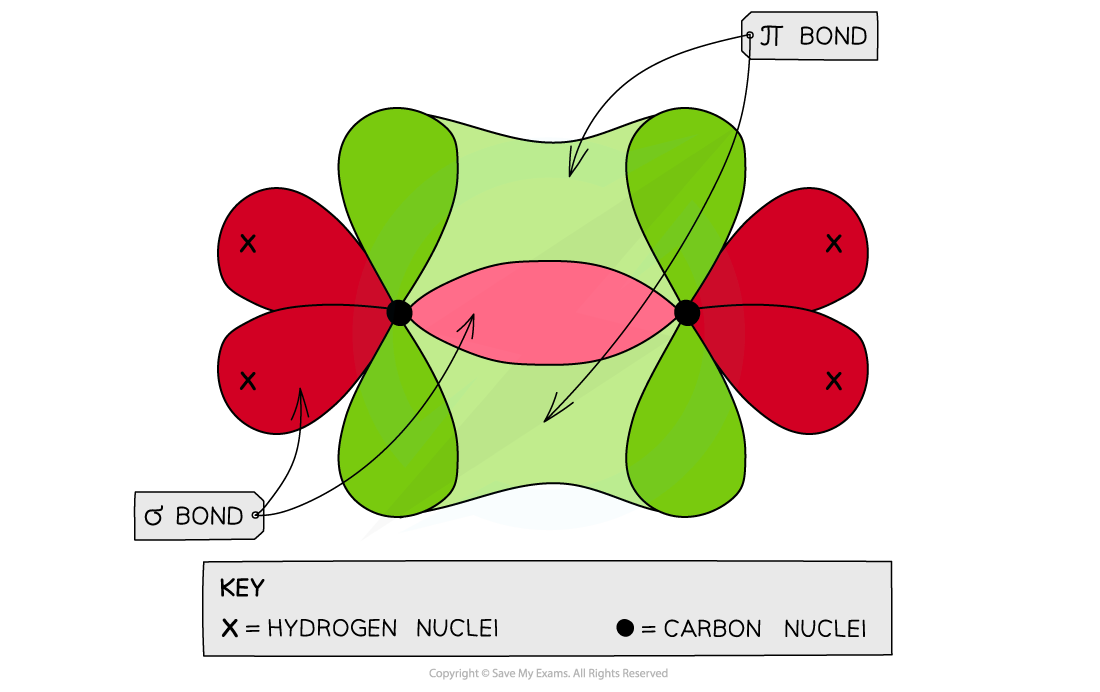
Each carbon atom in ethene forms two sigma bonds with hydrogen atoms and one σ?bond with another carbon atom. The fourth electron is used to form a π?bond between the two carbon atoms
- Ethyne
- This molecule contains a?triple bond?formed from?two π bonds?(at right angles to each other)?and one?σ bond
- Each carbon atom uses?two?of its?four?electrons to form σ bonds
- One σ bond is formed with the hydrogen atom
- One σ bond is formed with the other carbon atom
- Two electrons are used to form two π bonds with the other carbon atom
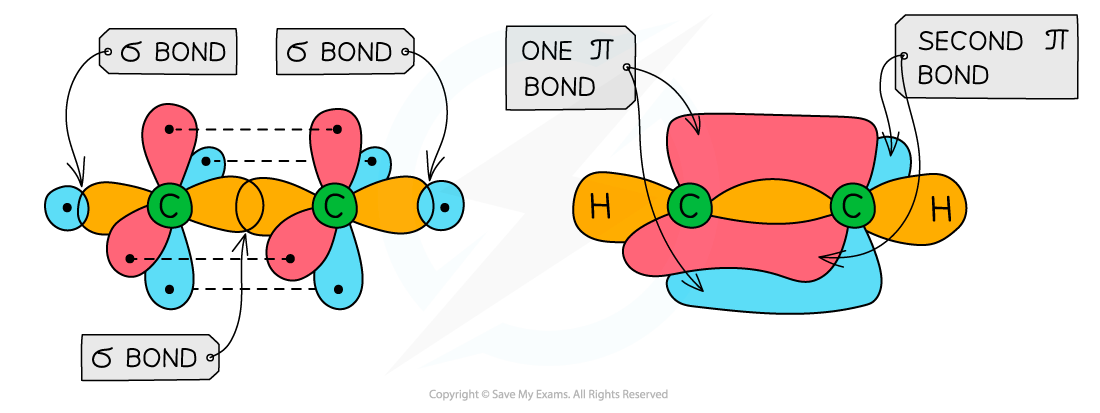
Ethyne has a triple bond formed from two π bonds and one σ bond between the two carbon atoms
- Hydrogen cyanide
- Hydrogen cyanide contains a?triple bond
- One σ bond is formed between the H and C atom (overlap of an sp C hybridised orbital with the 1s H orbital)
- A second σ bond is formed between the C and N atom (overlap of an sp C hybridised orbital with a p orbital of N)
- The remaining?two sets?of p orbitals of?nitrogen and carbon?will overlap to form?two?π bonds?at right angles to each other
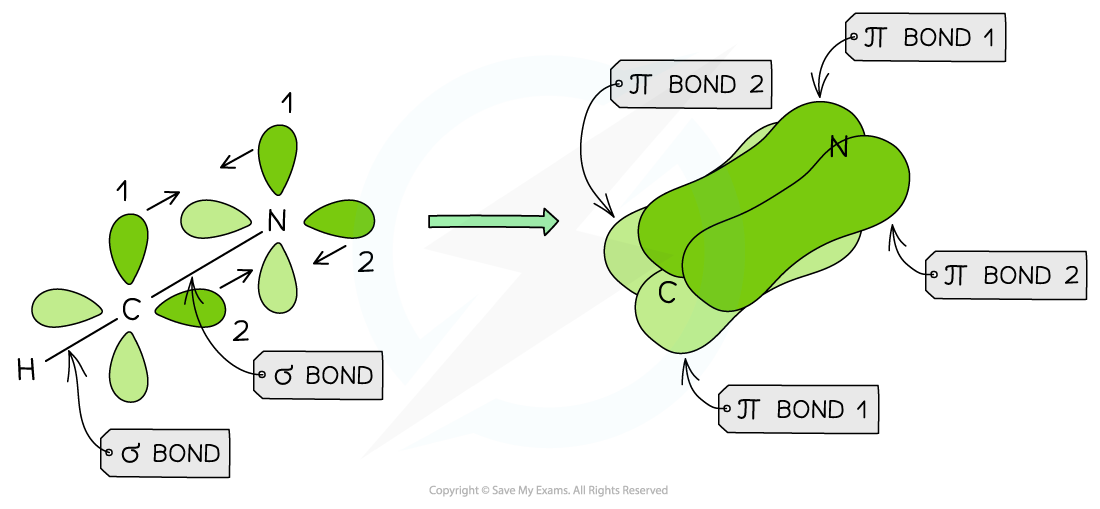 Hydrogen cyanide has a triple bond formed from the overlap of two sets of p orbitals of nitrogen and carbon and the overlap of an sp hybridised carbon orbital and a p orbital on the nitrogen
- Nitrogen
- Nitrogen too contains a?triple bond
- The triple bond is formed from the overlap of the s orbitals on each N to form a?σ bond?and the overlap of?two sets?of p orbitals on the nitrogen atoms to form?two π bonds
- These π bonds are at?right angles to each other
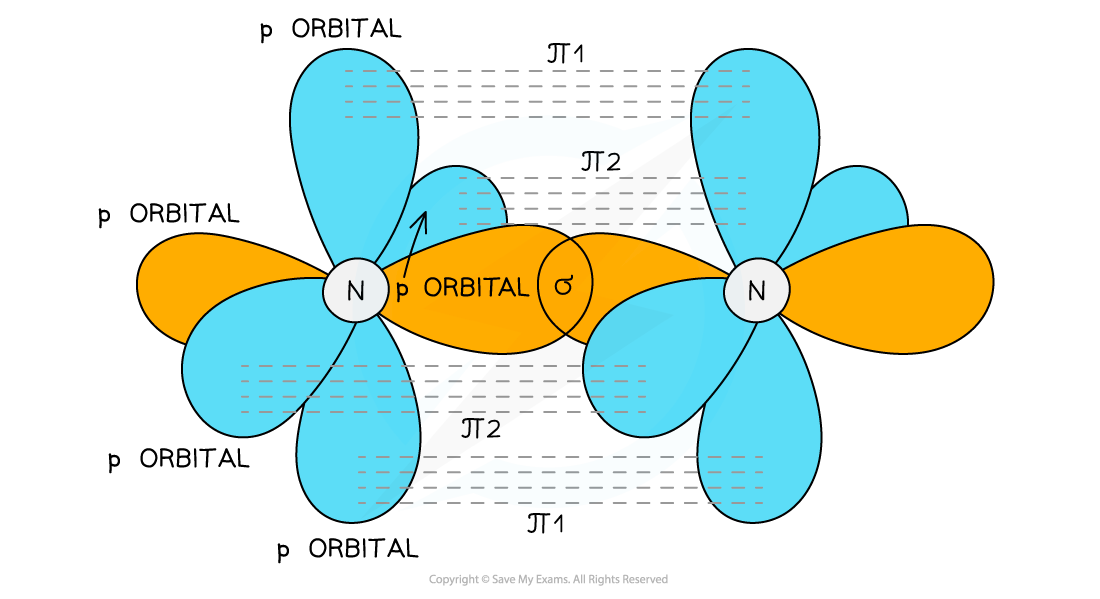
The triple bond is formed from two π bonds and one σ bond
Hybridisation
- The?p atomic orbitals?can also overlap?end-on?to form σ bonds
- In order for them to do this, they first need to become?modified?in order to gain?s orbital character
- The orbitals are therefore slightly changed in shape to make one of the p orbital?lobes bigger
- This mixing of atomic orbitals to form covalent bonds is called?hybridisation
- Mixing one s orbital with three p orbitals is called?sp3?hybridisation?(each orbital has ? s character and ? p character)
- Mixing one s orbital with two p orbitals is called?sp2?hybridisation
- Mixing one s orbital with one p orbital forms?sp?hybridised?orbitals
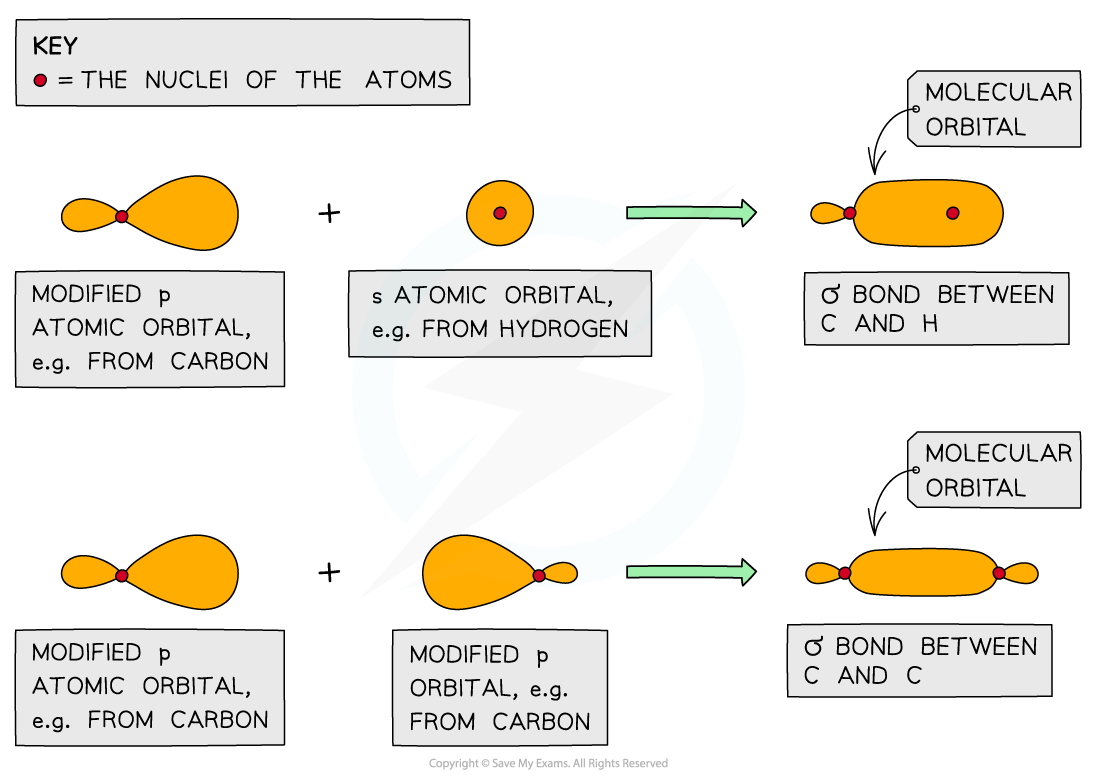
π orbitals can be formed from the end-on overlap of p orbitals
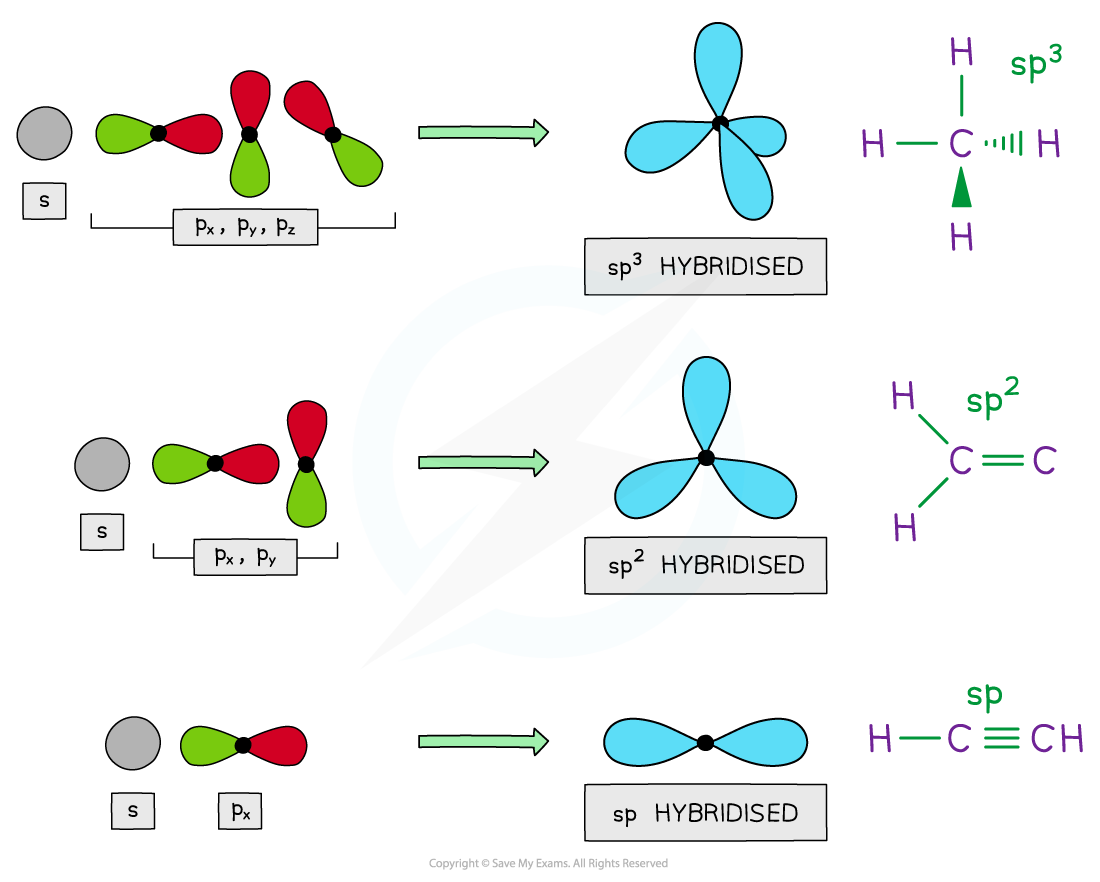
The mixing of s orbitals with p orbitals to form molecular bonds is called hybridisation
轉載自savemyexams
以上就是關于【CIE A Level Chemistry復習筆記1.3.9 Hybridisation】的解答,如需了解學校/賽事/課程動態(tài),可至翰林教育官網獲取更多信息。
往期文章閱讀推薦:
翰林獨家 | 經濟學競賽核心精講,一冊打通NEC/IEO/USAEBO!
2026 ALEVEL 夏考A率出爐!愛德思vs牛津AQA,哪些科目真的“好出分”?


翰林AMC8視頻課重磅上線!

國際競賽真題資源免費領取






