IB DP Physics: SL復(fù)習(xí)筆記7.3.2 Quarks & Leptons

Quarks & Leptons
Quarks
- Quarks are?fundamental particles?that make up other subatomic particles such as?protons and neutrons
- Protons and neutrons are in a category of particles called?hadrons
Hadrons are defined as any particle made up of quarks
- Fundamental?means that quarks are not made up of any other particles. Another example is electrons
- Quarks have?never?been observed?on their own, they’re either in pairs or groups of three
- There are six flavours (types) of quarks that exist:
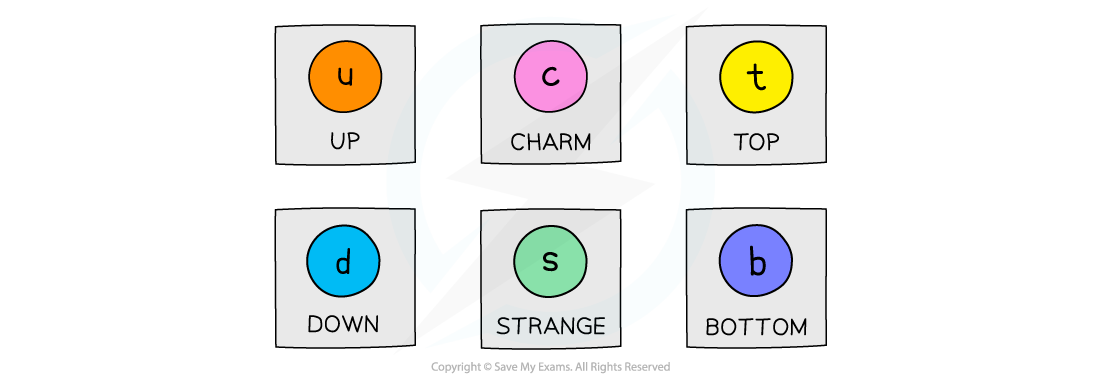
The six flavours of quarks
- The charge of a hadron is determined by the sum of the charges of its quarks
- Each flavour of quark has a certain relative charge:
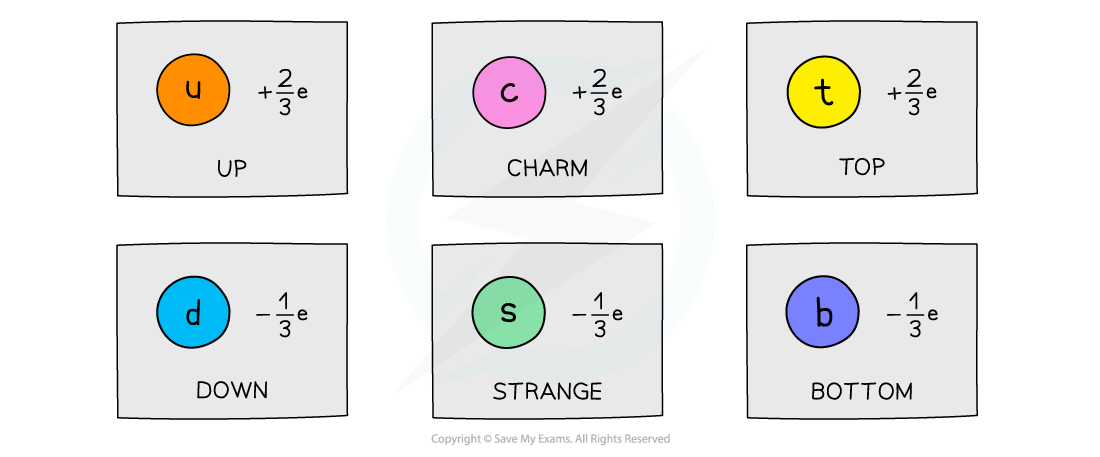 Each flavour of quark has a charge of either +?e or -?e
- For example, a proton is made up of two up quarks and a down quark. Adding up their charges gives the charge of a proton:
+?e + ?e - ?e = +1e
- The equivalent antiparticle of the quark is the anti-quark
- These are identical to quarks except with opposite relative charges
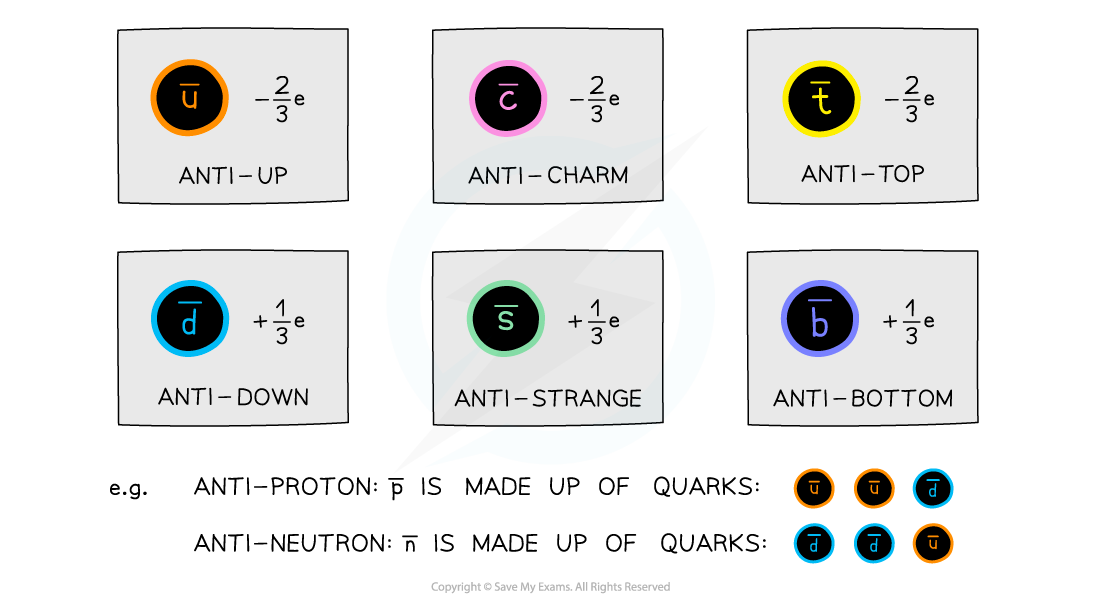
Each flavour of anti-quark has a charge of either -?e or +?e. The quark composition of anti-protons and anti-neutrons changes to anti-quarks
- Quarks have a?baryon number of +1/3
- Anti-quarks having a?baryon number of –1/3
- Strange quarks have?a strangeness of –1
- Anti-strange quarks have?a strangeness of +1
- This is unique to the strange quark
Worked Example
Particles are made up of a combination of three quarks or two quarks. Which quark combination would?not?give a particle a charge of -1 or 0?
A.?up, strange, strange
B.?charm, charm, down
C.?top, anti-up
D.?anti-up, anti-up, anti-strange
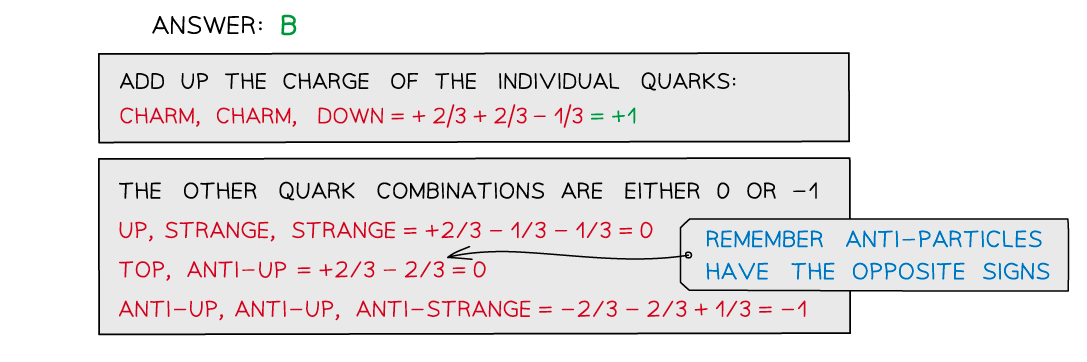
Worked Example
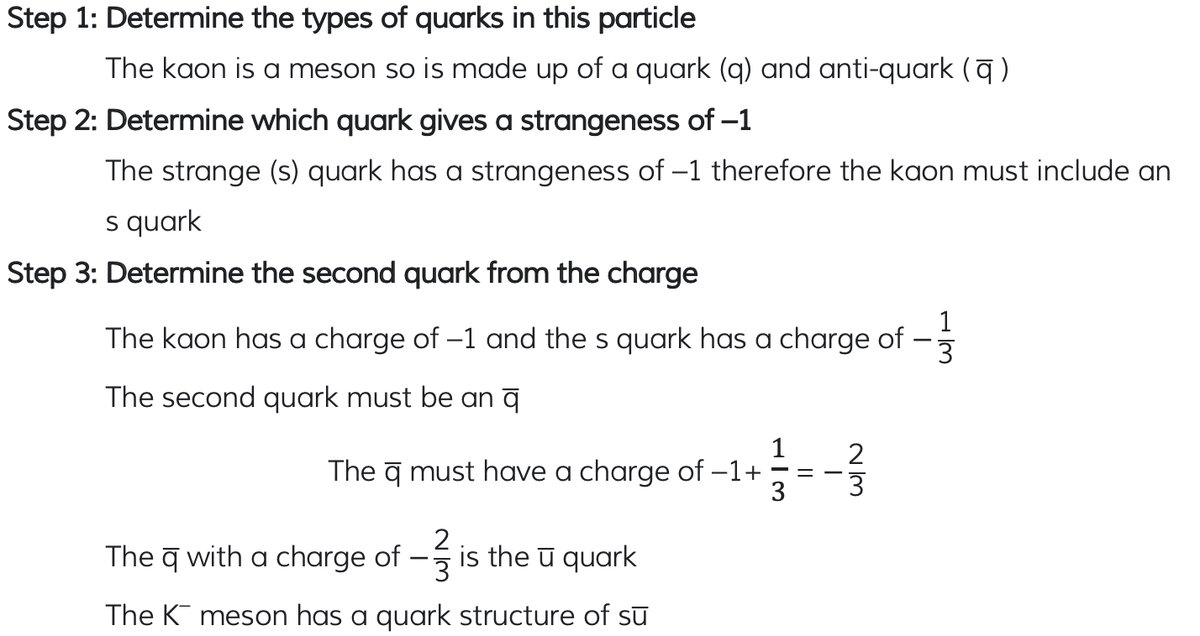
A K-?particle has a strangeness of –1. Determine the quark structure of this particle.
Leptons
- Leptons?are a group of?fundamental?(elementary) particles
- This means they are not made up of any other particles (no quarks)
- There are six leptons altogether:
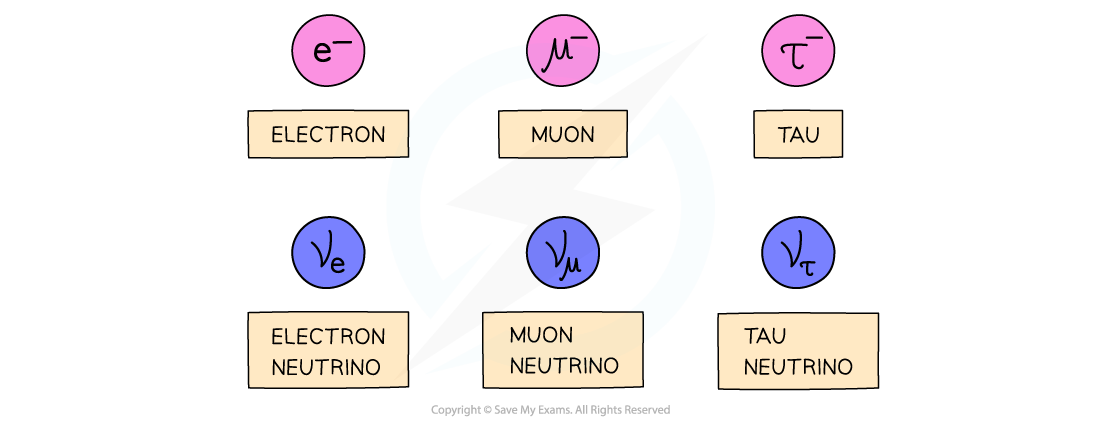 The six leptons are all fundamental particles
- The muon and tau particle are very similar to the electron but with slightly larger mass
- Electrons, muon, and tau particles?all?have a charge of -1e and a mass of 0.0005u
- There are three?flavours?(types) of neutrinos?(electron, muon, tau)
- Neutrinos are the most abundant leptons in the universe
- They have?no charge?and?negligible?mass (almost 0)
- Leptons interact with the weak interaction, electromagnetic and gravitational forces
- However, they do?not?interact with the strong force
- Although quarks are fundamental particles too, they are not classed as leptons
- Leptons do?not?interact with the strong force, whilst quarks do
Worked Example
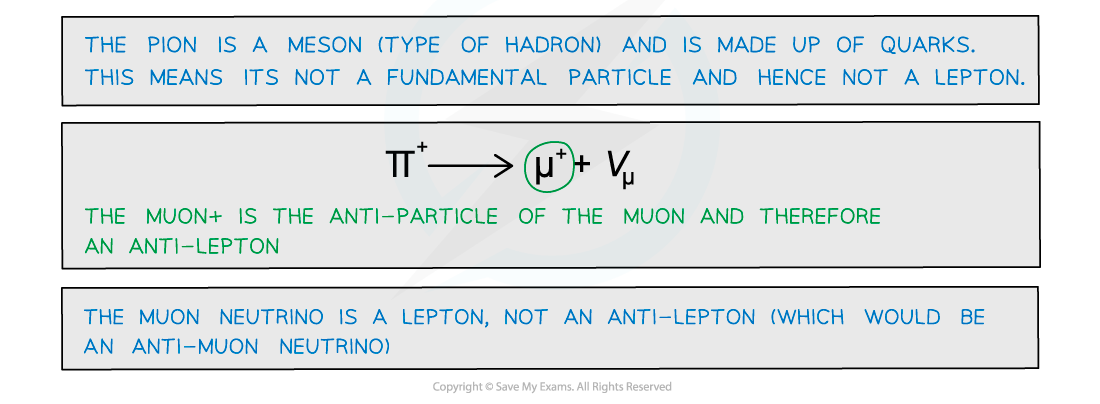
Circle all the anti-leptons in the following decay equation.

Lepton Number
- Similar to baryon number, the lepton number,?L?is the number of leptons in an interaction
- L?depends on whether the particle is a lepton, anti-lepton or neither
- Leptons have a lepton number?L?= +1
- Anti-leptons have a lepton number?L?= –1
- Particles that are not leptons have a lepton number?L?= 0
- Lepton number is a quantum number and is conserved in all interactions
- This is helpful for knowing whether an interaction is able to happen
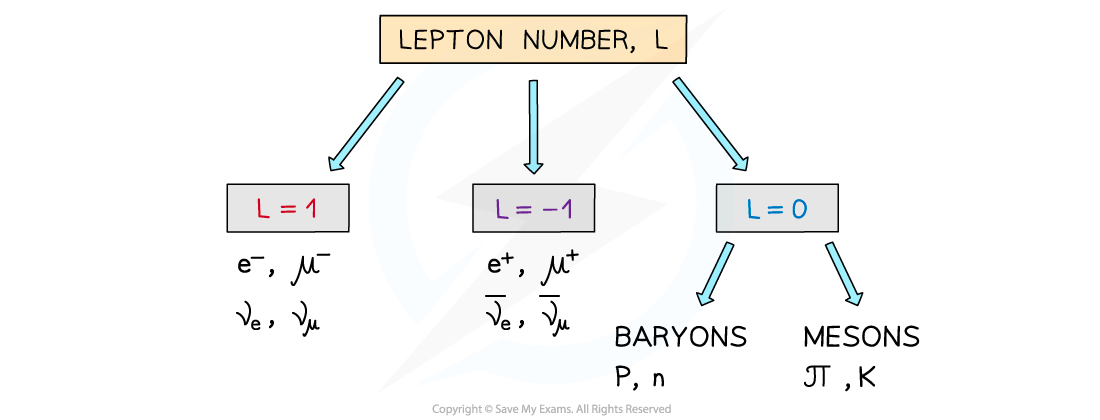
The lepton number depends if the particle is a lepton, anti-lepton or neither
Worked Example
If the lepton number is conserved in the following decay, identify whether particle X should be a neutrino or anti-neutrino
Step 1:?Determine the lepton number of all the particles on both sides of the equation
-
- 0 + (–1) = 0 + X
Step 2: Identify the lepton number of X
-
- If the lepton number must be conserved, X must also have a lepton number of –1
Step 3: State the particle X
-
- Particle X is an anti-neutrino
Protons & Neutrons
Protons and Neutrons
- Protons and neutrons are?not?fundamental particles. They are each made up of three quarks
- Protons?are made up of?two up quarks and a down quark
- Neutrons?are made up of?two down quarks and an up quark
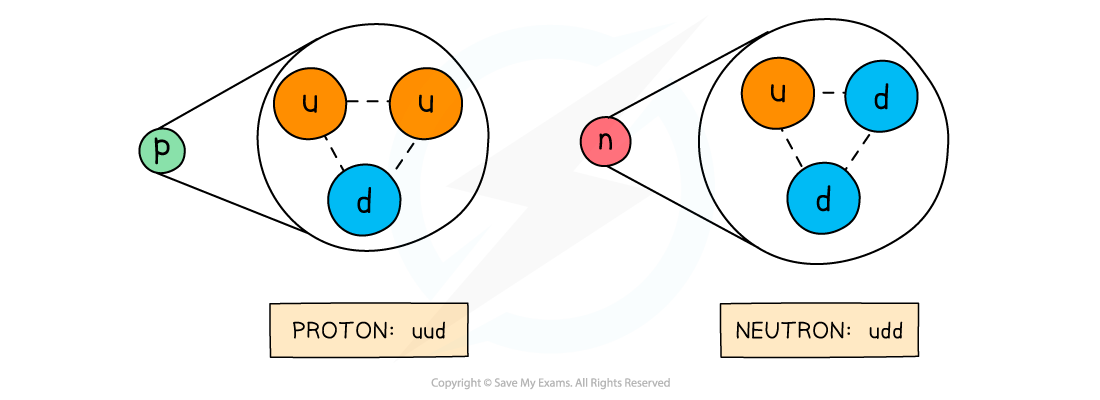
Protons and neutrons are made up of three quarks
- You will be expected to remember these quark combinations for exam questions
Protons as Baryons
- The proton is the most stable baryon
- This means it has the?longest half-life?of any baryon and is the particle which other baryons eventually decay to
- It is the most stable baryon because it is also the?lightest baryon
- Radioactive decay occurs when heavier particles decay into lighter particles
- A decay of the proton would therefore violate the conservation of baryon number
- It is theorized that the proton has a half-life of around 1032?years and research experiments are still underway that are designed to detect proton decay
Worked Example

Step 1:?Calculate number of protons:
-
- The number of protons is from the proton number = 26 protons
Step 2:?Calculate number of neutrons:
-
- The number of neutrons = nucleon number - proton number = 56 - 26 = 30 neutrons
Step 3:?Up quarks in a proton:
-
- Protons are made up of?uud?quarks = 2 up quarks
Step 4:?Up quarks in a neutron:
-
- Neutrons are made up of?udd?quarks = 1 up quark
Step 5:?Total number of up quarks:
-
- 26 protons x 2 up quarks = 52 up quarks
- 30 neutrons x 1 up quark = 30 up quarks
- 52 + 30 = 82 up quarks
β– and β+ decay
- Beta decay happens via the?weak interaction
- This is one of the four fundamental forces and it’s responsible for radioactive decays
Quark Composition: β-?decay
- Recall that?β-?decay is when a neutron turns into a proton emitting an electron and anti-electron neutrino
- More specifically, a neutron turns into a proton because a?down quark turns into an up quark
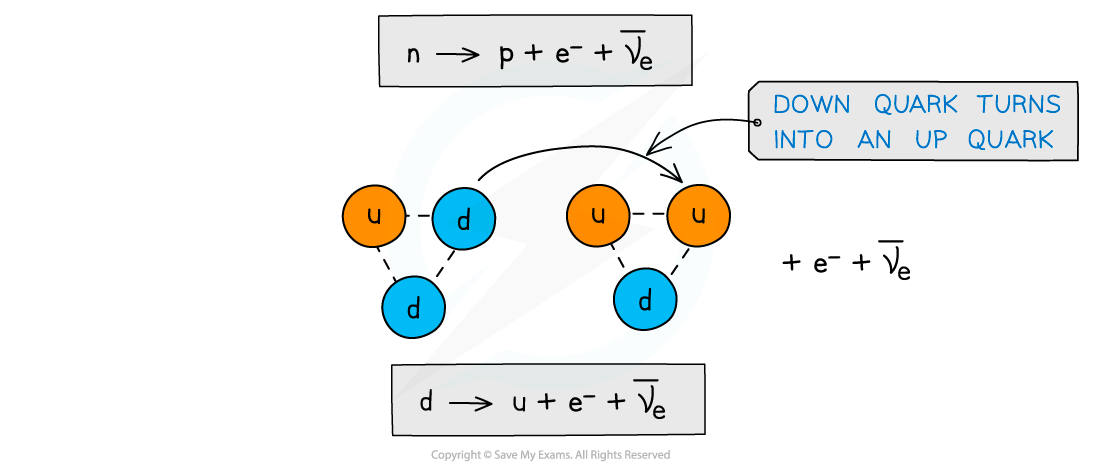
Beta minus decay is when a down quark turns into an up quark
Quark Composition: β+?decay
- Recall that?β+?decay is when a proton turns into a neutron emitting a positron and an electron neutrino
- More specifically, a proton turns into a neutron because an?up quark turns into a down quark
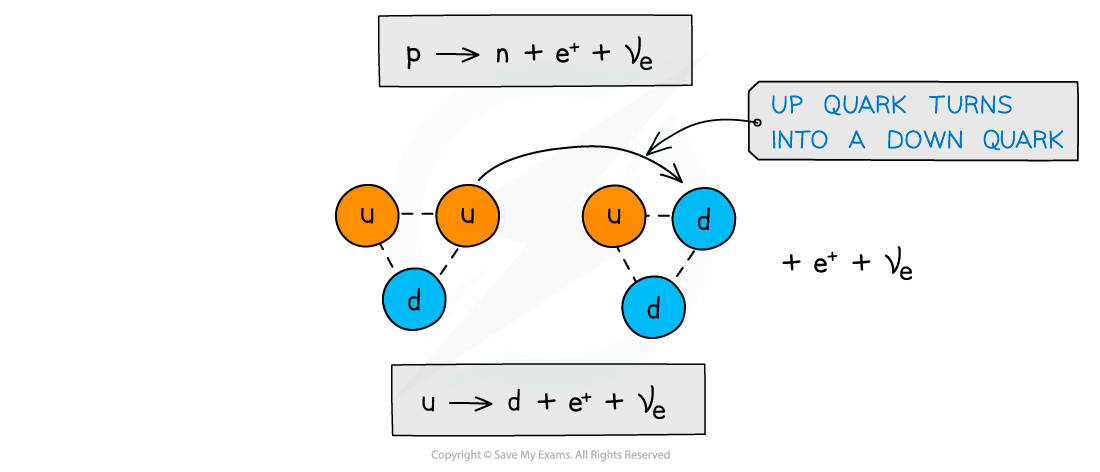
Beta plus decay is when an up quark turns into a down quark
Worked Example
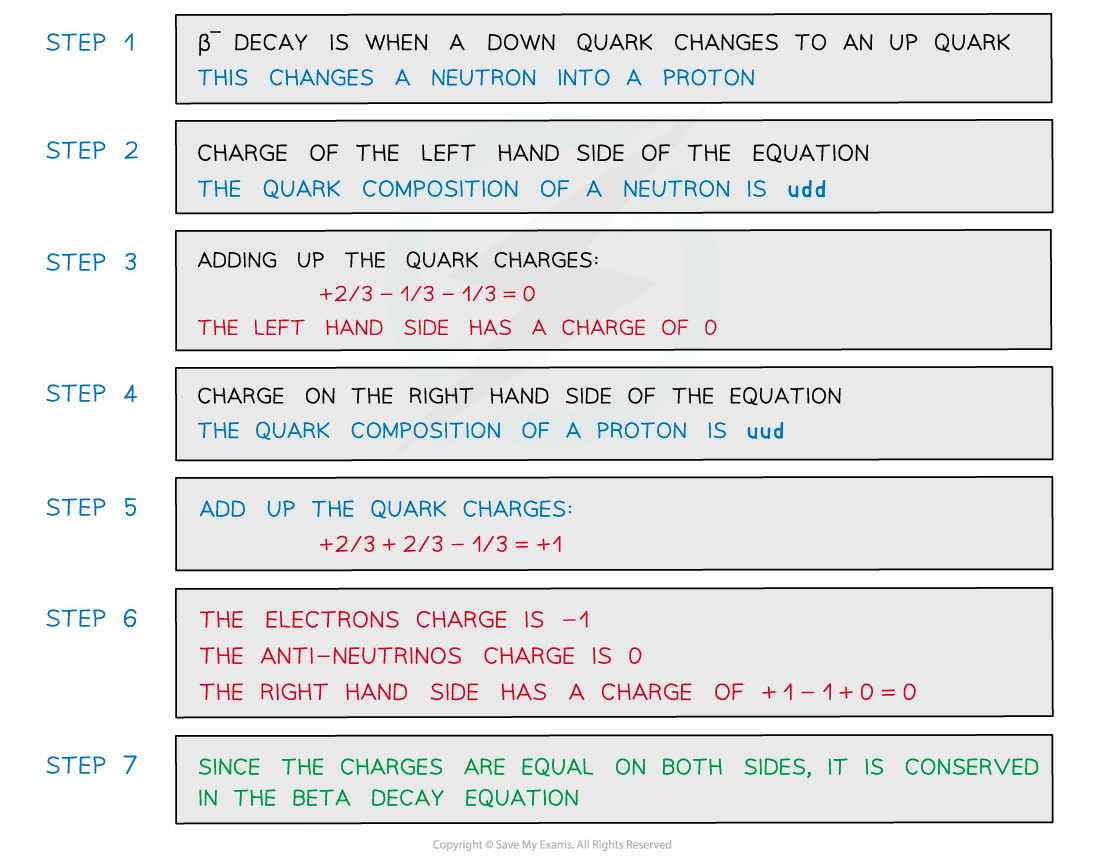
The equation for β–?decay is
Using the quark model of beta decay, prove that the charge is conserved in this equation.
轉(zhuǎn)載自savemyexams
以上就是關(guān)于【IB DP Physics: SL復(fù)習(xí)筆記7.3.2 Quarks & Leptons】的解答,如需了解學(xué)校/賽事/課程動(dòng)態(tài),可至翰林教育官網(wǎng)獲取更多信息。
往期文章閱讀推薦:
翰林獨(dú)家 | 經(jīng)濟(jì)學(xué)競(jìng)賽核心精講,一冊(cè)打通NEC/IEO/USAEBO!
2026 AMC10/12美國(guó)數(shù)學(xué)競(jìng)賽新賽季!【翰林教育 × 清華大學(xué)出版社】獨(dú)家教材全面發(fā)售!


翰林AMC8視頻課重磅上線!

國(guó)際競(jìng)賽真題資源免費(fèi)領(lǐng)取






