IB DP Physics: SL復習筆記5.4.3 Magnetic Force on a Current-Carrying Conductor

Magnetic Force on a Current-Carrying Conductor
- A current-carrying conductor produces its own?magnetic field
- When interacting with an external magnetic field, it will experience a?force
- A current-carrying conductor will only experience a force if the current through it is?perpendicular?to the direction of the magnetic field lines
- A simple situation would be a copper rod placed within a uniform magnetic field
- When current is passed through the copper rod, it experiences a force that makes it move
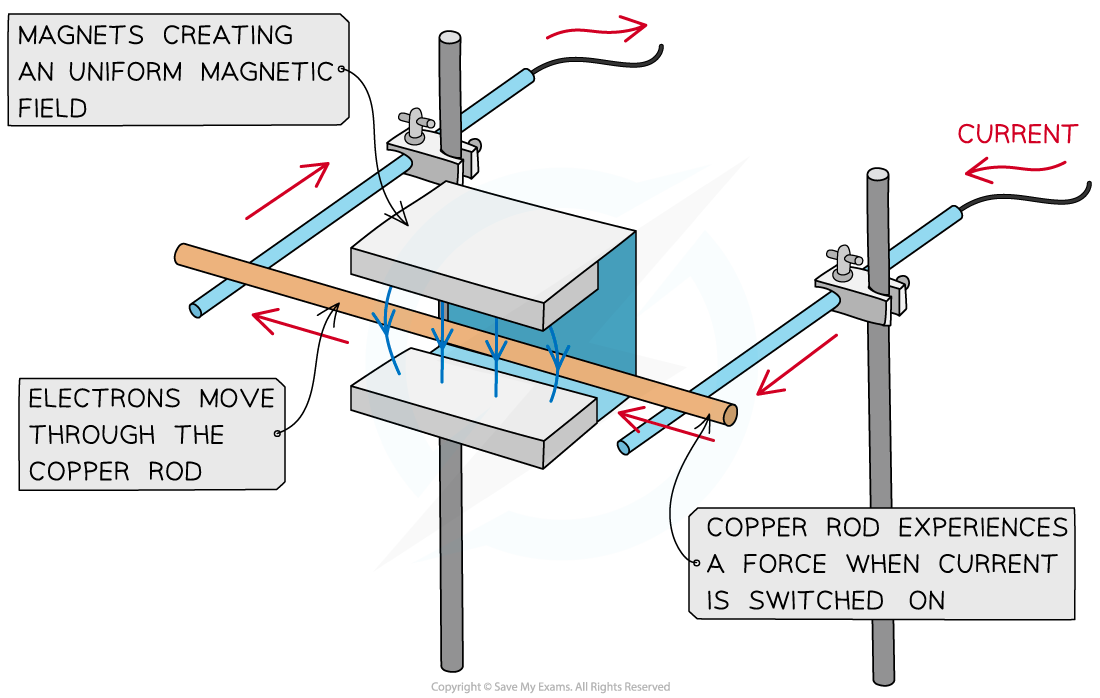
A copper rod moves within a magnetic field when current is passed through it
Calculating Magnetic Force on a Current-Carrying Conductor
- The strength of a?magnetic field?is known as the?magnetic flux density, B
- This is also known as the magnetic field strength
- It is measured in units of?Tesla (T)
- The force?F?on a conductor carrying current?I?at right angles to a magnetic field with flux density?B?is defined by the equation
F = BIL sinθ
- Where:
- F = force on a current carrying conductor in a B field (N)
- B = magnetic flux density of external B field (T)
- I = current in the conductor (A)
- L = length of the conductor (m)
- θ = angle between the conductor and external B field (degrees)
- This equation shows that the greater the current or the magnetic field strength, the greater the force on the conductor
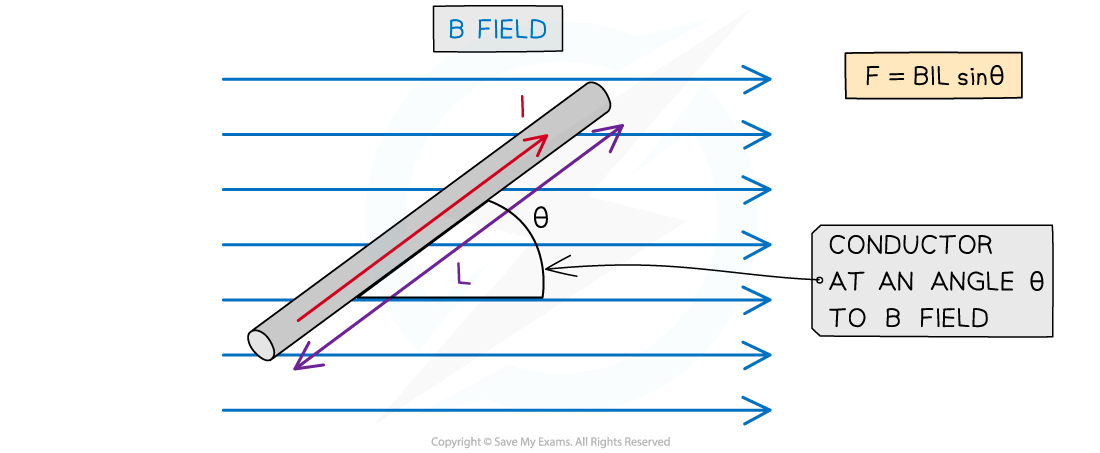
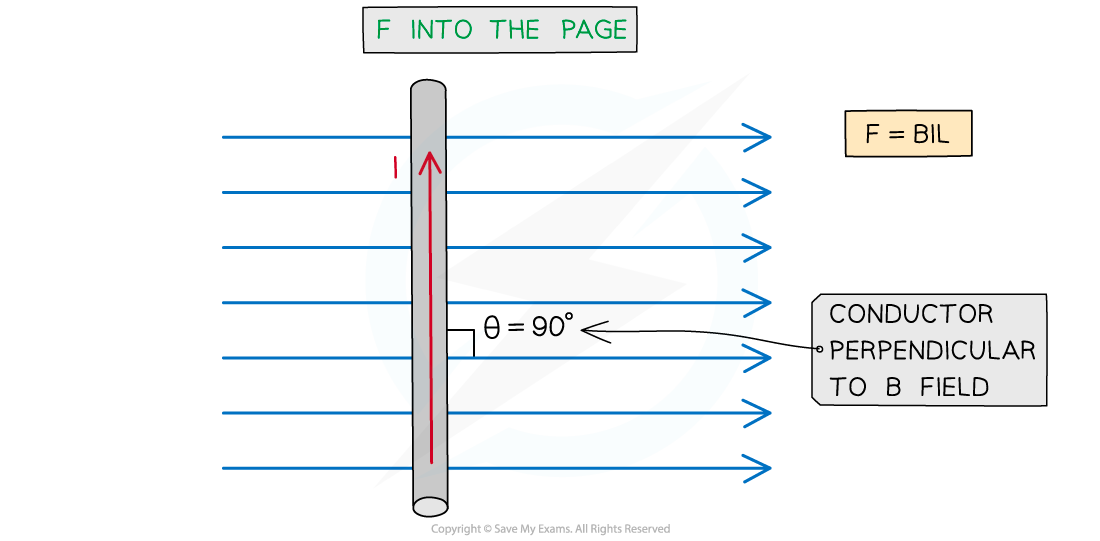
Magnitude of the force on a current carrying conductor depends on the angle of the conductor to the external B field
- The?maximum?force occurs when sin θ = 1
- This means θ = 90o?and the conductor is?perpendicular?to the B field
- This equation for the magnetic force now becomes:
F = BIL
- The?minimum?force (0) is when sin θ = 0
- This means θ = 0o?and the conductor is?parallel?to the B field
- It is important to note that a current-carrying conductor will experience?no?force if the current in the conductor is parallel to the field
Worked Example
A current of 0.87 A flows in a wire of length 1.4 m placed at 30o to a magnetic field of flux density 80 mT.Calculate the force on the wire.
Step 1:?Write down the known quantities
Magnetic flux density, B = 80 mT = 80 × 10-3?T
Current, I = 0.87 A
Length of wire, L = 1.4 m
Angle between the wire and the magnetic field, θ = 30o
Step 2:?Write down the equation for force on a current-carrying conductor
F = BIL sinθ
Step 3:?Substitute in values and calculate
F =? (80 × 10-3) × (0.87) × (1.4) × sin(30) = 0.04872 = 0.049 N (2 s.f)
Origin of the Forces Between Current-Carrying Conductors
- A current carrying conductor, such as a wire, produces a?magnetic field?around it
- The direction of the field depends on the direction of the current through the wire
- This is determined by the?right hand thumb rule
- Parallel current-carrying conductors will therefore either attract or repel each other
- If the currents are in the?same?direction in both conductors, the magnetic field lines between the conductors cancel out – the conductors will?attract?each other
- If the currents are in the?opposite?direction in both conductors, the magnetic field lines between the conductors push each other apart – the conductors will?repel?each other
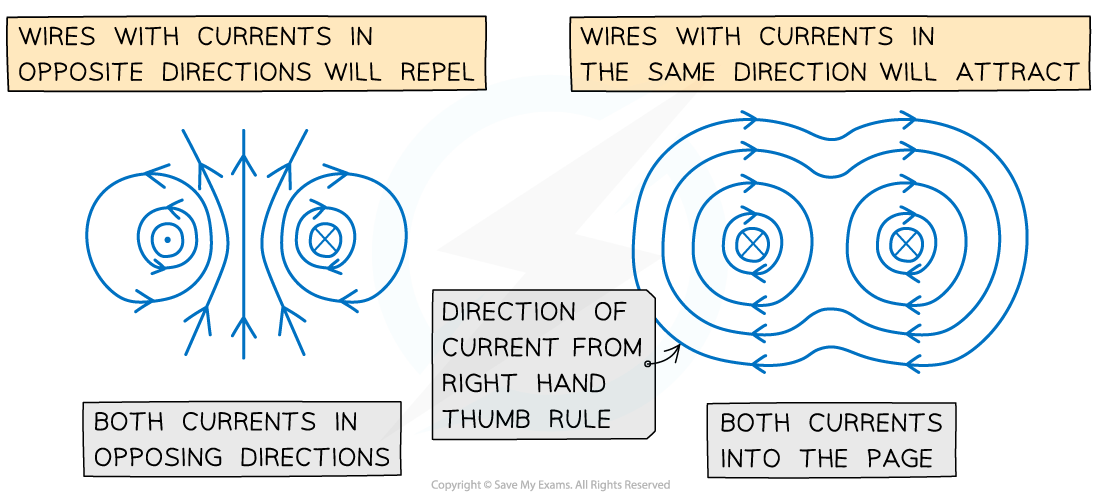
Both wires will attract if their currents are in the same direction and repel if in opposite directions
- When the conductors?attract, the direction of the?magnetic forces?will be?towards?each other
- When the conductors?repel, the direction of the magnetic forces will be?away?from each other
- The magnitude of each force depend on the amount of current and length of the wire
Worked Example
Two long, straight, current-carrying conductors, WX and YZ, are held at a close distance, as shown in diagram 1.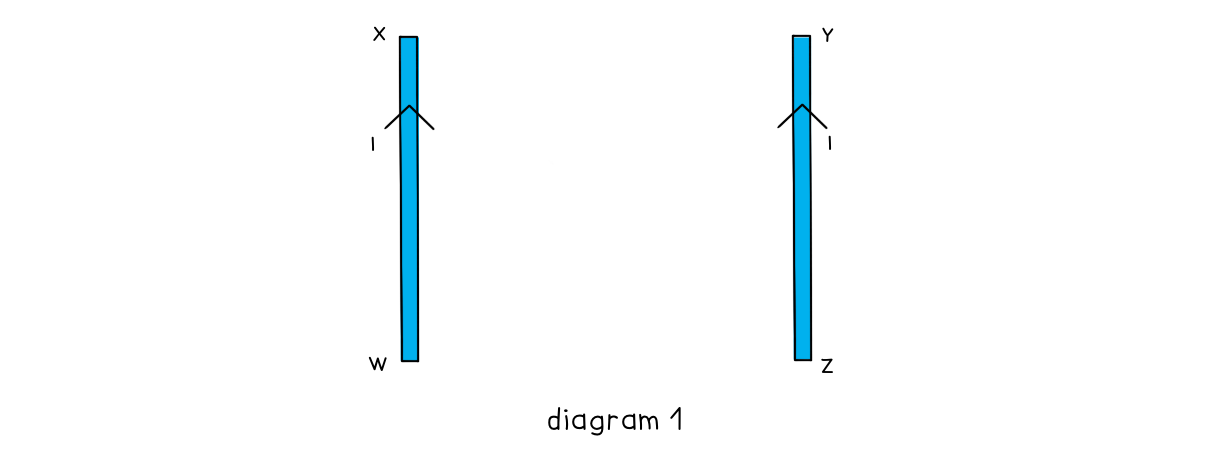
The conductors each carry the same magnitude current in the same direction. A plan view from above the conductors is shown in diagram 2.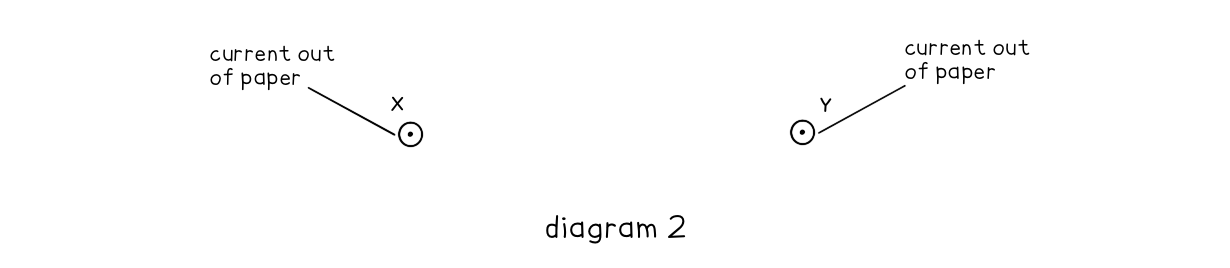 On diagram 2, draw arrows, one in each case, to show the direction of:
- The magnetic field at X due to the current in wire YZ (label this arrow BYZ)
- The force at X as a result of the magnetic field due to the current in the wire YZ (label this arrow FYZ)
- The magnetic field at Y due to the current in wire WX (label this arrow BWX)
- The force at Y as a result of the magnetic field due to the current in the wire WX (label this arrow FWX)

- Newton’s Third Law states:
- When two bodies interact, the force on one body is?equal but opposite?in direction to the force on the other body
- Therefore, the forces on the wires act in equal but opposite directions
Exam Tip
Remember that the direction of current flow is the flow of?positive?charge (positive to negative), and this is in the?opposite direction?to the flow of electrons
轉載自savemyexams
以上就是關于【IB DP Physics: SL復習筆記5.4.3 Magnetic Force on a Current-Carrying Conductor】的解答,如需了解學校/賽事/課程動態,可至翰林教育官網獲取更多信息。
往期文章閱讀推薦:
翰林獨家 | 經濟學競賽核心精講,一冊打通NEC/IEO/USAEBO!
2026 AMC10/12美國數學競賽新賽季!【翰林教育 × 清華大學出版社】獨家教材全面發售!


翰林AMC8視頻課重磅上線!

國際競賽真題資源免費領取






