IB DP Physics: SL復習筆記4.2.1 Properties of Waves

Properties of Waves
- Travelling waves?are defined as follows:
Oscillations that transfer energy from one place to another without transferring matter
- Energy is transferred by the waves, but matter is not
- The direction of the motion of the wave is the direction of the energy transfer
- Travelling waves can be of two types:
- Mechanical Waves, which propagate through a medium and cannot take place in a vacuum
- Electromagnetic Waves, which can travel through a vacuum
- Waves are generated by?oscillating sources
- These oscillations travel?away?from the source
- Oscillations can propagate through a?medium?(e.g. air, water) or in?vacuum?(i.e. no particles), depending on the type of wave
- The key properties of?travelling waves?are as follows:
- Displacement?(x) of a wave is the distance of a point on the wave from its equilibrium position
- It is a vector quantity; it can be positive or negative
- Measured in metres (m)
- Wavelength?(λ) is the length of one complete oscillation measured from same point on two consecutive waves
- For example, two crests, or two troughs
- Measured in metres (m)
- Amplitude?(x0) is the maximum displacement of an oscillating wave from its equilibrium position (x?= 0)
- Amplitude can be positive or negative depending on the direction of the displacement
- Measured in metres (m)
- Period?(T) is the time taken for a fixed point on the wave to undergo one complete oscillation
- Measured in seconds (s)
- Frequency?(f) is the number of full oscillations per second
- Measured in Hertz (Hz)
- Wave speed?(c)?is the distance travelled by the wave per unit time
- Measured in metres per second (m s-1)
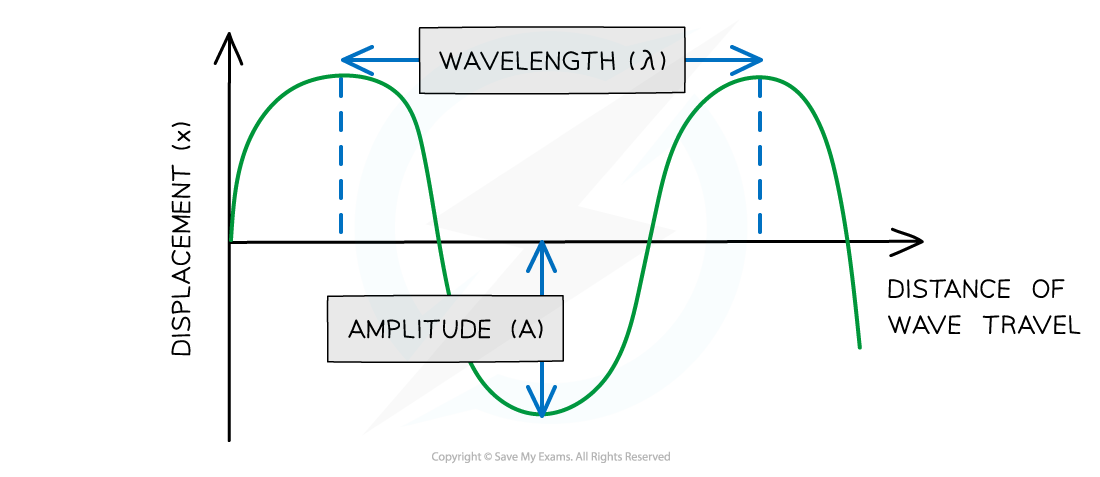
Diagram showing the amplitude and wavelength of a wave
- The frequency,?f, and the period,?T, of a travelling wave are related to each other by the equation:

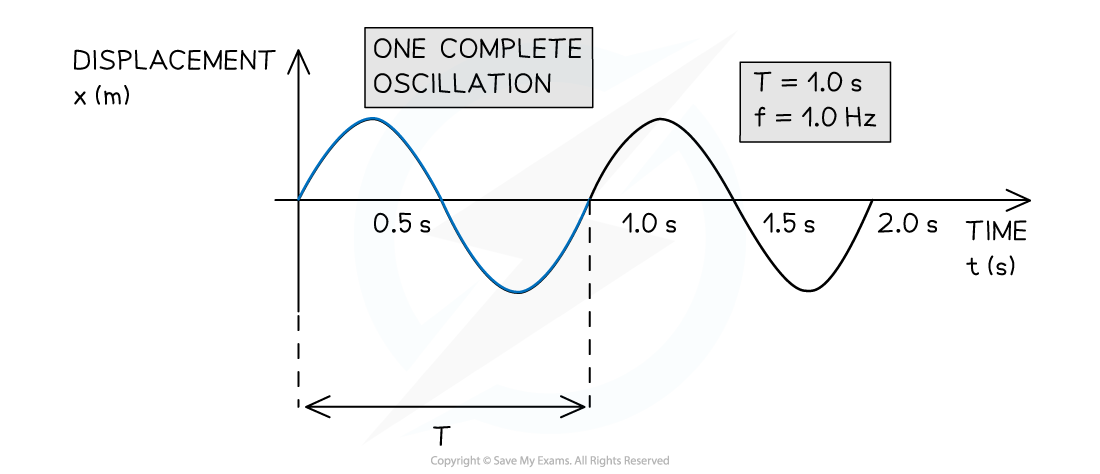
Period T and frequency f of a travelling wave
Worked Example
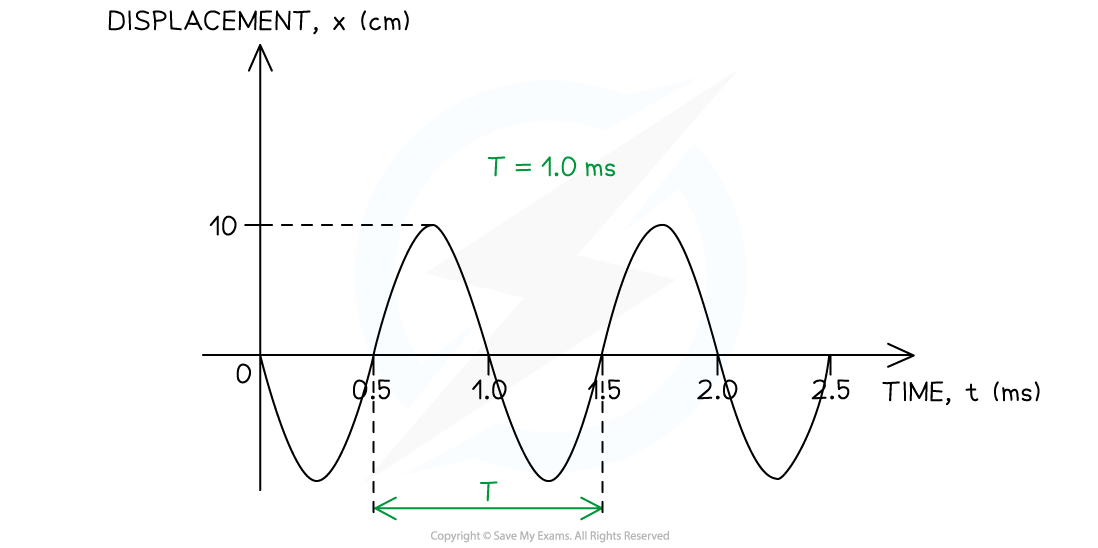
The graph below shows a travelling wave.
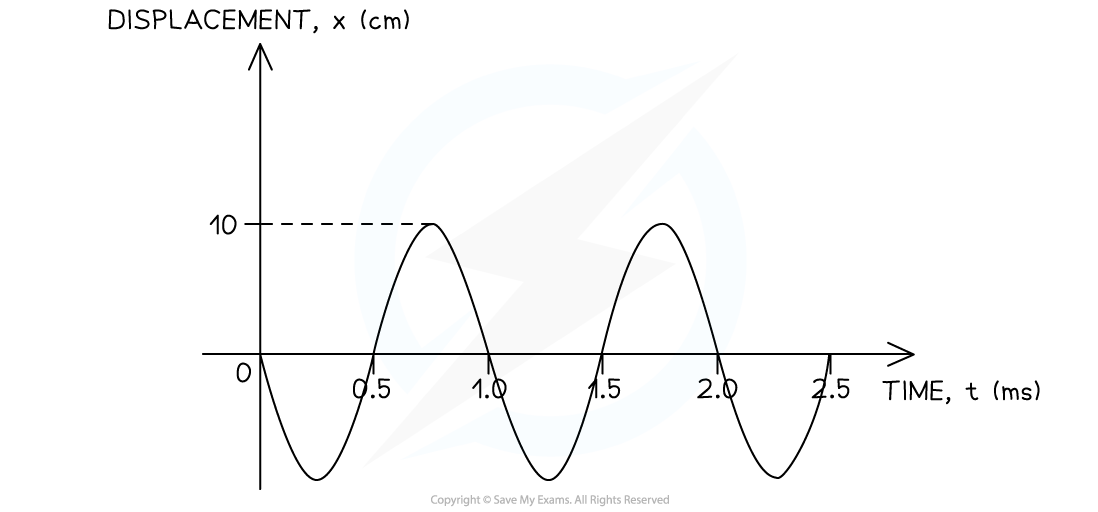
Determine:
(i) The amplitude?A?of the wave in metres (m)
(ii) The frequency f of the wave in hertz (Hz)
(i) Identify the amplitude?A?of the wave on the graph
-
- The amplitude is defined as the maximum displacement from the equilibrium position (x?= 0)
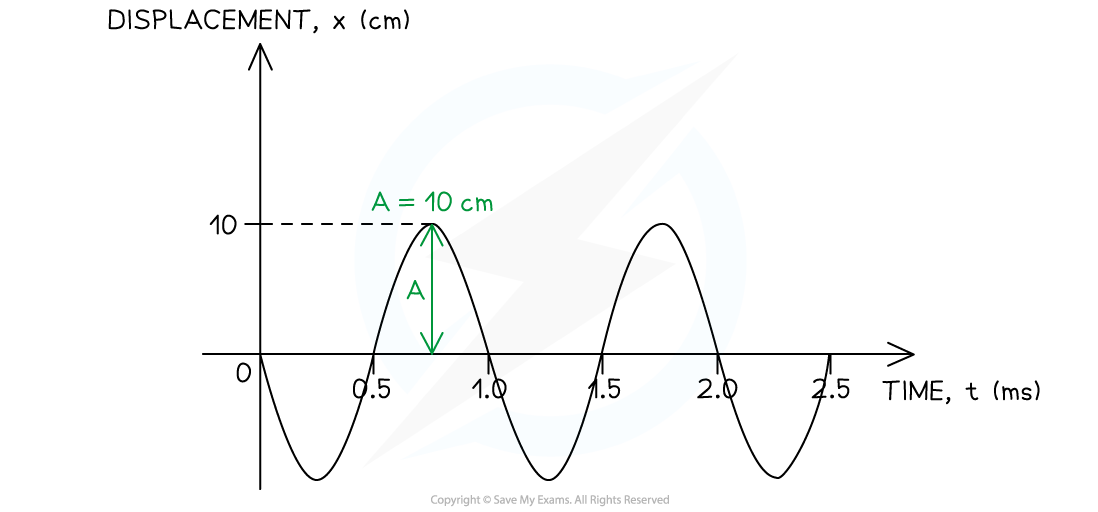
-
- The amplitude must be converted from centimetres (cm) into metres (m)
(ii) Calculate the frequency of the wave
Step 1: Identify the period?T?of the wave on the graph
-
- The period is defined as the time taken for one complete oscillation to occur
-
- The period must be converted from milliseconds (ms) into seconds (s)
T?= 1 × 10⁻³ s
Step 2: Write down the relationship between the frequency?f?and the period?T

Step 3: Substitute the value of the period determined in Step 1

f?= 1000 Hz
The Wave Equation
- The wave equation describes the relationship between the wave speed, the wavelength and the frequency of the wave
c = fλ
- Where
- c?= wave speed in metres per second (m s?1)
- f?= frequency in hertz (Hz)
- λ?= wavelength in metres (m)
Deriving the Wave Equation
- The wave equation can be derived using the equation for speed
 Where
Where
- v?= velocity or speed in metres per second (m s?1)
- d?= distance travelled in metres (m)
- t?= time taken in seconds (s)
- When the source of a wave undergoes one complete oscillation, the travelling wave propagates forward by a?distance?equal to one wavelength?λ
- The travelling wave covers this distance in the?time?it takes the source to complete one oscillation, the time period?T
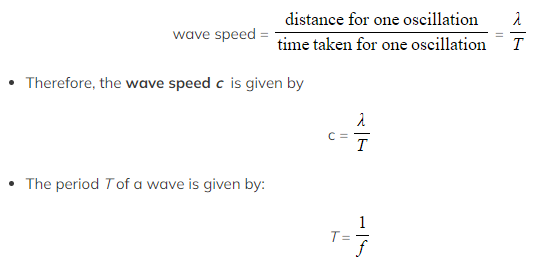 Therefore, combining these equations gives the wave equation
c = fλ
Worked Example
A travelling wave has a period of 1.0 μs and travels at a velocity of 100 cm s–1. Calculate the wavelength of the wave. Give your answer in metres (m).
Step 1: Write down the known quantities
-
- Period,?T?= 1.0 μs = 1.0 × 10⁻⁶?s
- Velocity,?c?= 100 cm s–1?= 1.0 m s–1
Note the conversions:
-
- The period must be converted from microseconds (μs) into seconds (s)
- The velocity must be converted from cm s–1?into?m s–1
Step 2: Write down the relationship between the frequency?f?and the period?T
Step 3: Substitute the value of the period into the above equation to calculate the frequency

f?= 1.0 × 10⁶?Hz
Step 4: Write down the wave equation
c = fλ
Step 5: Rearrange the wave equation to calculate the wavelength?λ

Step 6: Substitute the numbers into the above equation

λ?= 1 × 10⁻⁶?m
轉載自savemyexams
以上就是關于【IB DP Physics: SL復習筆記4.2.1 Properties of Waves】的解答,如需了解學校/賽事/課程動態,可至翰林教育官網獲取更多信息。
往期文章閱讀推薦:
翰林獨家 | 經濟學競賽核心精講,一冊打通NEC/IEO/USAEBO!
2026 AMC10/12美國數學競賽新賽季!【翰林教育 × 清華大學出版社】獨家教材全面發售!


翰林AMC8視頻課重磅上線!

國際競賽真題資源免費領取






