IB DP Chemistry: HL復習筆記4.1.5 Bond Polarity

Bond Polarity
- When two atoms in a covalent bond have the?same electronegativity?the covalent bond is?nonpolar
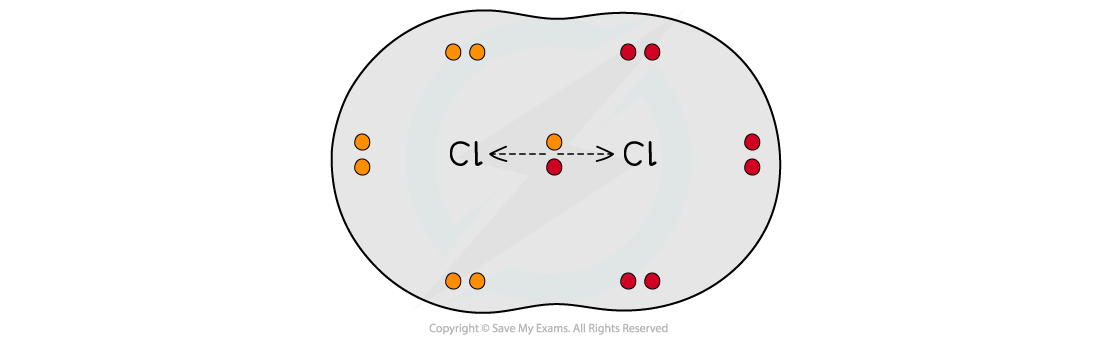
The two chlorine atoms have identical electronegativities so the bonding electrons are shared equally between the two atoms
- When two atoms in a covalent bond have?different electronegativities?the covalent bond is?polar?and the electrons will be drawn towards the?more electronegative?atom
- As a result of this:
- The negative charge centre and positive charge centre do not?coincide?with each other
- This means that the?electron distribution?is?asymmetric
- The?less?electronegative?atom gets a partial charge of?δ+?(delta?positive)
- The?more?electronegative?atom gets a partial charge of?δ-?(delta?negative)
- The greater the difference in?electronegativity?the more polar the bond becomes
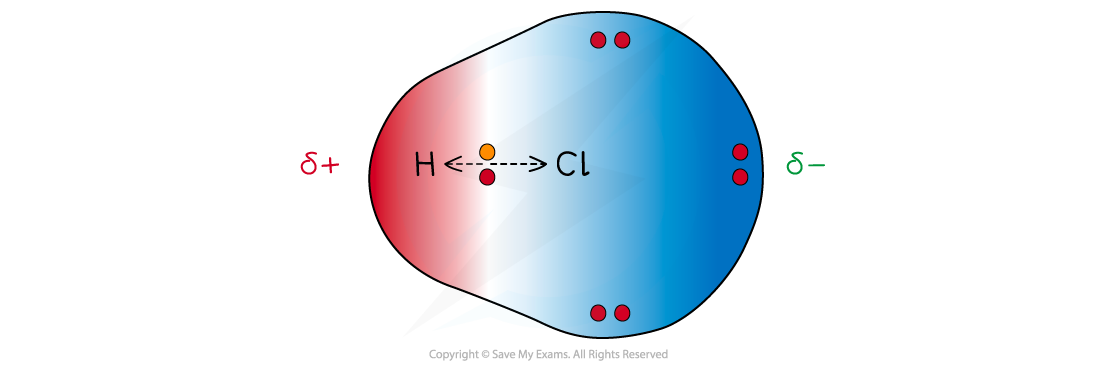
Cl has a greater electronegativity than H causing the electrons to be more attracted towards the Cl atom which becomes delta negative and the H delta positive
Dipole moment
- The?dipole moment?is a measure of how?polar?a bond is
- The?direction?of the dipole moment is shown by the following sign in which the?arrow?points to the?partially negatively charged end?of the dipole:

The sign shows the direction of the dipole moment and the arrow points to the delta negative end of the dipole
Worked Example
The electronegativity values of four elements are given.
C = 2.6? ? ? ? N = 3.0? ? ? ?O = 3.4? ? ? ?F = 4.0
What is the order of?increasing?polarity of the?bonds in the following compounds?A. CO < OF2?< NO < CF4
B. NO < OF2?< CO < CF4
C. CF4?< CO < OF2?< NO
D. CF4?< NO < OF2?< CO
Answer:
The correct option is?B.
-
- You have to calculate the difference in electronegativity for the bonds and then rank them from smallest to largest:
NO? (3.4 - 3.0 =?0.4)
OF2?(4.0 - 3.4 =?0.6)
CO? ?(3.4 - 2.6 =?0.8)
CF4? (4.0 - 2.6 =?1.4)
轉載自savemyexams
以上就是關于【IB DP Chemistry: HL復習筆記4.1.5 Bond Polarity】的解答,如需了解學校/賽事/課程動態,可至翰林教育官網獲取更多信息。
往期文章閱讀推薦:
翰林獨家 | 經濟學競賽核心精講,一冊打通NEC/IEO/USAEBO!
2026 AMC10/12美國數學競賽新賽季!【翰林教育 × 清華大學出版社】獨家教材全面發售!


翰林AMC8視頻課重磅上線!

國際競賽真題資源免費領取






