IB DP Maths: AA HL復習筆記1.8.3 Introduction to Argand Diagrams

What is the complex plane?
- The complex plane, sometimes also known as the Argand plane, is a two-dimensional plane on which complex numbers can be represented geometrically
- It is similar to a two-dimensional Cartesian coordinate grid
- The?x-axis is known as the?real?axis (Re)
- ?The?y-axis is known as the?imaginary?axis (Im)
- The complex plane emphasises the fact that a complex number is two dimensional
- i.e it has two parts, a real and imaginary part
- Whereas a real number only has one dimension represented on a number line (the?x-axis only)
What is an Argand diagram?
- An Argand diagram is a geometrical representation of complex numbers on a?complex plane
- A complex number can be represented as either a point or a vector
- The complex number?x?+?yi is represented by the point with cartesian coordinate (x, y)
- The?real?part is represented by the point on the?real?(x-)?axis
- The?imaginary?part is represented by the point on the?imaginary?(y-)?axis
- Complex numbers are often represented as?vectors
- A line segment is drawn from the origin to the cartesian coordinate point
- An arrow is added in the direction away from the origin
- This allows for geometrical representations of complex numbers
Exam Tip
- When setting up an Argand diagram you do not need to draw fully scaled axes, you only need the essential information for the points you want to show, this will save a lot of time
Worked Example
a)? ? ?Plot the complex numbers?z1??= 2 + 2i?and?z2?= 3 – 4i as points on an Argand diagram.
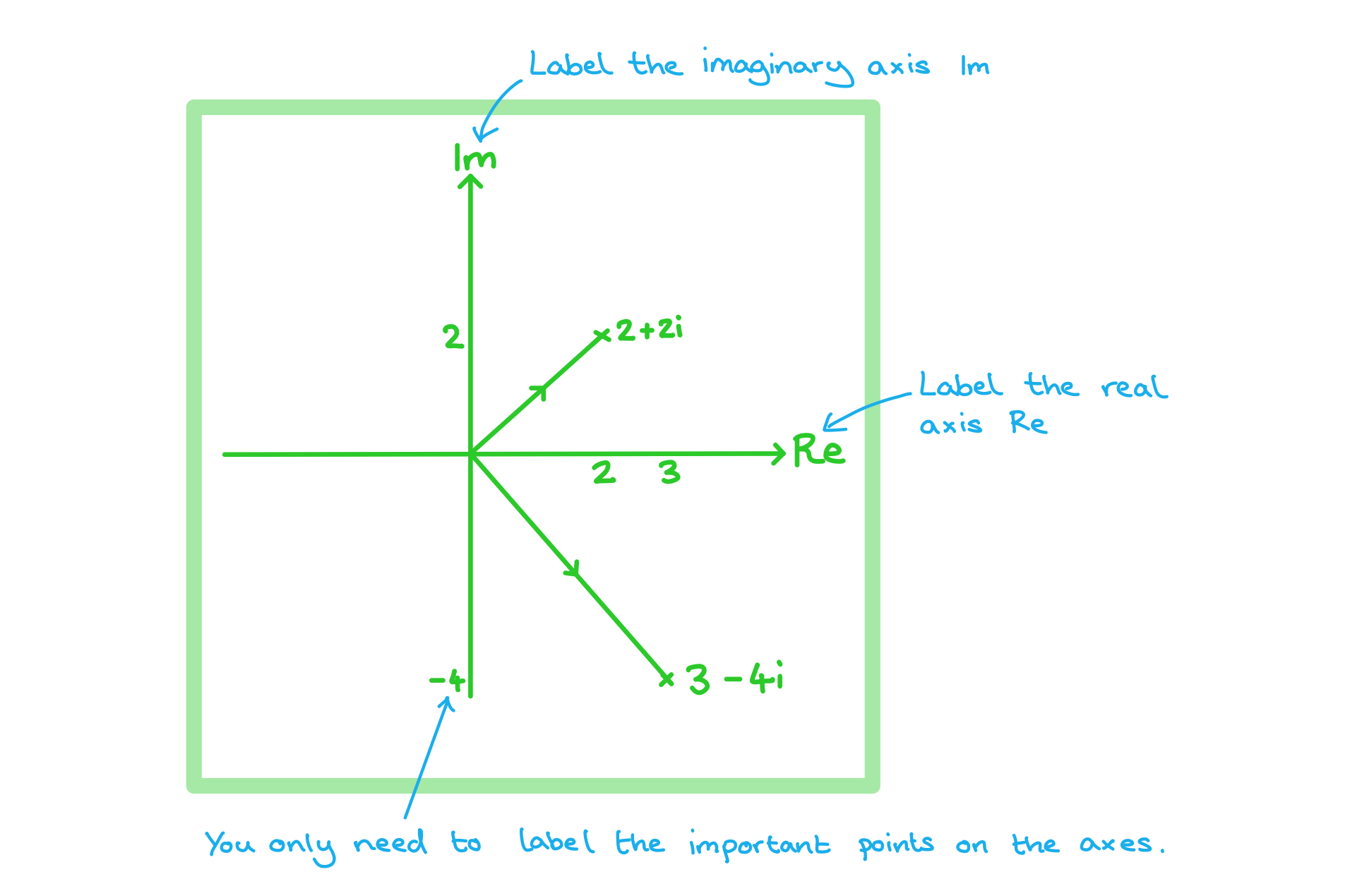
b)? ? ?Write down the complex numbers represented by the points A and B on the Argand diagram below.

轉載自savemyexams
以上就是關于【IB DP Maths: AA HL復習筆記1.8.3 Introduction to Argand Diagrams】的解答,如需了解學校/賽事/課程動態,可至翰林教育官網獲取更多信息。
往期文章閱讀推薦:
翰林獨家 | 經濟學競賽核心精講,一冊打通NEC/IEO/USAEBO!
2026 AMC10/12美國數學競賽新賽季!【翰林教育 × 清華大學出版社】獨家教材全面發售!


翰林AMC8視頻課重磅上線!

國際競賽真題資源免費領取






