AQA A Level Physics復習筆記5.1.1 Basics of Electricity

Electric Current & Potential Difference
Electric Current
- Electric current is defined as?the rate of flow of positive charge?carriers
- It is measured in units of?amperes (A)?or?amps
- The charge, current and time are related by the equation:

- Charge is sometimes written as ΔQ?which means 'change in charge'
- Similarly, time is written as Δt?means 'change in time'
- When two oppositely charged conductors are connected together (by a length of wire), charge will flow between the two conductors, causing a current
- Therefore, rearranging for current,?I?gives the equation:

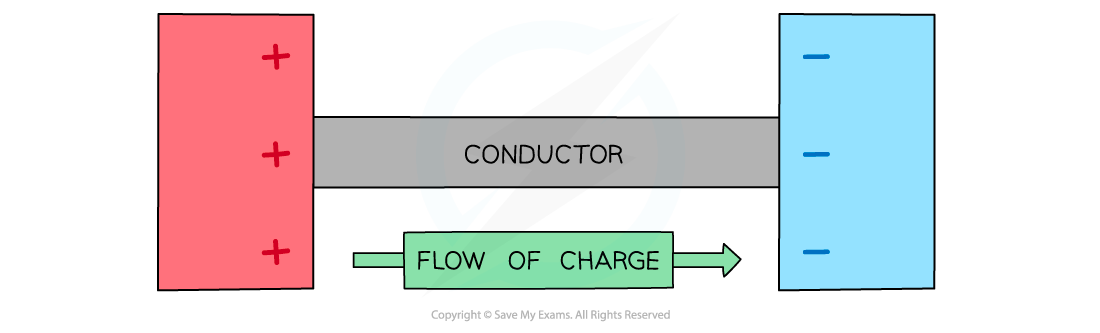
Charge can flow between two conductors. The direction of conventional current in a metal is from positive to negative
- In electrical wires, the current is a flow of?electrons
- Electrons are negatively charged; they flow away from the negative terminal of a cell towards the positive terminal
- Conventional current is defined as the flow of?positive?charge from the?positive terminal of a cell to the negative terminal
- This is the opposite to the direction of electron flow, as the conventional current was described before electric current was really understood

By definition, conventional current always goes from positive to negative (even through electrons go the other way)
- There are several examples of electric currents, including in household wiring and electrical appliances
- Current is measured using an?ammeter
- Ammeters should always be connected in?series?with the part of the circuit you wish to measure the current through

An ammeter can be used to measure the current around a circuit and is always connected in series
Potential Difference
- A cell makes one end of the circuit positive and the other negative
- This sets up a?potential difference?across the circuit
- This is sometimes known as the?voltage
- The potential difference is defined as?the work done per unit charge?and is measured in units of?volts (V)
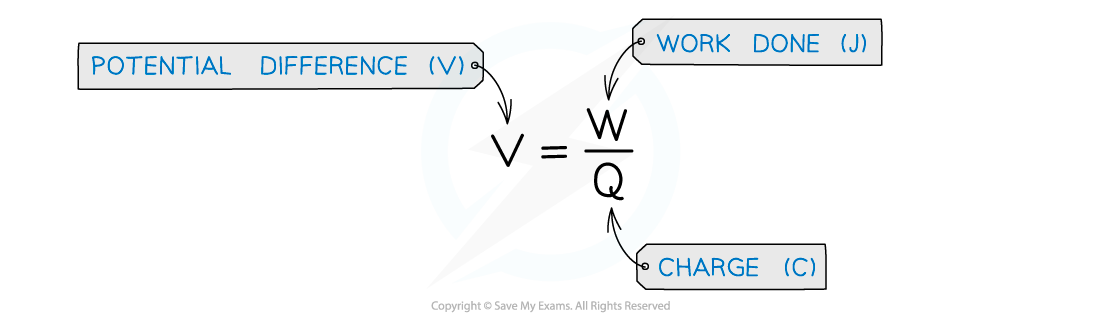
- Potential difference (or voltage) is measured using a?voltmeter
- A voltmeter is always set up in parallel to the component you are measuring the voltage for
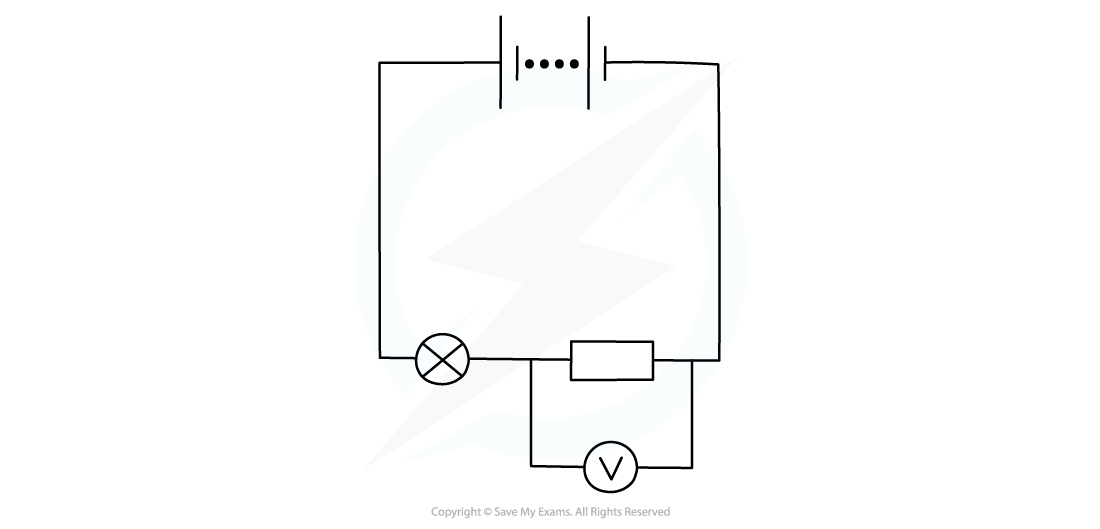
Potential difference can be measured by connecting a voltmeter in parallel between two points in a circuit
Worked Example
When will 8 mA of current pass through an electrical circuit?
A.? ? ?When 1 J of energy is used by 1 C of charge
B.? ? ?When a charge of 4 C passes in 500 s
C.? ? ?When a charge of 8 C passes in 100 s
D.? ? ?When a charge of 1 C passes in 8 s
ANSWER:? ?B
Step 1: Write out the equation relating current, charge and time
Q?=?It
Step 2: Rule out any obviously incorrect options
-
- Option?A does not contain charge or time, so can be ruled out
Step 3: Try the rest of the options to determine the correct answer
-
- Consider option?B:
I?= 4 / 500 = 8 × 10⁻³?= 8 mA
-
- Consider option?C:
I?= 8 / 100 = 80 × 10–3?= 80 mA
-
- Consider option?D:
I?= 1 / 8 = 125 × 10–3?= 125 mA
-
- Therefore, the correct answer is?B
Exam Tip
Although electric charge can be positive or negative, since the conventional direction of current is the flow of?positive?charge the current should always be a positive value for your exam answers. Think of potential difference as being the?energy per coulomb?of charge transferred between two points in a circuit
Resistance
- Resistance is defined as the?opposition?to current
- For a given potential difference:?The higher the resistance the lower the current
- Wires are often made from copper because copper has a?low?electrical resistance. This is also known as a?good conductor
- The resistance?R?of a conductor is defined as the ratio of the potential difference?V?across to the current?I?in it
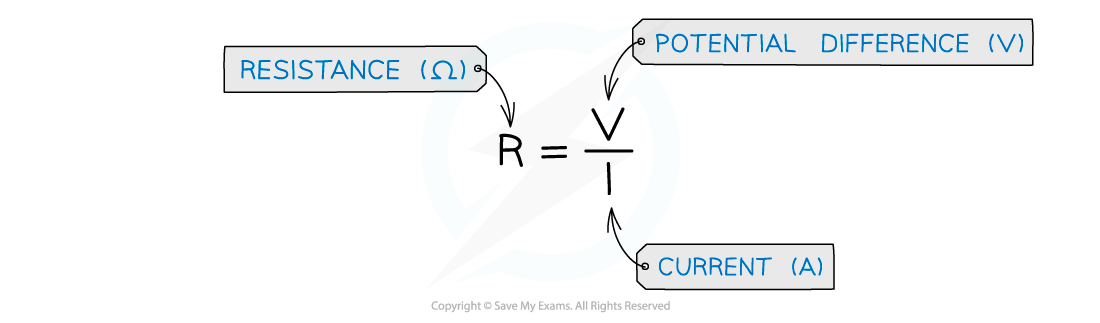
Resistance of a component is the ratio of the potential difference and current
- Resistance is measured in?Ohms (Ω)
- An Ohm is defined as?one volt per ampere
- The resistance controls the size of the current in a circuit
- A?higher?resistance means a?smaller?current
- A?lower?resistance means a?larger?current
- All electrical components, including wires, have some value of resistance
Exam Tip
Although all electrical components have resistance, the resistance of wires is taken to be?zero?in exam questions.
轉載自savemyexams
以上就是關于【AQA A Level Physics復習筆記5.1.1 Basics of Electricity】的解答,如需了解學校/賽事/課程動態,可至翰林教育官網獲取更多信息。
往期文章閱讀推薦:
翰林獨家 | 經濟學競賽核心精講,一冊打通NEC/IEO/USAEBO!
2026 ALEVEL 夏考A率出爐!愛德思vs牛津AQA,哪些科目真的“好出分”?


翰林AMC8視頻課重磅上線!

國際競賽真題資源免費領取






