AQA A Level Chemistry復(fù)習(xí)筆記5.1.2 Born-Haber Cycles

Constructing Born-Haber Cycles
- A?Born-Haber cycle?is a specific application of?Hess's Law?for ionic compounds and enable us to calculate lattice enthalpy which cannot be found by experiment
- The basic principle of drawing the cycle is to construct a diagram in which energy increases going up the diagram
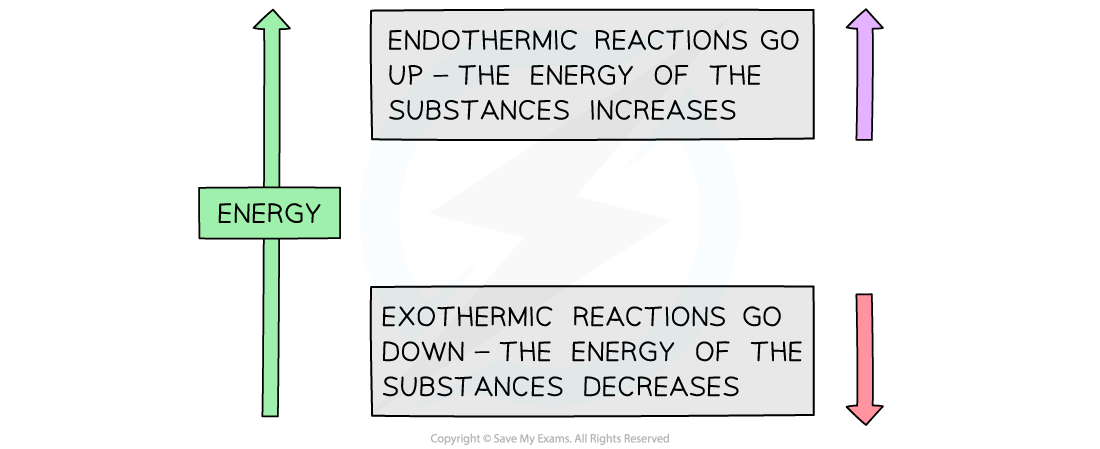
The basic principle of a Born-Haber cycle
- The cycle shows all the steps needed to turn atoms into gaseous ions and from gaseous ions into the ionic lattice
- The alternative route to the ionic lattice begins from the enthalpy of formation of the elements in their standard states
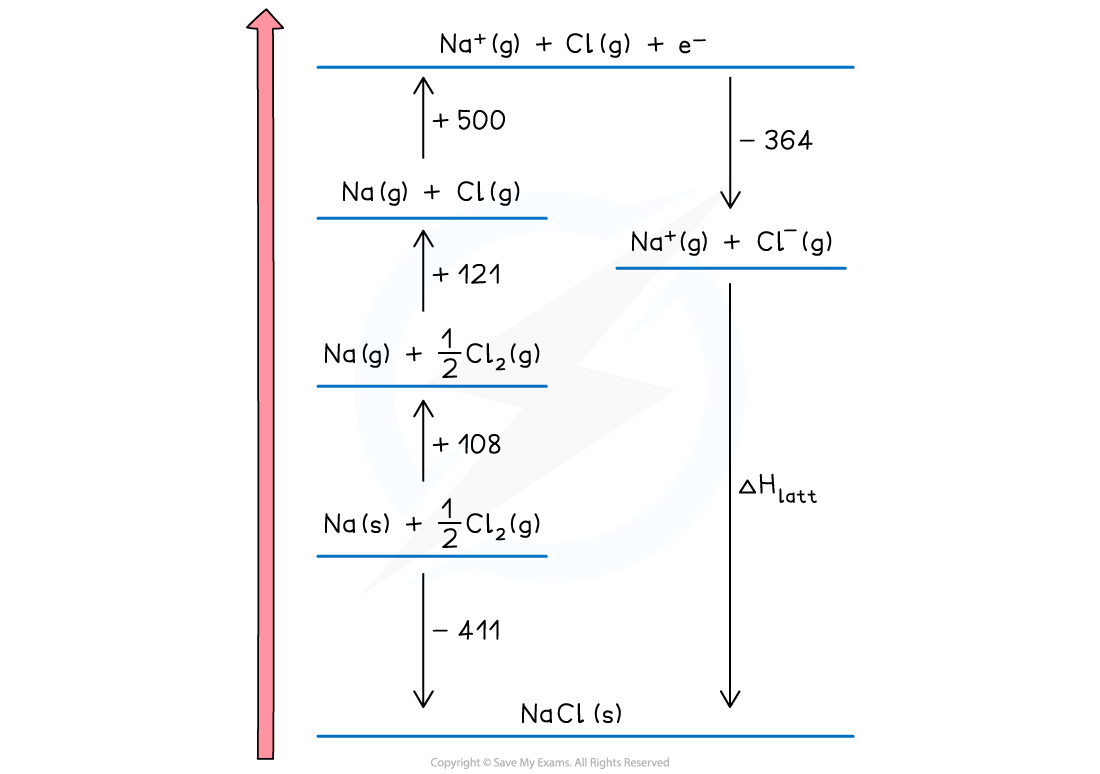
Drawing the cycle for sodium chloride
- A good starting point is to draw the elements with their state symbols about a third of the way up the diagram
- This is shown as the left hand side of the equation for the process indicated
- The location is marked by drawing a horizontal bar or line which represents the starting energy level
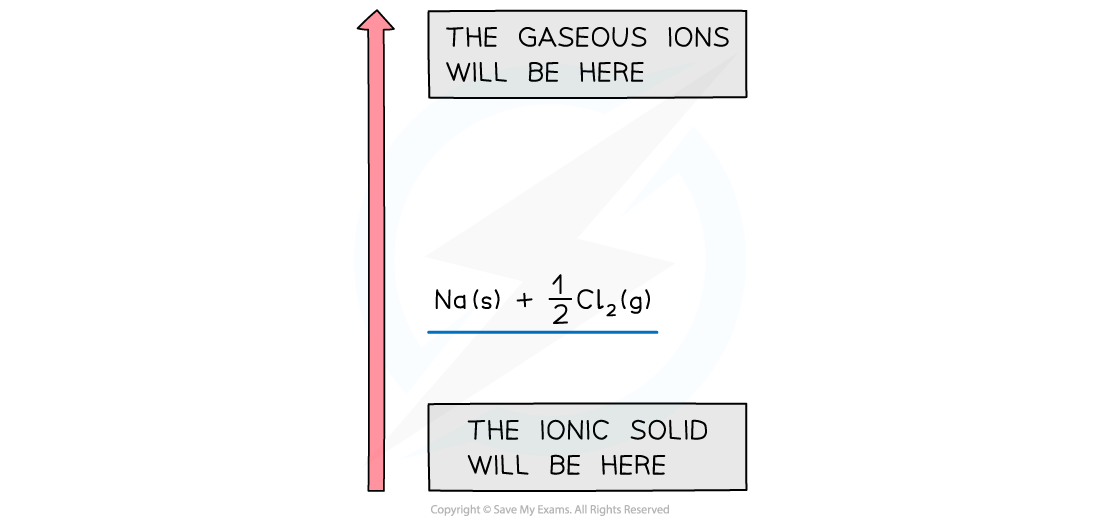
Drawing a Born-Haber cycle step 1
- Next, we need to create the gaseous ions
- This is a two step process of first creating the gaseous atoms and then turning them into ions
- Creating gaseous atoms is a bond breaking process, so arrows must be drawn upwards
- It doesn't matter whether you start with sodium or chlorine
- The enthalpy of atomisation of sodium is
Na (s) → Na (g)? ? ? ? ? ?ΔHat??= +108 kJ mol?-1
- The enthalpy of atomisation of chlorine is
?Cl2?(g) → Cl?(g)? ? ? ?ΔHat??= +121 kJ mol?-1
- We can show the products of the process on the horizontal lines and the energy value against a vertical arrow connecting the energy levels
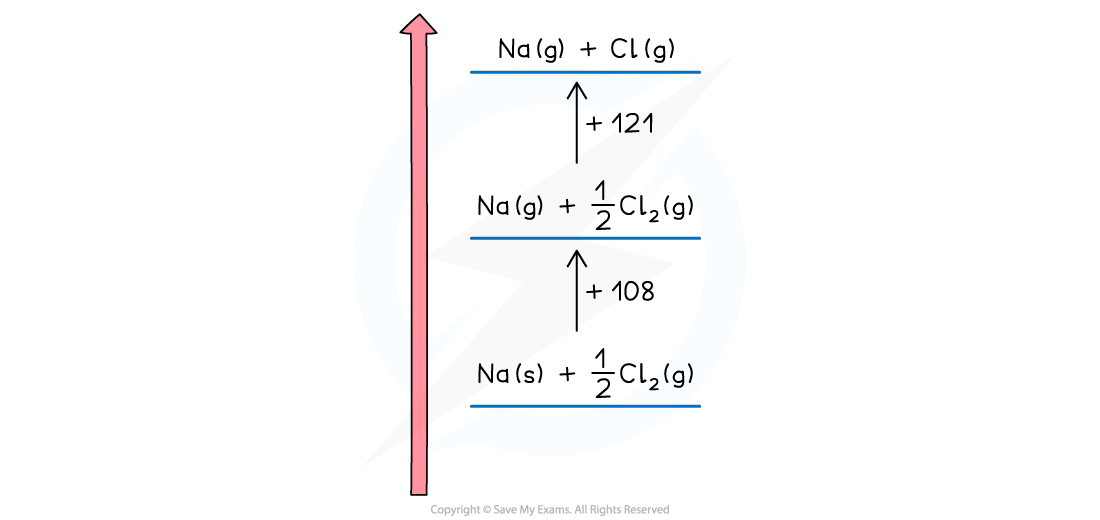
Drawing a Born-Haber cycle step 2 - creating the gaseous atoms
- Now the ions are created
- The sodium ion loses an electron, so this energy change is the first ionisation energy for sodium
Na (g) → Na+?(g) + e–? ? ? ? ??ΔHie??= +500 kJ mol-1
- The change is endothermic so the direction continues upwards
- The chlorine atom gains an electron, so this is electron affinity
Cl?(g)?+ e–?→ Cl-?(g)? ? ? ? ? ?ΔHea??= -364 kJ mol-1
- The exothermic change means this is downwards
- The change is displaced to the right to make the diagram easier to read
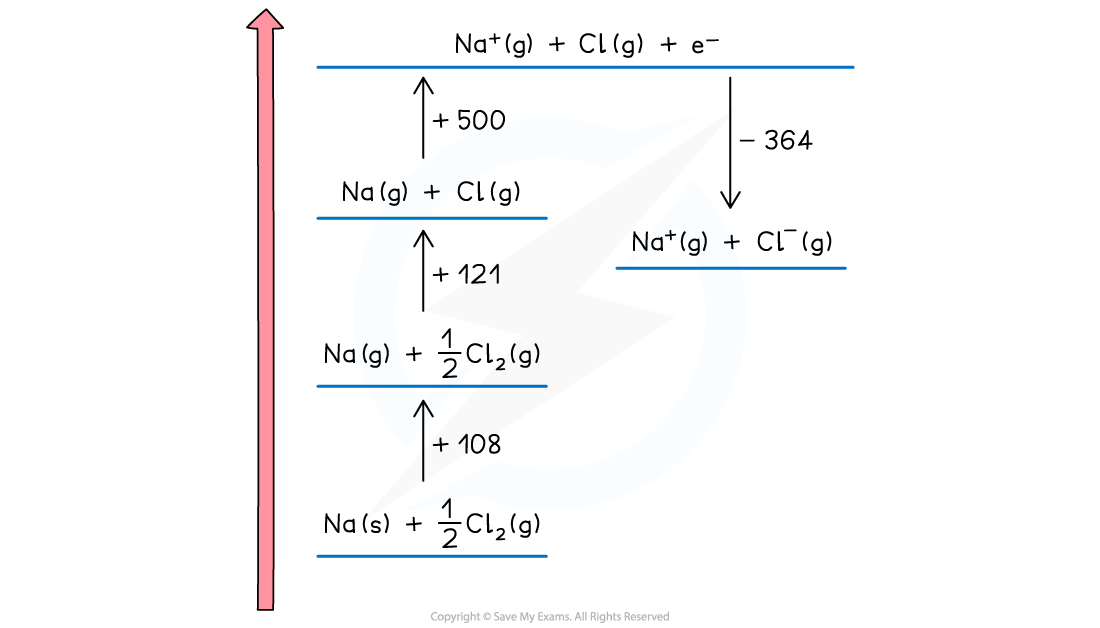
Drawing a Born-Haber cycle step 3 - creating the gaseous ions
- The two remaining parts of the cycle can now be completed
- The enthalpy of formation of sodium chloride is added at the bottom of the diagram
Na(s) +??Cl2?(g)?→ NaCl?(s)? ? ? ? ? ? ΔHf??= -411 kJ mol?-1
- This is an exothermic change for sodium chloride so the arrow points downwards
- Enthalpy of formation can be exothermic or endothermic, so you may need to show it above the elements ( and displaced to the right) for a endothermic change
- The final change is lattice enthalpy, which is usually shown a formation. For sodium chloride the equation is
Na+(g) + Cl-(g) → NaCl?(s)? ΔHlatt?
Drawing a Born-Haber cycle step 4 - completing the cycle
- The cycle is now complete
- The cycle is usually used to calculate the lattice enthalpy of an ionic solid, but can be used to find other enthalpy changes if you are given the lattice enthalpy
Worked Example
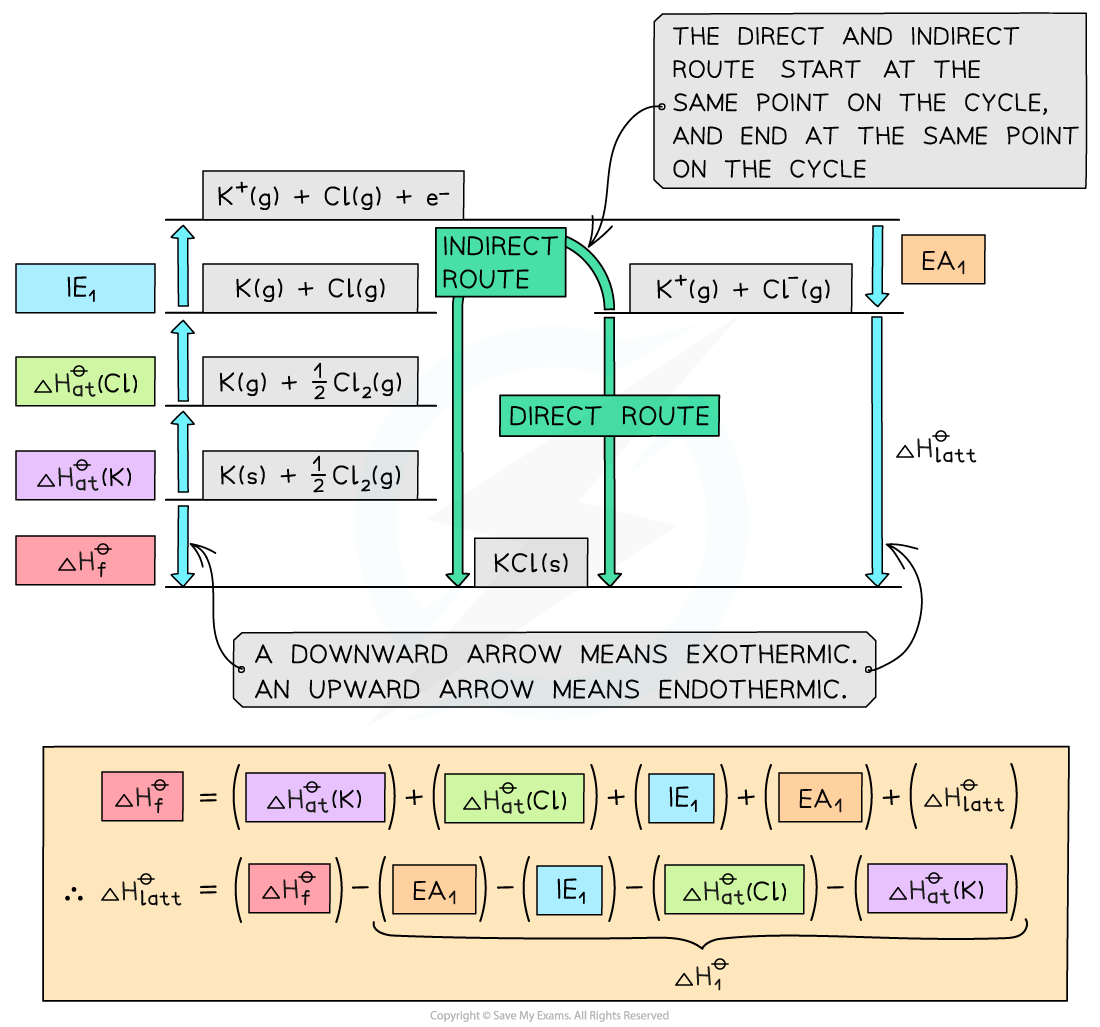
Constructing a Born-Haber cycle for KClConstruct a Born-Haber Cycle which can be used to calculate the lattice energy of potassium chloride.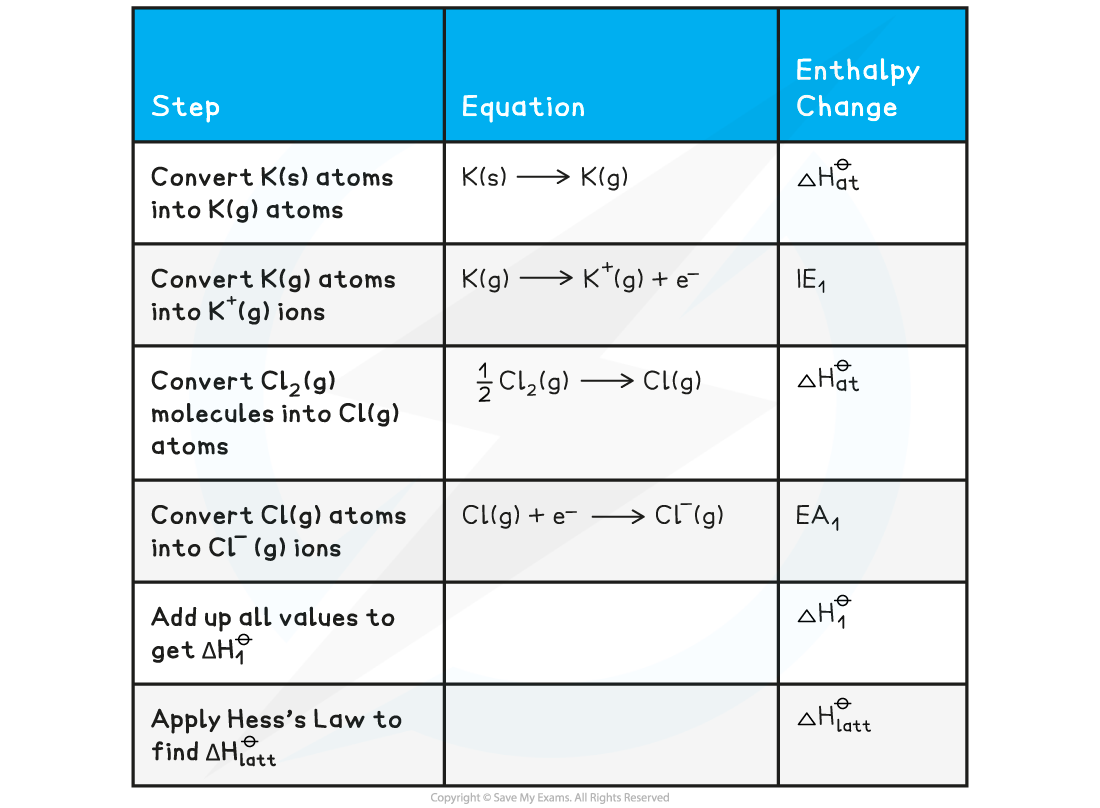
Answer
Worked Example
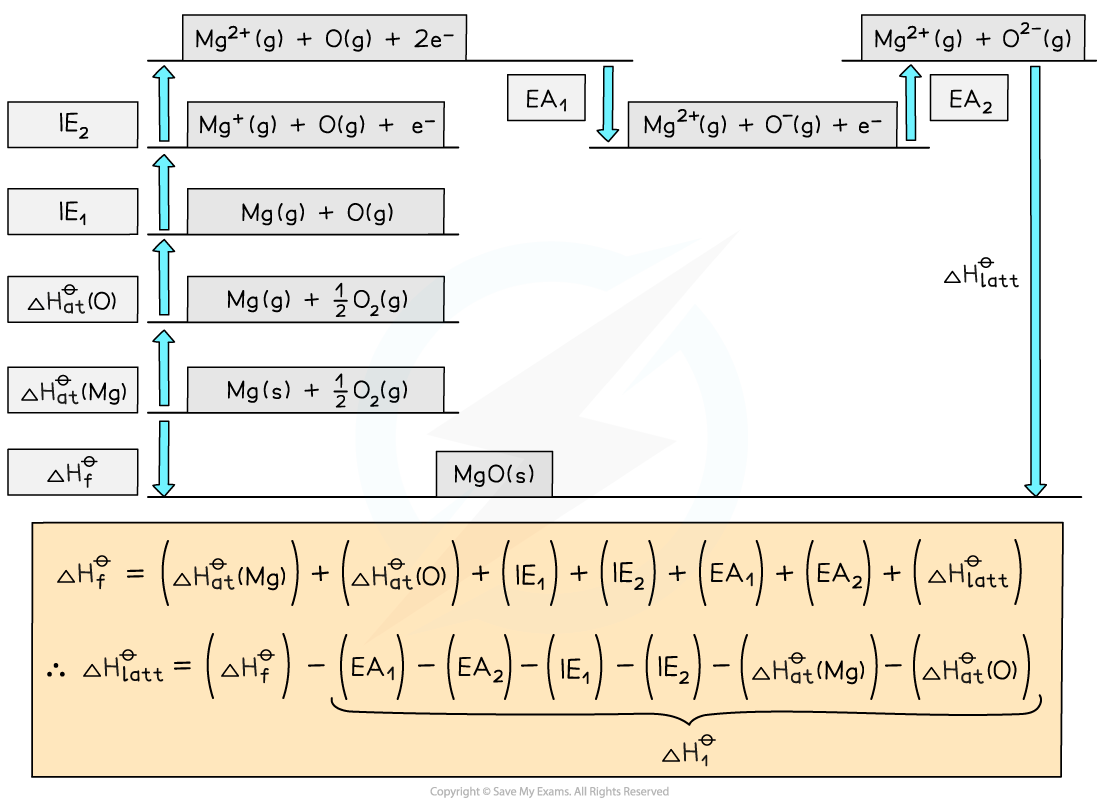
Constructing a Born-Haber cycle for MgOConstruct a Born-Haber Cycle which can be used to calculate the lattice energy of magnesium oxide.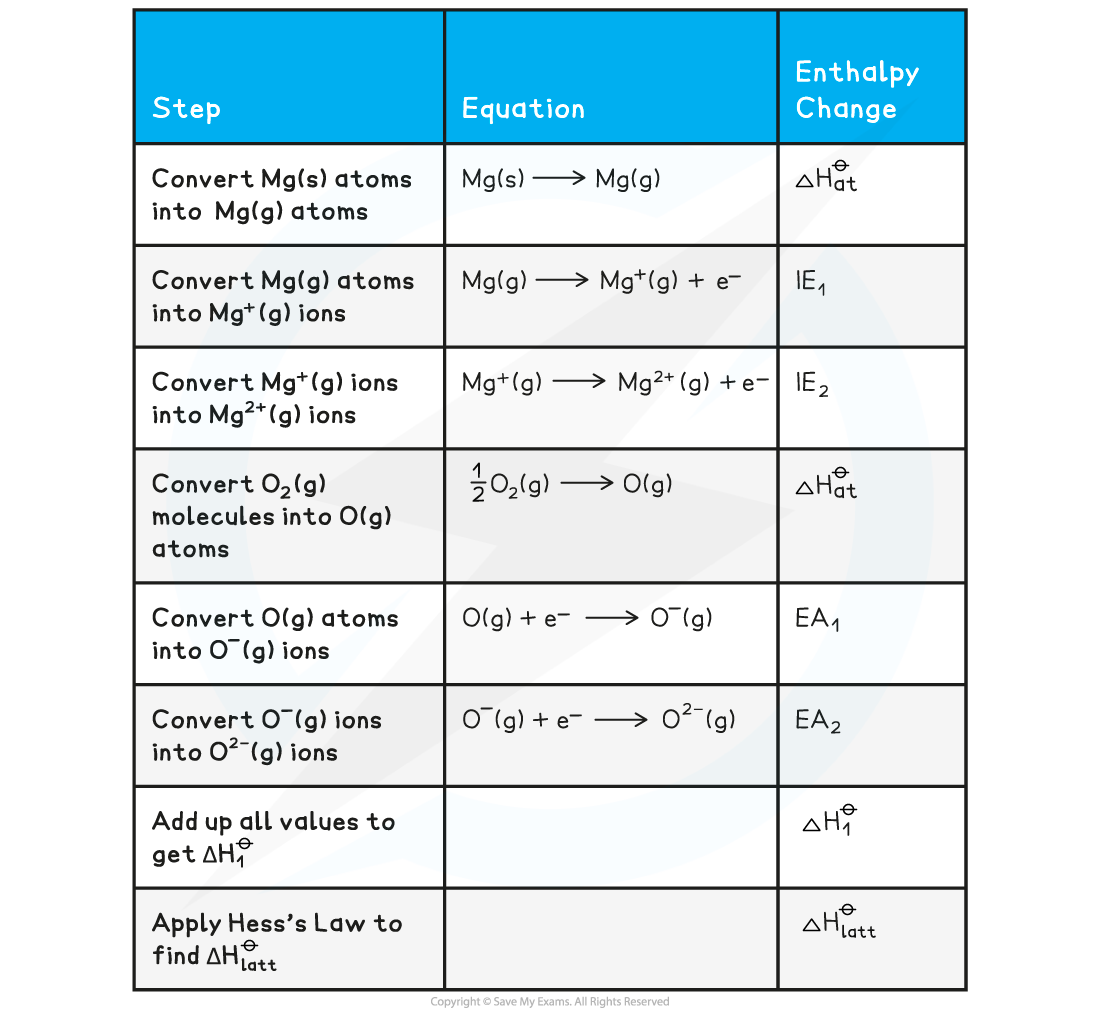
Answer
Exam Tip
When constructing Born-Haber cycles, the direction of the changes is important, but the relative size of the steps does not matter so don't worry if the steps don't correspond to the magnitude of the energy changes.You don't need to show the energy axis in a Born-Haber cycle, but you do need to show the electron(s) in the ionisation step otherwise you might lose marks in an exam.
轉(zhuǎn)載自savemyexams
以上就是關(guān)于【AQA A Level Chemistry復(fù)習(xí)筆記5.1.2 Born-Haber Cycles】的解答,如需了解學(xué)校/賽事/課程動(dòng)態(tài),可至翰林教育官網(wǎng)獲取更多信息。
往期文章閱讀推薦:
翰林獨(dú)家 | 經(jīng)濟(jì)學(xué)競賽核心精講,一冊(cè)打通NEC/IEO/USAEBO!
2026 ALEVEL 夏考A率出爐!愛德思vs牛津AQA,哪些科目真的“好出分”?


翰林AMC8視頻課重磅上線!

國際競賽真題資源免費(fèi)領(lǐng)取






