AQA A Level Biology復(fù)習(xí)筆記7.3.4 Types of Selection

Types of Selection & Their Effects
- Environmental factors that affect the chance of survival of an organism are referred to as?selection pressures
- For example, there could be high levels of competition for food between lions if there is not plentiful prey available; this environmental factor ‘selects’ for faster, more powerful lions that are better hunters
- These selection pressures can have different effects on the?allele frequencies?of a population through?natural selection
- There are three types of selection:
- Stabilising?selection
- Disruptive?selection
- Directional?selection
Stabilising selection
- Stabilising?selection is natural selection that keeps allele frequencies relatively?constant?over generations
- This means things stay as they are unless there is a change in the environment
- A classic example of stabilising selection can be seen in human birth weights
- Very-low and very-high birth weights are selected against leading to the?maintenance of the intermediate?birth weights
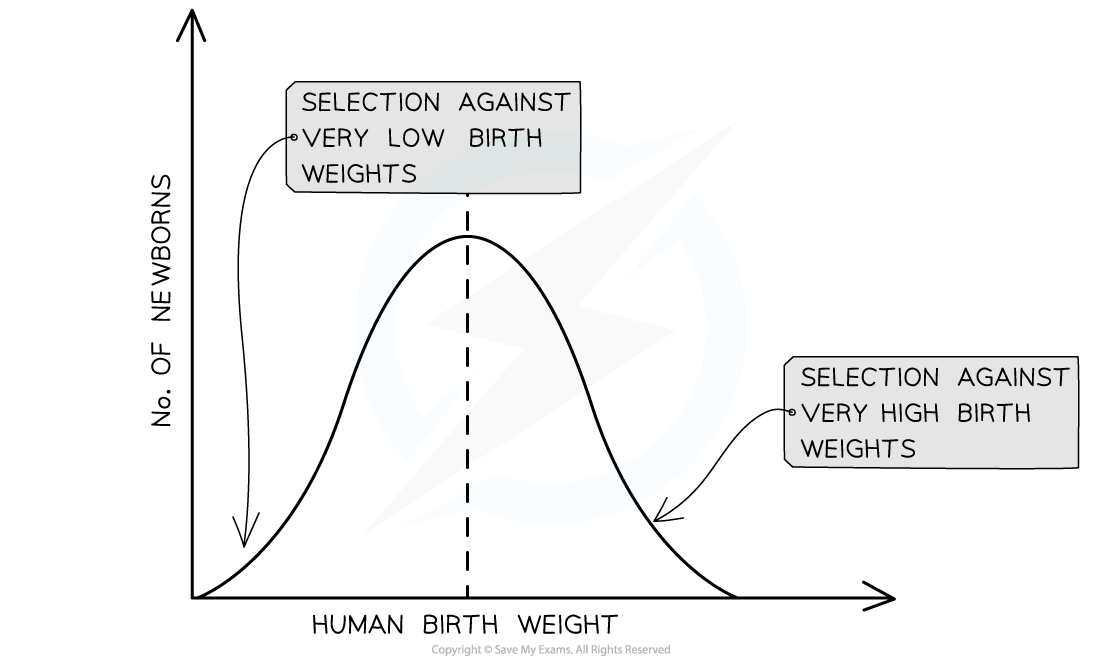
Stabilising selection on human birth weight
Directional selection
- Directional?selection is natural selection that produces a?gradual change?in allele frequencies over several generations
- This usually happens when there is a?change in environment?/ selection pressures or a?new allele?has appeared in the population that is advantageous
- For example: A recent finding has shown that climate change is having an effect on fish size in certain habitats
- The increase in temperature is?selecting for a smaller body size?and against a larger body size
- Warmer seas cause fish metabolism to speed up and so increases their need for?oxygen; oxygen levels are lower in warmer seas
- Larger fish have greater?metabolic?needs than smaller fish, and so they feel the effect of increased temperatures more strongly
- Organisms are?sensitive?to changes in?temperature?primarily because of the effect that temperature can have on?enzyme?activity
- Fish?with a?smaller?body size are therefore fitter and?better?adapted?to living in seas experiencing increased temperatures
- Fish body size is determined by both genetic and environmental factors
- Fish of a smaller size are?more likely?to reproduce and pass on their alleles to offspring
- Over?generations,?this leads to an?increase?in the?frequency?of?alleles?that produce a small body size and a decrease in the frequency of alleles that produce a larger body size
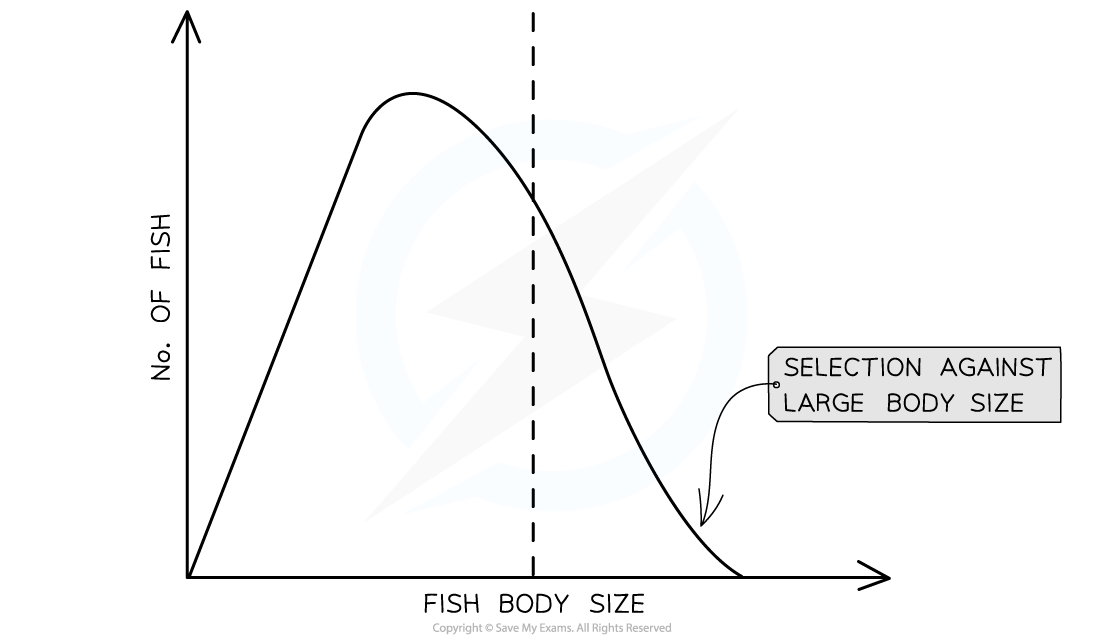
Directional selection acting on fish body size
Disruptive selection
- Disruptive?selection is natural selection that?maintains high frequencies of two different sets of alleles
- In other words, individuals with intermediate phenotypes or alleles are selected against
- Disruptive selection causes?polymorphism: the continued existence of two or more distinct phenotypes in species
- This can occur in an environment that shows?variation
- For example, birds that live on the Galapagos Islands use their beaks to forage for different sized seeds
- The size of the bird's beaks are either small or large with the intermediate medium-sized beak selected against
- The reason for this is that the different types of seed available are more efficiently foraged by a shorter or longer beak
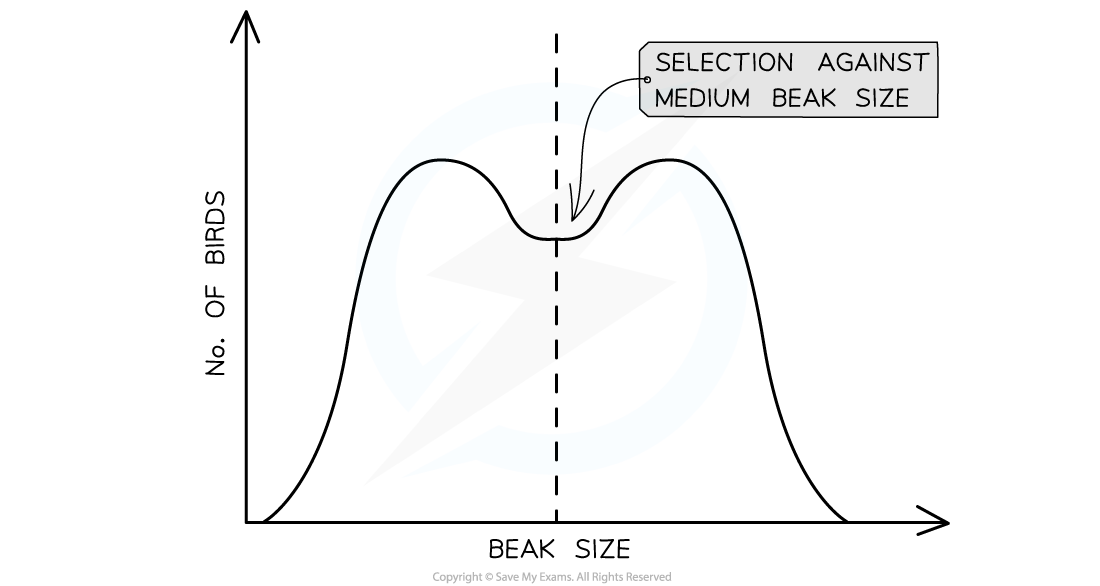
Disruptive selection acting on beak size in a bird population
Exam Tip
Become familiar with the shapes of the graphs above. They can help you answer questions about the type of selection that is occurring in a population. For example, you may be given a graph like one of those above and be asked to identify the type of selection that is occurring. Alternatively, an exam question could contain a description of the phenotypes in a population, including the relative frequencies of these phenotypes and how these are changing over time. From this, you should be able to identify the type of selection occurring.
轉(zhuǎn)載自savemyexams
以上就是關(guān)于【AQA A Level Biology復(fù)習(xí)筆記7.3.4 Types of Selection】的解答,如需了解學(xué)校/賽事/課程動(dòng)態(tài),可至翰林教育官網(wǎng)獲取更多信息。
往期文章閱讀推薦:
翰林獨(dú)家 | 經(jīng)濟(jì)學(xué)競(jìng)賽核心精講,一冊(cè)打通NEC/IEO/USAEBO!
2026 ALEVEL 夏考A率出爐!愛德思vs牛津AQA,哪些科目真的“好出分”?


翰林AMC8視頻課重磅上線!

國(guó)際競(jìng)賽真題資源免費(fèi)領(lǐng)取






