AQA A Level Biology復(fù)習(xí)筆記2.1.3 Specialisation of Eukaryotic Cells

Adaptations of Eukaryotic Cells
- In complex?multicellular?organisms,?eukaryotic?cells become?specialised?for?specific functions
- These specialised eukaryotic cells have?specific adaptations?to help them carry out their functions
- For example, the?structure of a cell?is adapted to help it carry out its function (this is why specialised eukaryotic cells can look extremely?different?from each other)
- Structural adaptations include:
- The?shape?of the cell
- The?organelles?the cell contains (or doesn’t contain)
- For example:
- Red blood cells are?biconcave?and?do not contain a nucleus.?This makes?more space?inside the cell so that they can transport as much?oxygen?as possible
- Cells that make large amounts of?proteins?will be adapted for this function by containing?many ribosomes?(the organelle responsible for protein production)
- Other examples include:
Neurones (nerve cells)
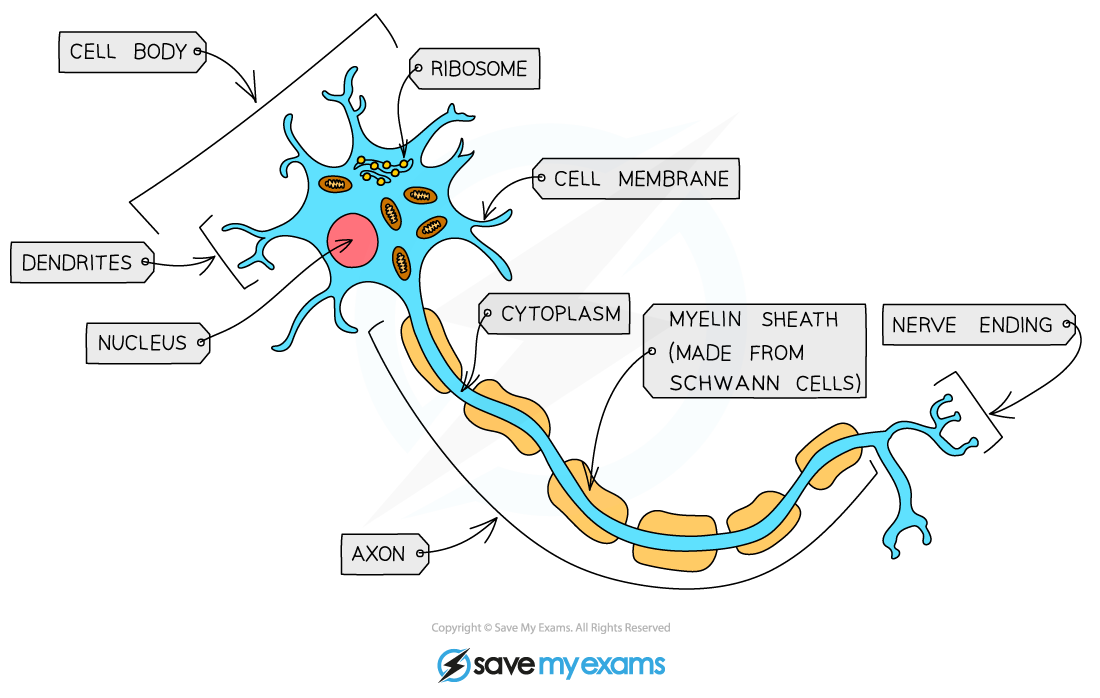
Nerve cells (neurones) have a characteristically elongated structure which allows them to coordinate information from the brain and spinal cord with the rest of the body
- Function: Conduction of impulses
- Adaptations:
- Has a?cell body?where most of the cellular structures are located and most protein synthesis occurs
- Extensions?of the cytoplasm from the cell body form dendrites (which receive signals) and axons (which transmit signals), allowing the neurone to?communicate?with other nerve cells, muscles and glands
- The axon (the main extension of cytoplasm away from the cell body) is covered with a fatty sheath, which?speeds up?nerve impulses. Axons can be up to 1m long in some animals and can therefore enable fast communication over long distances (from the brain all the way to the toes only using a few neurones!)
Muscle cells
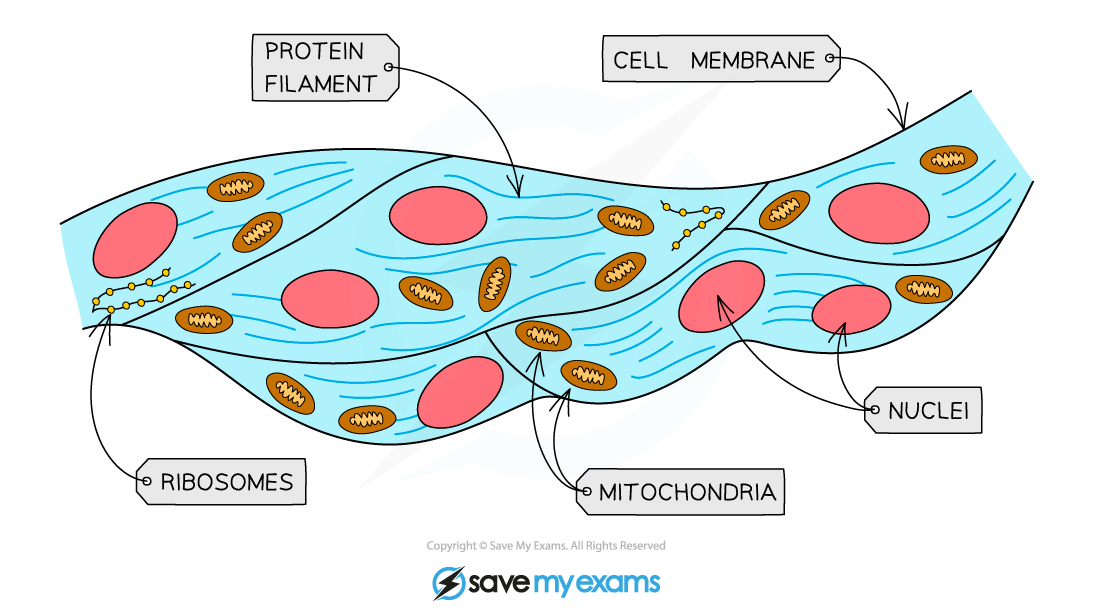
Muscle cells contain layers of fibres that allow them to contract. The image above shows skeletal muscle cells
- Function: Contraction for movement
- Adaptations:
- There are?three?different types of muscle in animals: skeletal, smooth and cardiac (heart)
- All muscle cells have?layers of protein filaments?in them, these layers can slide over each other causing muscle?contraction
- Muscle cells have a?high density of mitochondria?to provide sufficient energy (via respiration) for muscle contraction
- Skeletal muscle cells fuse together during development to form multinucleated cells that?contract in unison
Sperm cells
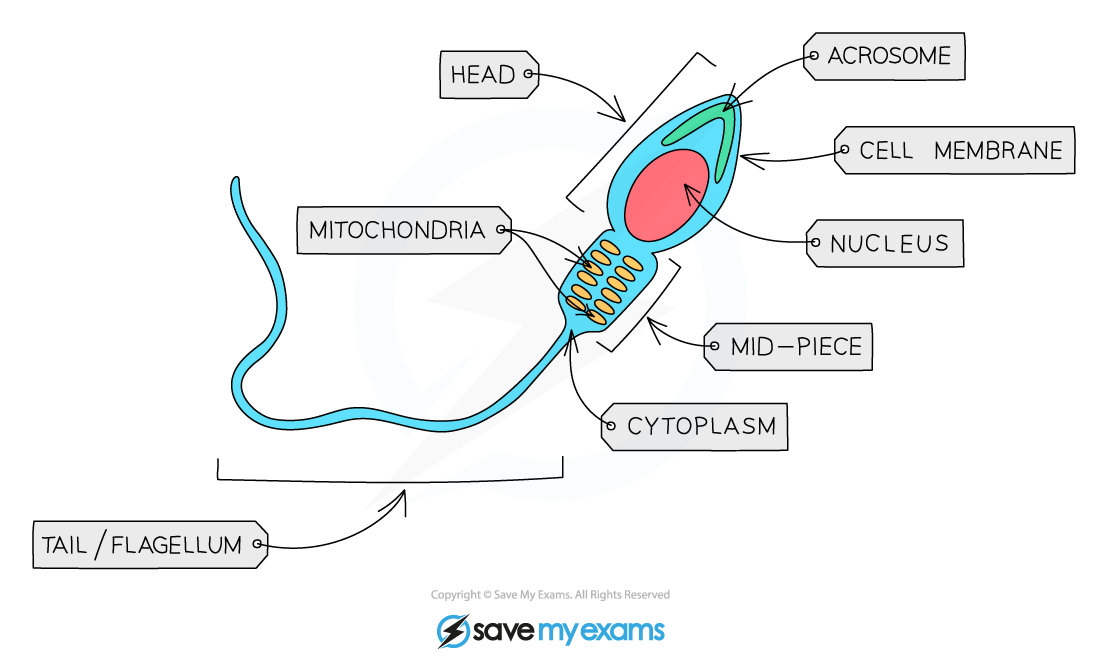
Sperm cells are motile – their tail helps propel them forward in search of an egg to fertilise.
- Function: Reproduction - to fuse with an egg, initiate the development of an embryo and pass on fathers genes
- Adaptations:
- The head contains a?nucleus?that contains?half?the normal number of?chromosomes?(haploid, no chromosome pairs)
- The?acrosome?in the head contains?digestive enzymes?that can break down the outer layer of an egg cell so that the haploid nucleus can enter to fuse with the egg’s nucleus
- The mid-piece is packed with?mitochondria?to release?energy?(via respiration) for the tail movement
- The?tail?rotates, propelling the sperm cell forwards and allowing it to?move?towards the egg
Root hair cells
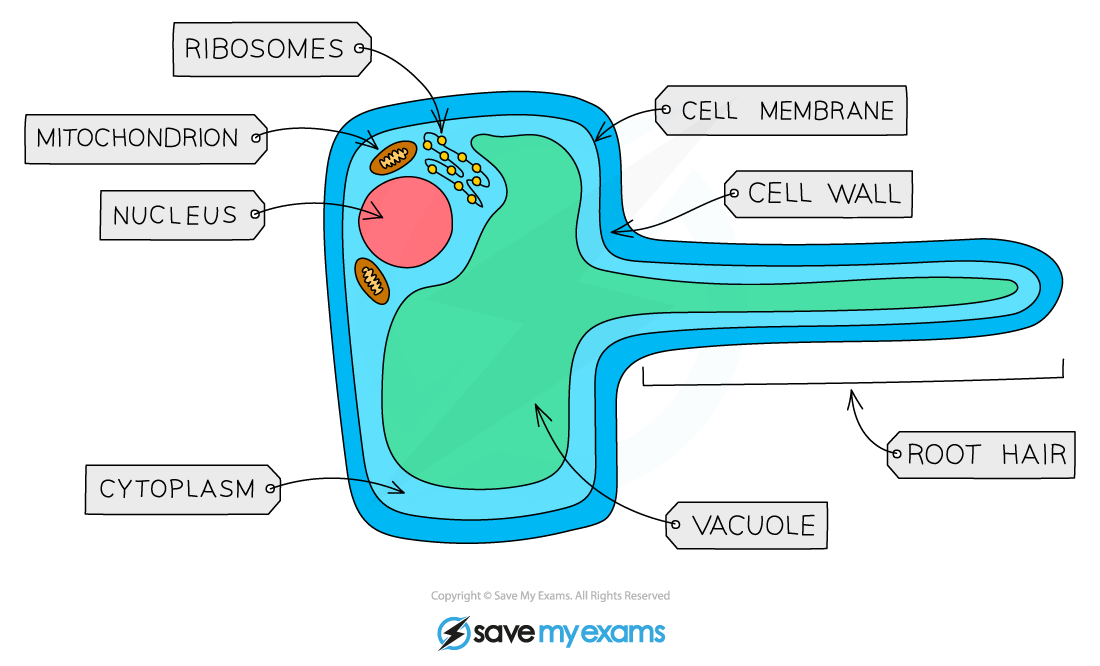
The root hair is an extension of the cytoplasm, increasing the surface area of the cell in contact with the soil to maximise absorption of water and minerals
- Function: Absorption of water and mineral ions from soil
- Adaptations:
- Root hair?to?increase surface area?(SA) so the rate of water uptake by osmosis is greater (can absorb more water and ions than if SA were lower)
- Thinner walls?than other plant cells so that water can move through easily (due to shorter diffusion distance)
- Permanent vacuole contains cell sap which is more?concentrated?than soil water, maintaining a?water potential gradient
- Mitochondria?for active transport of mineral ions
- Remember that chloroplasts are not found in these cells – there’s no light for photosynthesis underground!
Xylem vessel cells
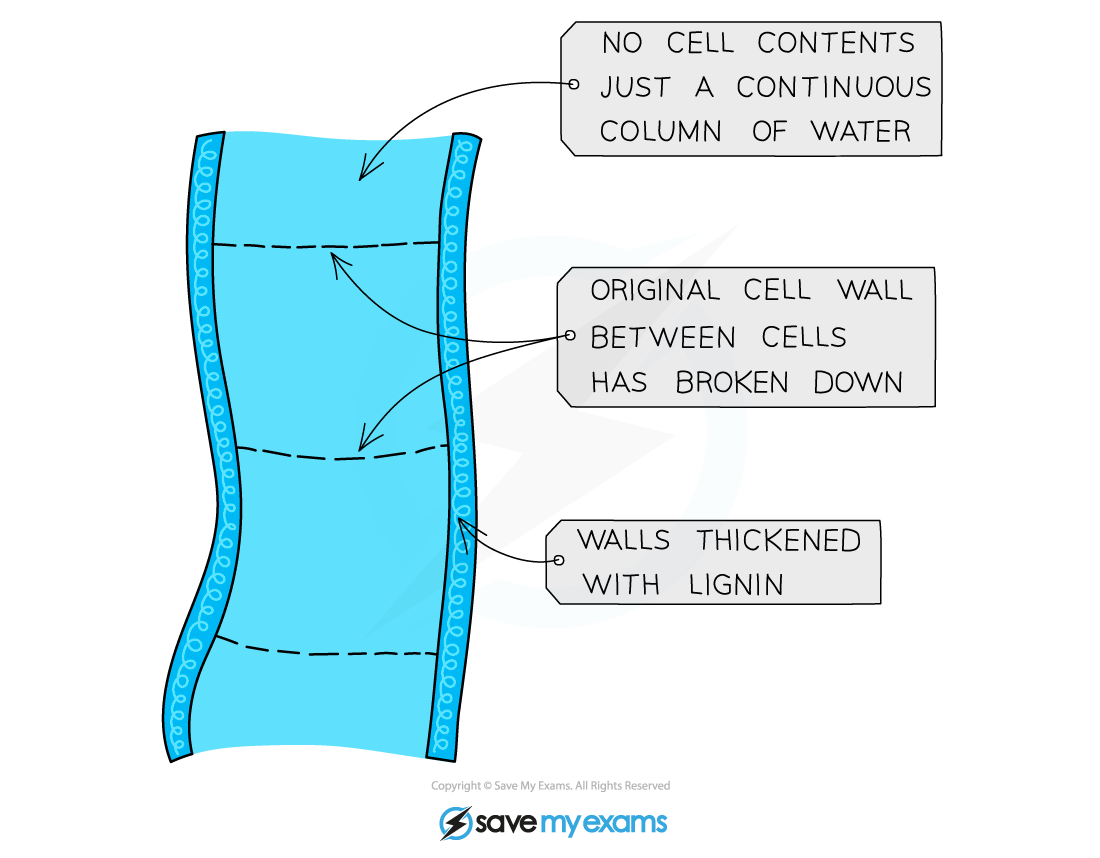
Xylem cells lose their top and bottom walls to form a continuous tube through which water moves from the roots to the leaves
- Function: transport tissue for water and dissolved ions
- Adaptations:
- No top and bottom walls?between cells to form continuous hollow tubes through which water is drawn upwards towards the leaves by transpiration
- Cells are essentially?dead, without organelles or cytoplasm, to allow?free movement of water
- Outer walls are?thickened?with a substance called?lignin, strengthening the tubes, which helps?support?the plant
Phloem vessel cells
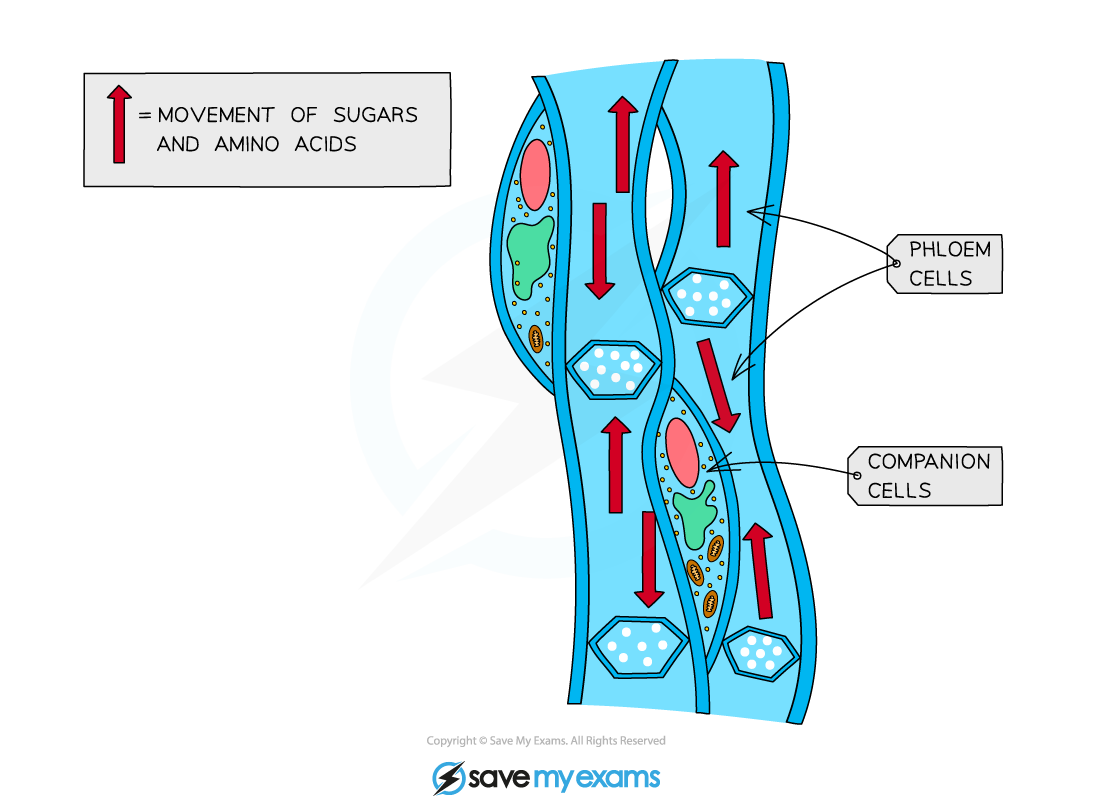
Phloem cells form tubes similar to xylem vessels, except the cells still retain some subcellular structures and are therefore living
- Function: transport of dissolved sugars and amino acids
- Adaptations:
- Made of?living?cells (as opposed to xylem vessels which are made of dead cells) which are supported by?companion cells
- Cells are?joined?end-to-end and contain holes in the end cell walls (sieve plates) forming tubes which allow sugars and amino acids to?flow easily?through (by translocation)
- Cells also have very?few subcellular structures?to aid the flow of materials
Exam Tip
In the exam, you could be required to apply your knowledge of organelles to explain how a particular specialised cell is adapted to its function. To answer these questions, just think about what organelles the cell might need in order to do its job (e.g. if the cell’s main function is to carry out photosynthesis it will need to contain many chloroplasts)!You may also be given some information (including an image) about an unfamiliar cell in an exam, and asked to describe how it’s able to carry out its function. This shouldn’t faze you – just look carefully at the shape of the cell and its subcellular structures!
轉(zhuǎn)載自savemyexams
以上就是關(guān)于【AQA A Level Biology復(fù)習(xí)筆記2.1.3 Specialisation of Eukaryotic Cells】的解答,如需了解學(xué)校/賽事/課程動(dòng)態(tài),可至翰林教育官網(wǎng)獲取更多信息。
往期文章閱讀推薦:
翰林獨(dú)家 | 經(jīng)濟(jì)學(xué)競(jìng)賽核心精講,一冊(cè)打通NEC/IEO/USAEBO!
2026 ALEVEL 夏考A率出爐!愛(ài)德思vs牛津AQA,哪些科目真的“好出分”?


翰林AMC8視頻課重磅上線!

國(guó)際競(jìng)賽真題資源免費(fèi)領(lǐng)取






