USACO 2016 February Contest, Bronze Problem 3. Load Balancing

原題下載
答案
(Analysis by Nick Wu)
There are a lot of possible fence combinations to consider - if we simply consider every possible even x-coordinate and every possible event y-coordinate, there would be?50000025000002?different combinations which is far too many.
Let us take an extreme example where there are two cows, one at?(1,1)(1,1)?and the other at?(999999,999999)(999999,999999). Note that every even x-coordinate between?22?and?999998999998?yields exactly the same division of cows into quadrants, no matter which y-coordinate we pick. By the same logic, every even y-coordinate between?22?and?999998999998?yields exactly the same division of cows into quadrants.
Therefore, we can make the following observation - if we set the vertical fence at?x=ax=a?but no cow is placed with an x-coordinate of?a?1a?1, we can move the vertical fence to?x=a?2x=a?2?and still preserve the same division of cows into quadrants. Similarly, if we set the horizontal fence at?y=by=b?but no cow is placed with a y-coordinate at?y=b?1y=b?1, we can move the horizontal fence to?y=b?2y=b?2.
This means that we only need to place vertical fences where?x=ax=a?and there is a cow with x-coordinate?a?1a?1, and we only need to place vertical fences where?y=by=b?and there is a cow with y-coordinate?b?1b?1.
This gives us at most ten thousand pairs to try, which is small enough.
Here is my Java code:
import java.io.*;
import java.util.*;
public class balancing {
	public static void main(String[] args) throws IOException {
		// initialize file I/O
		BufferedReader br = new BufferedReader(new FileReader("balancing.in"));
		PrintWriter pw = new PrintWriter(new BufferedWriter(new FileWriter("balancing.out")));

		// read in N, we can safely ignore B so we don't actually read the value
		StringTokenizer st = new StringTokenizer(br.readLine());
		int n = Integer.parseInt(st.nextToken());

		// create arrays to store locations of cows
		// cow i is at point (xLoc[i], yLoc[i])
		int[] xLoc = new int[n];
		int[] yLoc = new int[n];
		for(int i = 0; i < n; i++) {
			// read in location of cow i
			st = new StringTokenizer(br.readLine());
			xLoc[i] = Integer.parseInt(st.nextToken());
			yLoc[i] = Integer.parseInt(st.nextToken());
		}
		// in the absolute worst case, N cows will be in one quadrant
		int ans = n;
		for(int xIndex = 0; xIndex < n; xIndex++) {
			for(int yIndex = 0; yIndex < n; yIndex++) {
				// identify the fence location
				// vertical fence at x=xDiv
				// horizontal fence at y=yDiv
				int xDiv = xLoc[xIndex]+1;
				int yDiv = yLoc[yIndex]+1;
				int upperLeft = 0;
				int upperRight = 0;
				int lowerLeft = 0;
				int lowerRight = 0;
				// identify which quadrant each cows lands in
				for(int i = 0; i < n; i++) {
					if(xLoc[i] < xDiv && yLoc[i] < yDiv) {
						lowerLeft++;
					}
					if(xLoc[i] < xDiv && yLoc[i] > yDiv) {
						upperLeft++;
					}
					if(xLoc[i] > xDiv && yLoc[i] < yDiv) {
						lowerRight++;
					}
					if(xLoc[i] > xDiv && yLoc[i] > yDiv) {
						upperRight++;
					}
				}
				// figure out which region has the most cows
				int worstRegion = 0;
				if(upperLeft > worstRegion) {
					worstRegion = upperLeft;
				}
				if(upperRight > worstRegion) {
					worstRegion = upperRight;
				}
				if(lowerLeft > worstRegion) {
					worstRegion = lowerLeft;
				}
				if(lowerRight > worstRegion) {
					worstRegion = lowerRight;
				}
				// determine if we have found a better pair of fences
				if(worstRegion < ans) {
					ans = worstRegion;
				}
			}
		}
		// print the answer
		pw.println(ans);
		// close output stream
		pw.close();
	}
}
翰林USACO課程體系流程圖
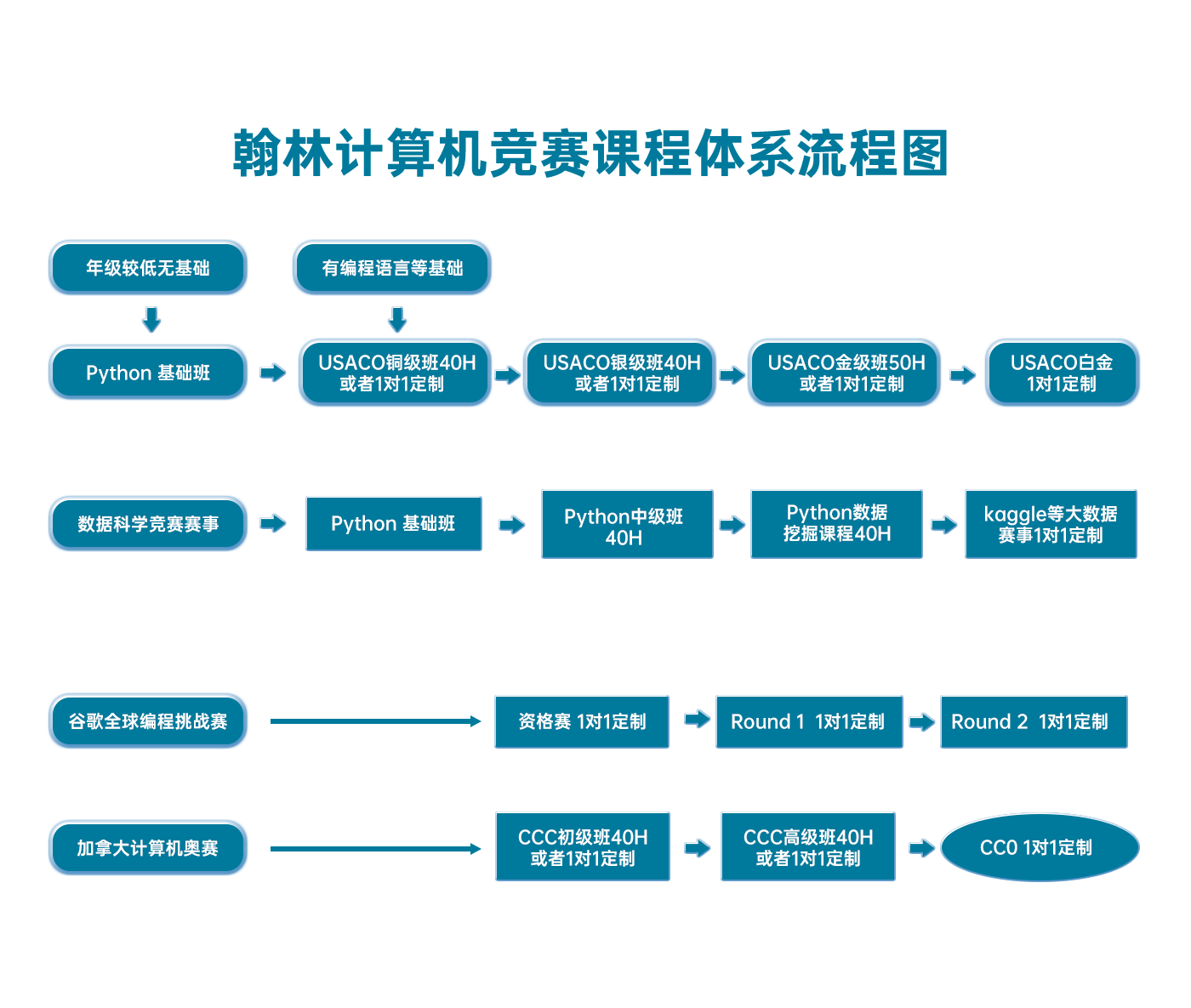
以上就是關于【USACO 2016 February Contest, Bronze Problem 3. Load Balancing】的解答,如需了解學校/賽事/課程動態,可至翰林教育官網獲取更多信息。
往期文章閱讀推薦:
2027 USAAIO人工智能奧賽報名進行中!Round 1新規出爐,2月開賽如何備考?
外灘大會見證AI爆發!緊跟智能時代,從USACO計算機奧賽起步!


翰林AMC8視頻課重磅上線!

國際競賽真題資源免費領取






