Edexcel A Level Economics A:復習筆記3.4.5 Monopoly

Characteristics of Monopoly
- A monopoly is a market structure in which there is a?single seller
- There are no?substitute products
- The firm has?complete market power?& is able to set prices & control output
- This allows the firm to?maximise supernormal profit?in the short-run
- There is no long-run erosion of supernormal profit as competitors are unable to enter the industry
- High barriers to entry exist
- One of the main barriers is the ability of the monopoly to?prevent any competition?from entering the market
- E.g. by purchasing companies who are a potential threat
- One of the main barriers is the ability of the monopoly to?prevent any competition?from entering the market
- The?UK Competition & Markets Authority?defines a monopoly as any firm having more than 25%?market share
- It acts to?prevent?this from happening in most industries
Profit Maximising Equilibrium
- As a single seller of goods/services, the firm in a monopoly market is also the?entire market
- There is no differentiation between the firm & the industry
- It is a?price maker
- This means that its revenue curves are downward sloping
- In order to?maximise profits,?it produces at the point where marginal cost (MC) = marginal revenue (MR)
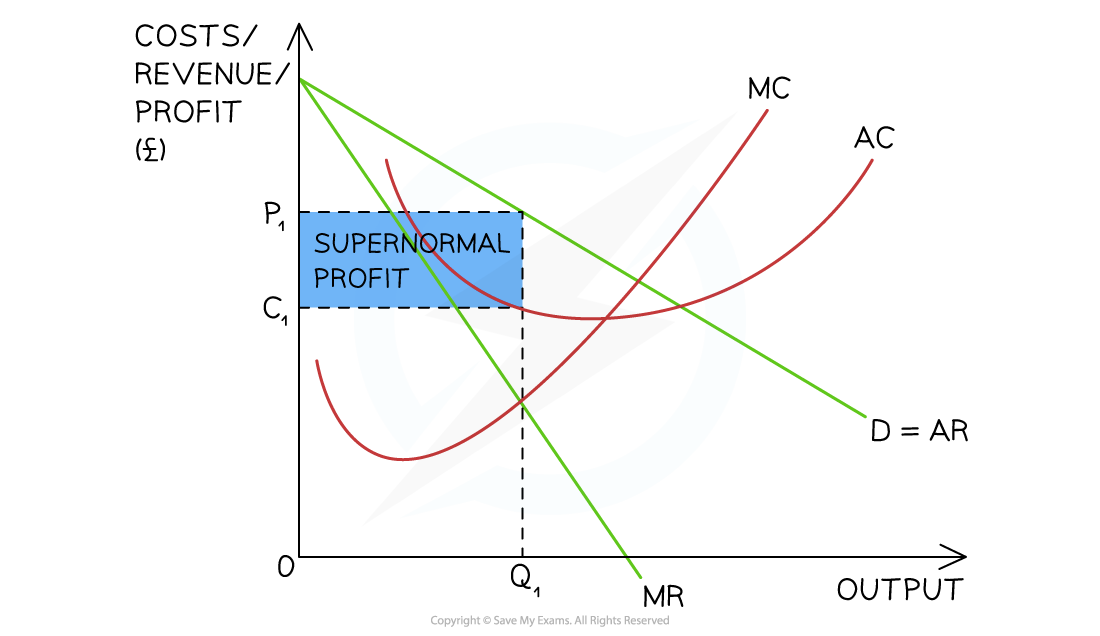
A diagram illustrating a monopoly making supernormal profit in the short-run & long-run as the AR > AC at the profit maximisation level of output (Q1)
Diagram Analysis
- The firm produces at the?profit maximisation level of output?where?MC = MR (Q1)
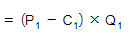
- At this level the?AR (P1) > AC (C1)
- The firm is making?supernormal profit
Exam Tip
Some exam questions require application of your knowledge. E.g. You may be asked to draw a cost and revenue diagram to show the likely impact of a reduction in sales on profits. This requires you to modify the diagram presented above by shifting the demand curve inwards. You will draw a second AR & MR curve to the left of the existing ones & then illustrate the new level of profit.
Third Degree Price Discrimination
- Price discrimination?occurs when a firm charges a?different price?for the?same good/service?in order to maximise its revenue
- There are different?types (degrees) of price?discrimination
- Third degree price discrimination?occurs when a firm charges?different prices to?different consumers?for the?same good/service?e.g. rail fares are priced differently depending on the time of travel
- Markets?are often?sub-divided?based on time, age, income & geographic location
- Some airline ticket portals?charge higher prices?to customers?using an?Apple computer?as they are likely to have higher income
The Following Conditions Must Be Met for Third Degree Price Discrimination to Occur
| Market Power | Varying Consumer Price Elasticity of Demand (PED) | Ability To Prevent Resale of Tickets |
| The firm must have the ability to?change prices?& it works best when there are no/few?substitutes | Some consumers must be?willing to pay more?& the firm must be able to identify these different consumer groups?i.e.?split the market into sub-markets | It must be able to?prevent consumers?buying in the low-price sub-market & reselling in the higher ones |
Illustrating Third Degree Price Discrimination
- In order to illustrate?third degree price discrimination?diagrammatically, the different sub-market diagrams are placed side by side
- The total market diagram is a combination of the sub-market diagrams
- The?total profit?is a combination of profits from the sub-markets
- The diagram below illustrates the?market for rail travel?in the UK where inelastic demand is?'peak'?hour demand & elastic demand is any other time of the day i.e.?'off-peak'
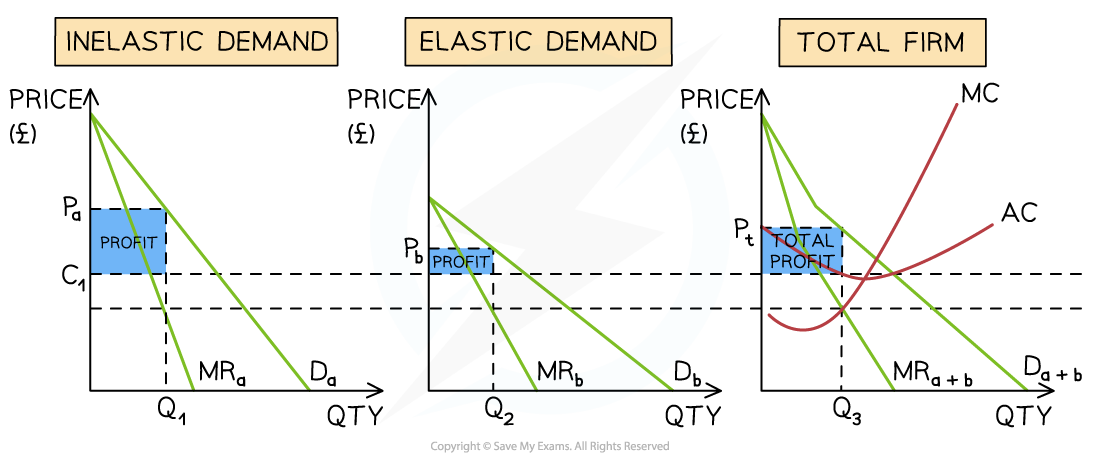
A third-degree price discrimination diagram demonstrates a market that has been divided based on price inelastic (peak travel) & price elastic demand (off-peak travel). Following the?revenue rule, prices are raised for peak demand & lowered for off-peak demand
Diagram Analysis
- Each train route has an effective?monopoly provider
- The overall firm is producing at the?profit maximising level of output?where?MC=MR
- This point is?extrapolated to both sub-markets?on the left by using the lower dotted line
- The average cost is extrapolated across both sub-markets using the?upper dotted line (C1)
- A?higher price for peak travel?has been set at Pa?& a?lower price for off-peak travel?has been set at Pb
- Following the revenue rule,?total revenue increases?in both markets
- The profit for?sub-market A = (Pa-C1) * Q1
- The profit for?sub-market B = (Pb-C1) * Q2
- The firm's total profit is the average selling price - the average costs
- Total profit = (Pt-C1) * Q3
- The firms'?total profits are higher?than if they had charged a single price to all customers
Costs & Benefits of Third-Degree Price Discrimination
Costs & Benefits of Third-Degree Price Discrimination to Consumers & Producers
| Consumers | Producers |
|
|
Costs & Benefits of Monopoly
- In several instances where the?Competition & Markets Authority?has acted to?decrease/limit monopoly power, the firms have taken the Regulator to court to attempt to convince them that the?firms market power will benefit consumers
- Theoretically this is possible, however in many cases the desire to?maximise profits?would prevent this from happening
The Advantages & Disadvantages Of Monopoly Power
| Stakeholder | Advantages | Disadvantages |
| The Firm |
|
|
| Employees |
|
|
| Consumers |
|
|
| Suppliers |
|
|
Natural Monopoly
- A?natural monopoly?occurs when the?most efficient number of firms in the industry is one
- This is often due to?associated infrastructure issues?e.g. delivery of utility services like water where it does not make sense to have multiple pipelines
- It can also be due to the?significant cost?that is generated when entering the industry e.g. the?sunk costs
- It can also be due to the ability of?economies of scale?to lower prices for consumers e.g. it makes sense to have one firm building five nuclear power stations as opposed to five firms as average costs will be lower with one firm producing
- Natural monopolies?usually occur in utility industries & are?regulated by the Government?to ensure that consumers are not charged higher monopoly prices
- This regulation is often in the form of a?maximum price
Exam Tip
When?evaluating monopolies?demonstrate critical thinking by acknowledging the positives as well as the negatives. For example, Amazon has partly become a monopoly by being very good at what they do & consumers benefit from lower prices & greater choice. However, this power means that they can also?abuse the suppliers?on their platform.
When?evaluating natural monopolies, consider the?government failure?that may occur with regard to?regulation & the imposition of maximum prices. There is a lot of disagreement about the?level of profits?that natural monopolies should be allowed to make. It is a normative issue.
轉載自savemyexams
以上就是關于【Edexcel A Level Economics A:復習筆記3.4.5 Monopoly】的解答,如需了解學校/賽事/課程動態,可至翰林教育官網獲取更多信息。
往期文章閱讀推薦:
翰林獨家 | 經濟學競賽核心精講,一冊打通NEC/IEO/USAEBO!
2026 ALEVEL 夏考A率出爐!愛德思vs牛津AQA,哪些科目真的“好出分”?


翰林AMC8視頻課重磅上線!

國際競賽真題資源免費領取






