CIE A Level Physics復習筆記1.1.4 Scalars & Vectors

What are Scalar & Vector Quantities?
- A?scalar?is a?quantity?which?only?has a magnitude (size)
- A?vector?is a quantity which has?both?a magnitude and a direction
- For example, if a person goes on a hike in the woods to a location which is a couple of miles from their starting point
- As the crow flies, their?displacement?will only be a few miles but the?distance?they walked will be much longer

Displacement is a vector while distance is a scalar quantity
- Distance?is a scalar quantity because it describes how an object has travelled overall, but not the direction it has travelled in
- Displacement?is a vector quantity because it describes how far an object is from where it started and in what direction
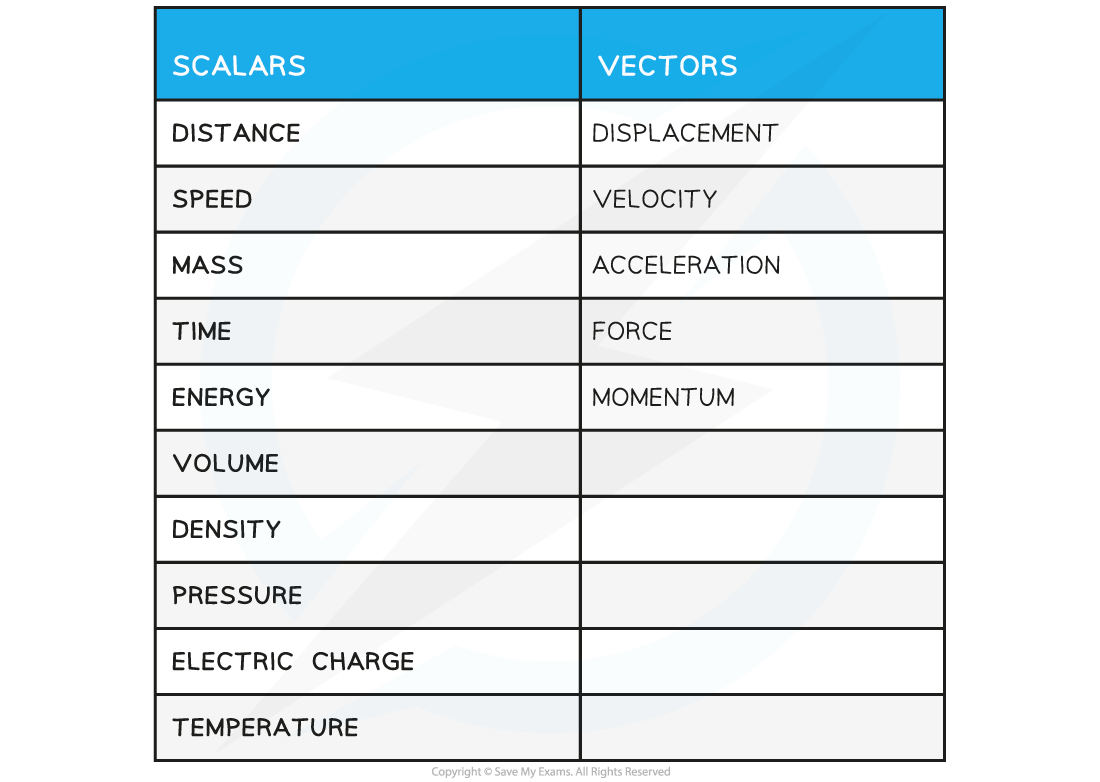
- There are a number of common scalar and vector quantities
Scalars and Vectors Table
Exam Tip
Do you have trouble figuring out if a quantity is a vector or a scalar? Just think - can this quantity have a minus sign? For example - can you have negative energy? No. Can you have negative displacement? Yes!
Combining Vectors
- Vectors?are represented by an arrow
- The arrowhead indicates the?direction?of the vector
- The length of the arrow represents the?magnitude
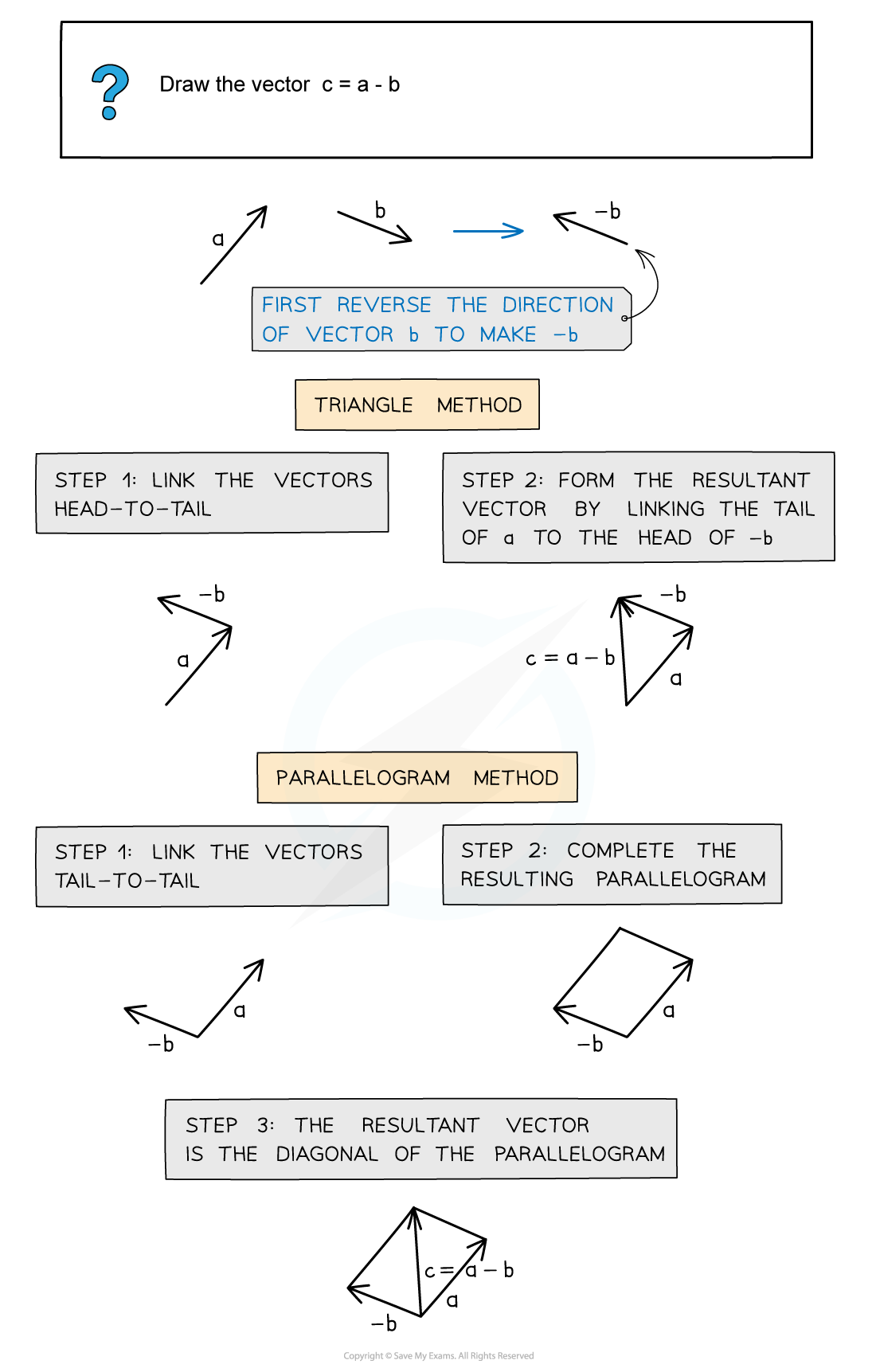
- Vectors can be combined by?adding?or?subtracting?them from each other
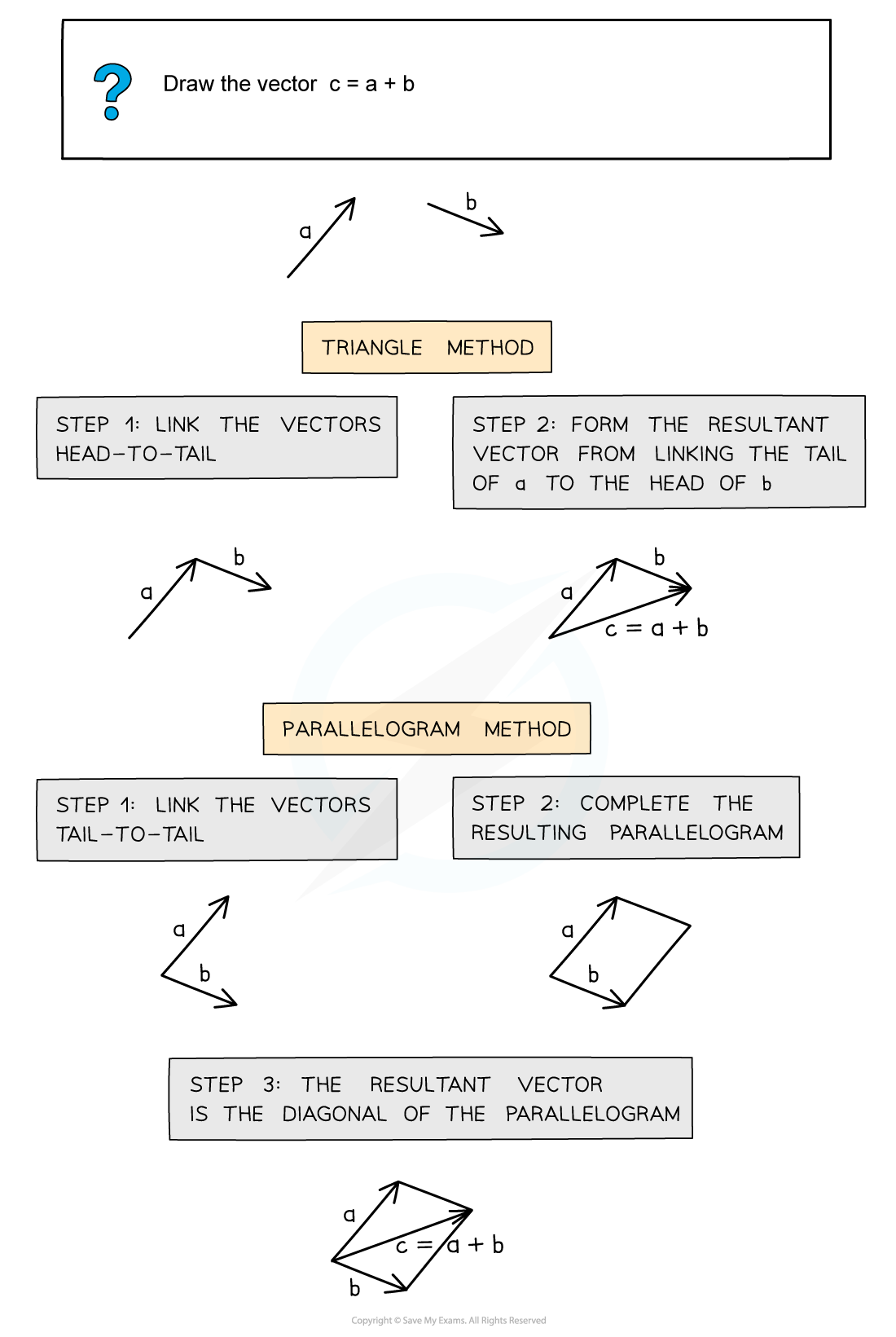
- There are two methods that can be used to combine vectors: the?triangle method?and the?parallelogram method
- To combine vectors using the triangle method:
- Step 1:?link the vectors head-to-tail
- Step 2:?the resultant vector is formed by connecting the tail of the first vector to the head of the second vector
- To combine vectors using the parallelogram method:
- Step 1:?link the vectors tail-to-tail
- Step 2:?complete the resulting parallelogram
- Step 3:?the resultant vector is the diagonal of the parallelogram
- When two or more vectors are added together (or one is subtracted from the other), a single vector is formed and is known as the?resultant?vector
Vector Addition
Vector Subtraction
Condition for Equilibrium
- Coplanar forces?can be represented by vector triangles
- In equilibrium, these are?closed?vector triangles. The vectors, when joined together, form a closed path
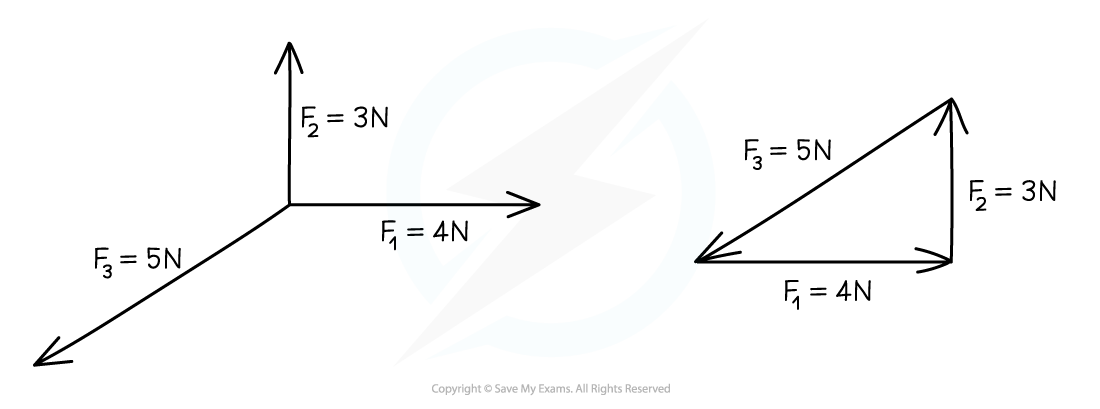
If three forces acting on an object are in equilibrium; they form a closed triangle
Resolving Vectors
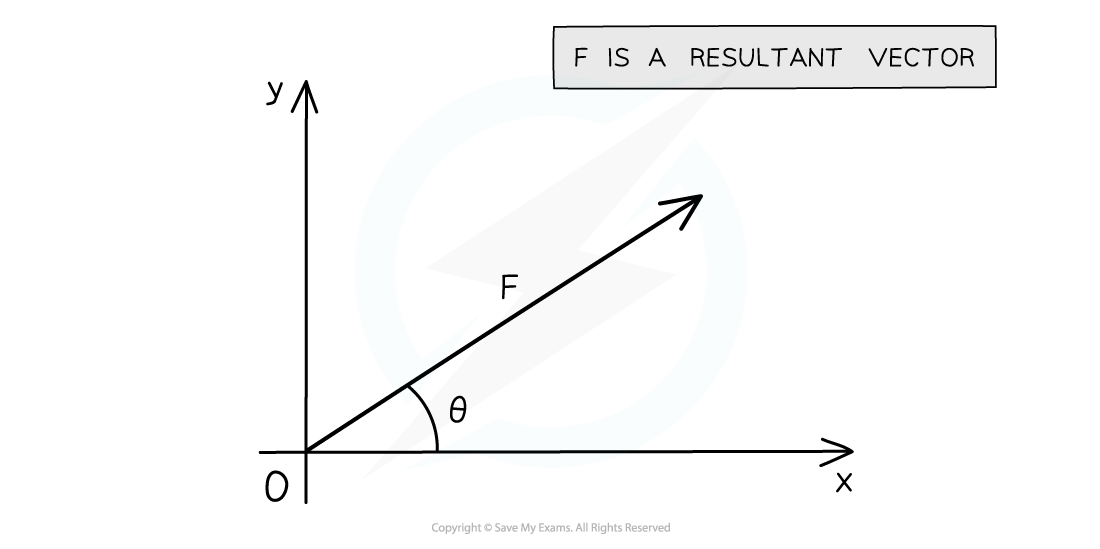
- Two vectors can be represented by a single?resultant vector?that has the same effect
- A single resultant vector can be resolved and represented by?two?vectors, which in combination have the same effect as the original one
- When a single resultant vector is broken down into its?parts, those?parts?are called components
- For example, a force vector of magnitude?F?and an angle of?θ?to the horizontal is shown below
- It is possible to?resolve?this vector into its?horizontal?and?vertical?components using trigonometry
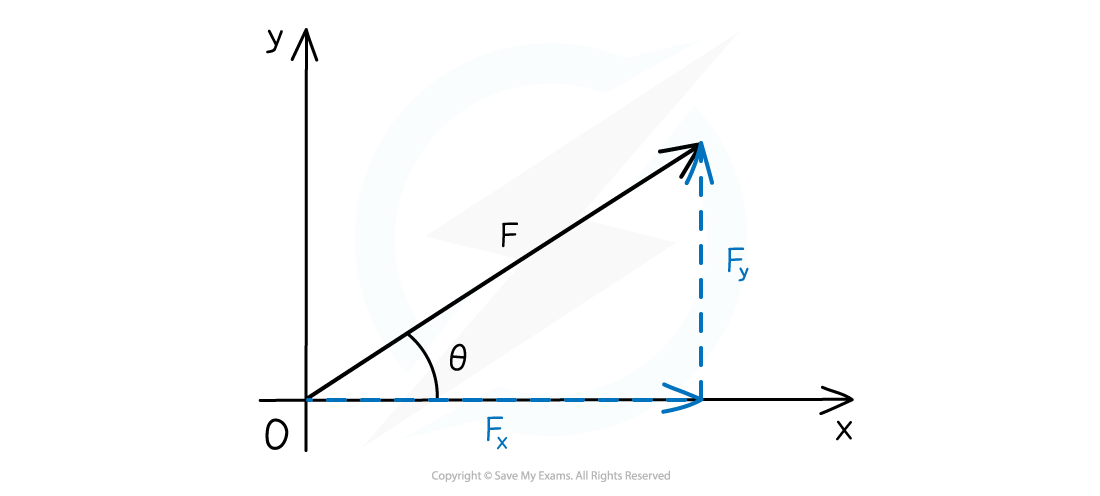
- For the?horizontal?component,?Fx?=?Fcosθ
- For the?vertical?component,?Fy?=?Fsinθ
轉載自savemyexams
以上就是關于【CIE A Level Physics復習筆記1.1.4 Scalars & Vectors】的解答,如需了解學校/賽事/課程動態,可至翰林教育官網獲取更多信息。
往期文章閱讀推薦:
MIT官方發布【2026年夏季推薦閱讀書單】!橫跨科學/人文/經濟...
全網破防!ALevel CIE數學M1疑似錯題?經濟P2難度飆升?5月6日大考考情分析必看!


翰林AMC8視頻課重磅上線!

國際競賽真題資源免費領取






