CIE A Level Chemistry復(fù)習(xí)筆記7.6.3 Basicity of Amines

Basicity of Aqueous Solutions of Amines
- The nitrogen atom in ammonia and amine molecules can?accept?a?proton?(H+?ion)
- They can therefore act as?bases?in aqueous solutions by?donating?its lone pair of electrons to a proton and form a?dative bond
- For example, ammonia undergoes an?acid-base?reaction with dilute hydrochloric acid (HCl) to form a salt
NH3?+ HCl → NH4+Cl-
base????? acid??????????? salt
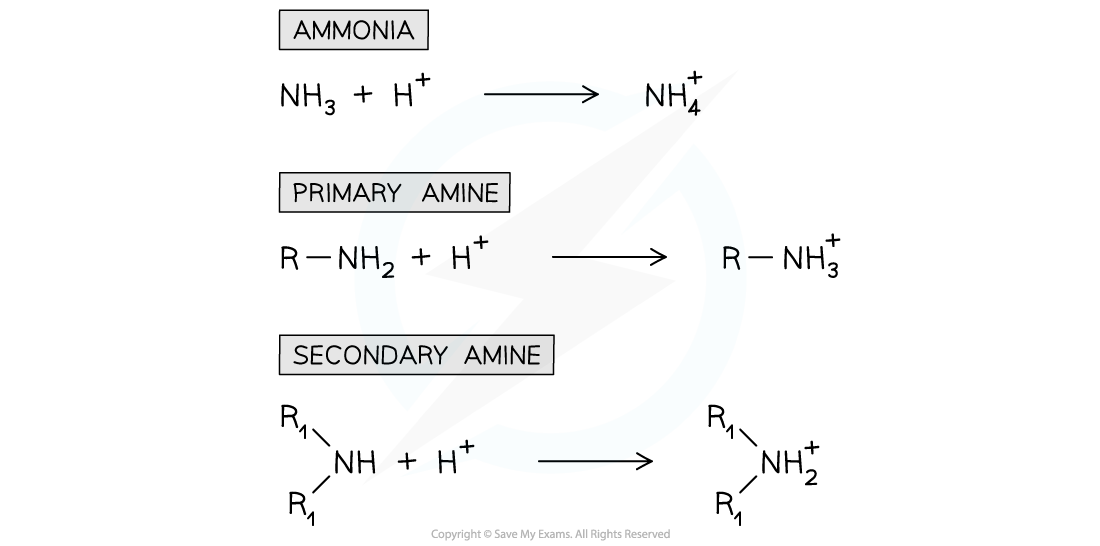
The nitrogen atom in ammonia and amines can donate its lone pair of electrons to form a bond with a proton and therefore act as a base
Strength of ammonia and amines as bases
- The?strength?of amines depends on the?availability?of the lone pair of electrons on the nitrogen atom to form a dative covalent bond with a proton
- The?more readily?this lone pair of electrons is available, the?stronger the base?is
- Factors that may affect the?basicity?of amines include:
- Positive inductive effect?- Some groups such as?alkyl groups?donate electron density to the nitrogen atom causing the lone pair of electrons to become more available and therefore?increasing?the amine’s?basicity
- Delocalisation?- The presence of aromatic rings such as the?benzene ring?causes the lone pair of electrons on the nitrogen atom to be?delocalised?into the benzene ring
- The lone pair becomes?less available?to form a dative covalent bond with ammonia and hence?decreases?the amine’s?basicity
- For example, ethylamine (which has an electron-donating ethyl group) is?more basic?than?phenylamine?(which has an electron-withdrawing benzene ring)
轉(zhuǎn)載自savemyexams
以上就是關(guān)于【CIE A Level Chemistry復(fù)習(xí)筆記7.6.3 Basicity of Amines】的解答,如需了解學(xué)校/賽事/課程動態(tài),可至翰林教育官網(wǎng)獲取更多信息。
往期文章閱讀推薦:
MIT官方發(fā)布【2026年夏季推薦閱讀書單】!橫跨科學(xué)/人文/經(jīng)濟(jì)...
全網(wǎng)破防!ALevel CIE數(shù)學(xué)M1疑似錯題?經(jīng)濟(jì)P2難度飆升?5月6日大考考情分析必看!


翰林AMC8視頻課重磅上線!

國際競賽真題資源免費(fèi)領(lǐng)取






