CIE A Level Chemistry復習筆記7.3.1 Production of Halogenoarenes

Production of Halogenoarenes
- Halogenoarenes?are arenes which are bonded to?halogen?atoms
- They can be prepared from?substitution reactions?of arenes with chlorine or bromine in the presence of an anhydrous catalyst
Substitution of benzene to form halogenoarenes
- Chlorine gas is bubbled into benzene at room temperature and in the presence of an anhydrous AlCl3?catalyst to form?chlorobenzene
- The AlCl3?catalyst is also called a?halogen carrier?and is required to generate the?electrophile?(Cl+)
- This electrophile?attacks?the electron-rich benzene ring in the?first stage?of the reaction which?disrupts?the delocalised π system in the ring
- To restore the?aromatic stabilization,?a hydrogen atom is removed in the?second stage?of the electrophilic substitution reaction to form chlorobenzene
- When this happens, the delocalised π system of the ring is?restored
- The same reaction occurs with benzene and bromine in the presence of an AlBr3?catalyst to form?bromobenzene
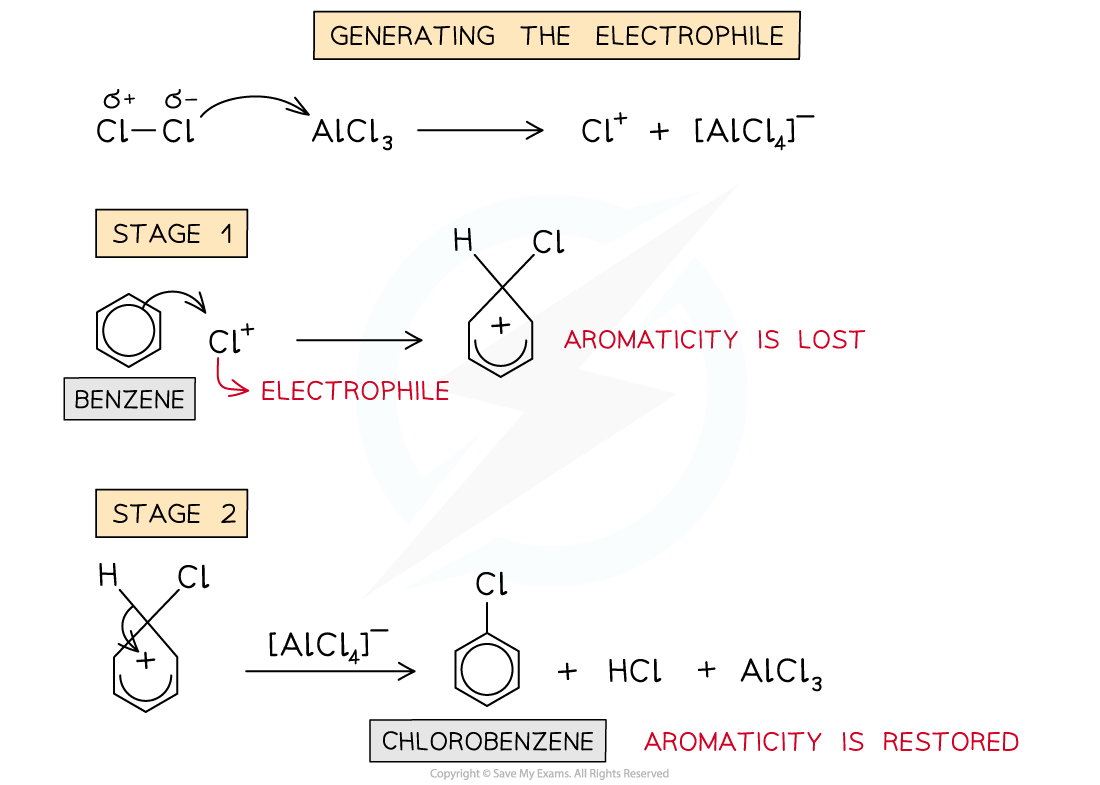
Halogenoarenes can be formed from the electrophilic substitution reaction of arenes with halogens
Substitution of methylbenzene to form halogenoarenes
- The?electrophilic substitution?of?methylbenzene?with halogens results in the formation of multiple halogenoarenes as products
- This is because the methyl group (which is an?alkyl?group) in methylbenzene is?electron-donating?and pushes?electron density?into the benzene ring
- This makes the benzene ring?more?reactive?towards electrophilic substitution reactions
- The methly group is said to be 2,3-directing and as a result, the?2?and?4?positions?are?activated
- Electrophilic substitution of methylbenzene with chlorine and anhydrous AlCl3?catalyst, therefore, gives?2-chloromethylbenzene?and?4-chloromethylbenzene
- The reaction mechanism is?the same?as the substitution mechanism of benzene
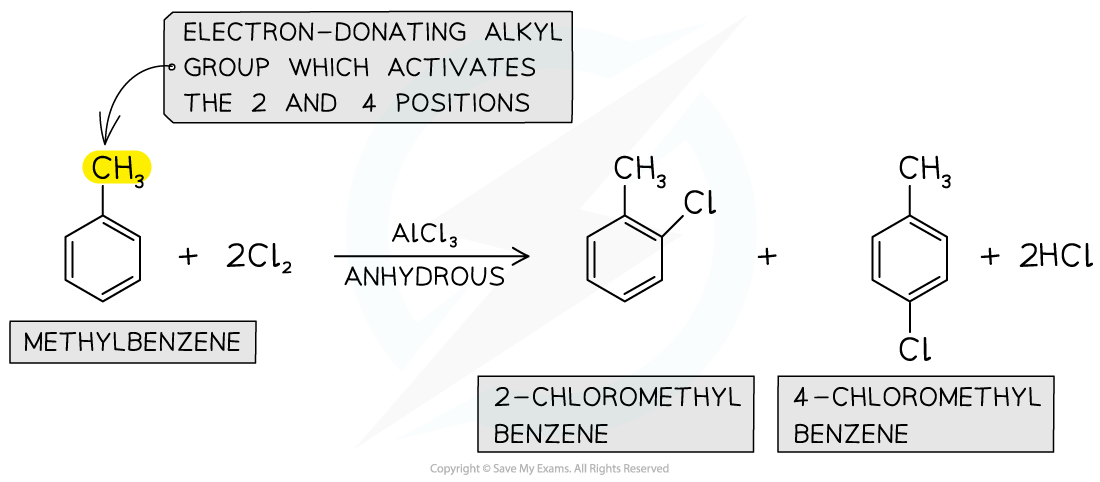
The methyl group on methylbenzene directs the incoming halogen on the 2 and 4 positio
- In the presence of?excess?chlorine, substitution on the?6 position?will also occur
轉載自savemyexams
以上就是關于【CIE A Level Chemistry復習筆記7.3.1 Production of Halogenoarenes】的解答,如需了解學校/賽事/課程動態,可至翰林教育官網獲取更多信息。
往期文章閱讀推薦:
翰林獨家 | 經濟學競賽核心精講,一冊打通NEC/IEO/USAEBO!
2026 ALEVEL 夏考A率出爐!愛德思vs牛津AQA,哪些科目真的“好出分”?


翰林AMC8視頻課重磅上線!

國際競賽真題資源免費領取






