CIE A Level Chemistry復習筆記3.4.2 Reactions of Alcohols

Reactions of Alcohols
- Alcohols?are reactive molecules which undergo a wide range of reactions
Combustion of alcohols
- Alcohols react with oxygen in the air when ignited and undergo?complete combustion?to form carbon dioxide and water
Alcohol + oxygen → carbon dioxide + water
 Complete combustion of alcohols to produce carbon dioxide and water
Substitution of alcohols
- In the?substitution?of alcohols, a hydroxy group (-OH) is replaced by a halogen to form an?halogenoalkane
- The substitution of the alcohol group for a halogen can be achieved by reacting the alcohol with:
- HX (rather than using HBr, KBr is reacted with H2SO4?or H3PO4?to make HBr that will then react with the alcohol)
- PCl3?and heat
- PCl5?at room temperature
- SOCl2
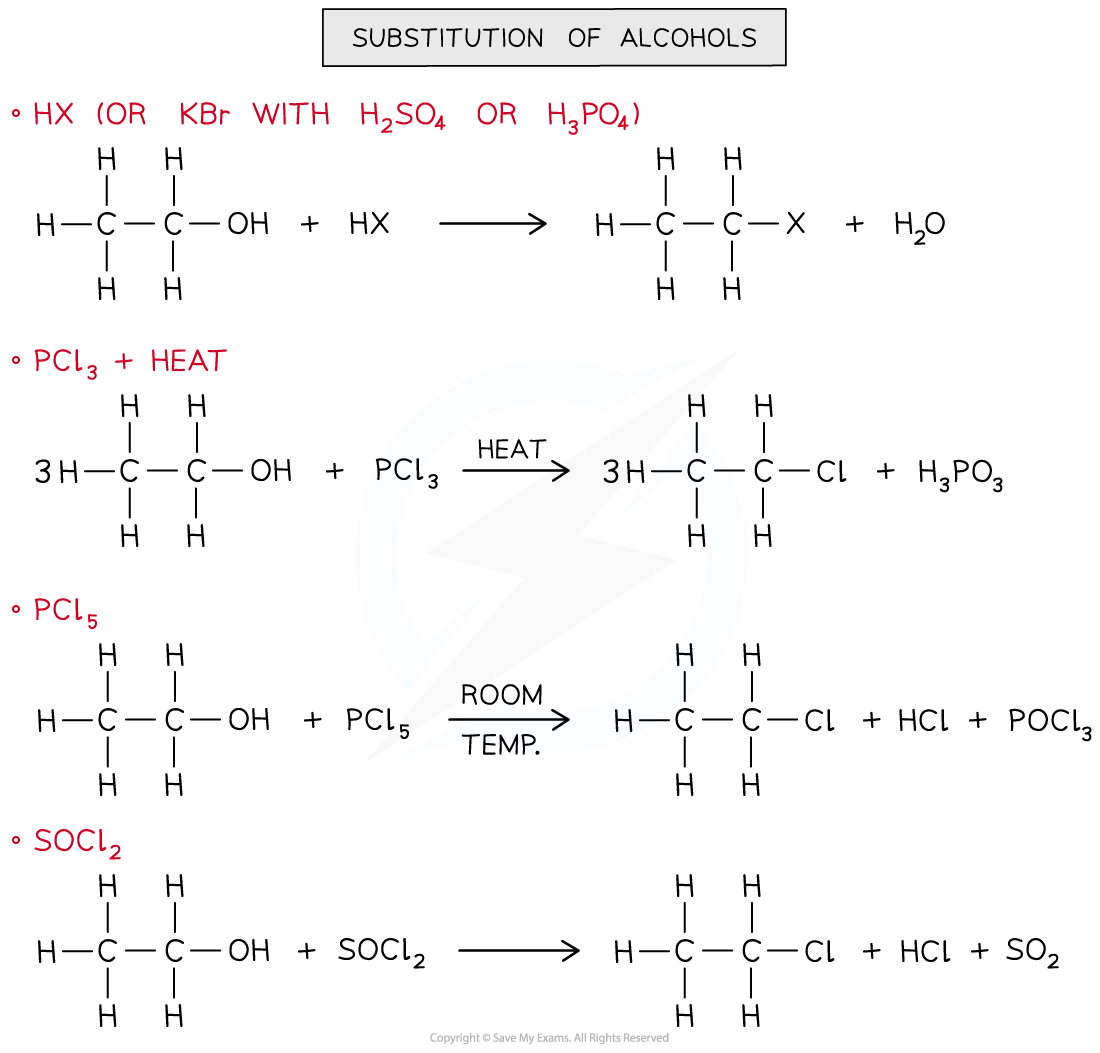 Substitution of alcohols to produce halogenoalkanes
Reaction with Na
- When an alcohol reacts with a?reactive metal?such as sodium (Na), the oxygen-hydrogen bond in the hydroxy group?breaks
- Though the reaction is less vigorous than sodium reacting with water,?hydrogen gas?is given off and a?basic?compound (alkoxide) is formed
- If the excess ethanol is evaporated off after the reaction a white crystalline solid of?sodium?alkoxide?is left
Alcohol + sodium → sodium alkoxide + hydrogen
- The longer the hydrocarbon chain in the alcohol, the less?vigorous?the reaction becomes
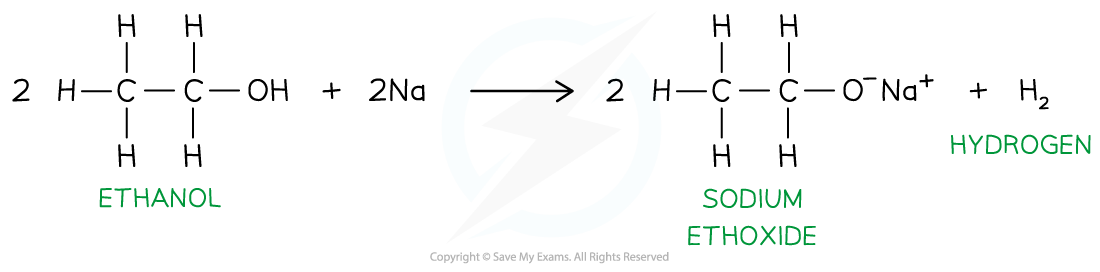 Alcohols react with Na to form a basic sodium alkoxide salt and hydrogen gas
Oxidation of alcohols
- Primary alcohols can be oxidised to form?aldehydes?which can undergo further oxidation to form?carboxylic?acids
- Secondary alcohols can be oxidised to form?ketones?only
- Tertiary alcohols do not undergo oxidation
- The oxidising agents of alcohols include?acidified K2Cr2O7?or?acidified KMnO4
- Acidified potassium dichromate(VI), K2Cr2O7, is an orange oxidising agent
- Acidified means that that the potassium dichromate(VI) is in a solution of?dilute?acid?(such as dilute sulfuric acid)
- For potassium dichromate(VI) to act as an oxidising agent, it itself needs to be reduced
- This reduction requires hydrogen (H+) ions which are provided by the acidic medium
- When alcohols are?oxidised?the orange dichromate ions (Cr2O72-) are reduced to green Cr3+?ions
- Acidified potassium manganate(VII), KMnO4, is a purple oxidising agent
- As with acidified K2Cr2O7?the potassium manganate(VII) is in an acidic medium to allow reduction of potassium manganate(VII) to take place
- When alcohols are?oxidised,?the purple manganate ions (MnO4-) are reduced to colourless Mn2+?ions
- As with acidified K2Cr2O7?the potassium manganate(VII) is in an acidic medium to allow reduction of potassium manganate(VII) to take place
- Warm primary alcohol is added to the oxidising agent
- The formed aldehyde has a lower boiling point than the alcohol reactant so it can be?distilled off?as soon as it forms
- If the aldehyde is not distilled off, further?refluxing?with excess oxidising agent will oxidise it to a carboxylic acid
- Since ketones cannot be further oxidised, the ketone product does not need to be?distilled off?straight away after it has been formed
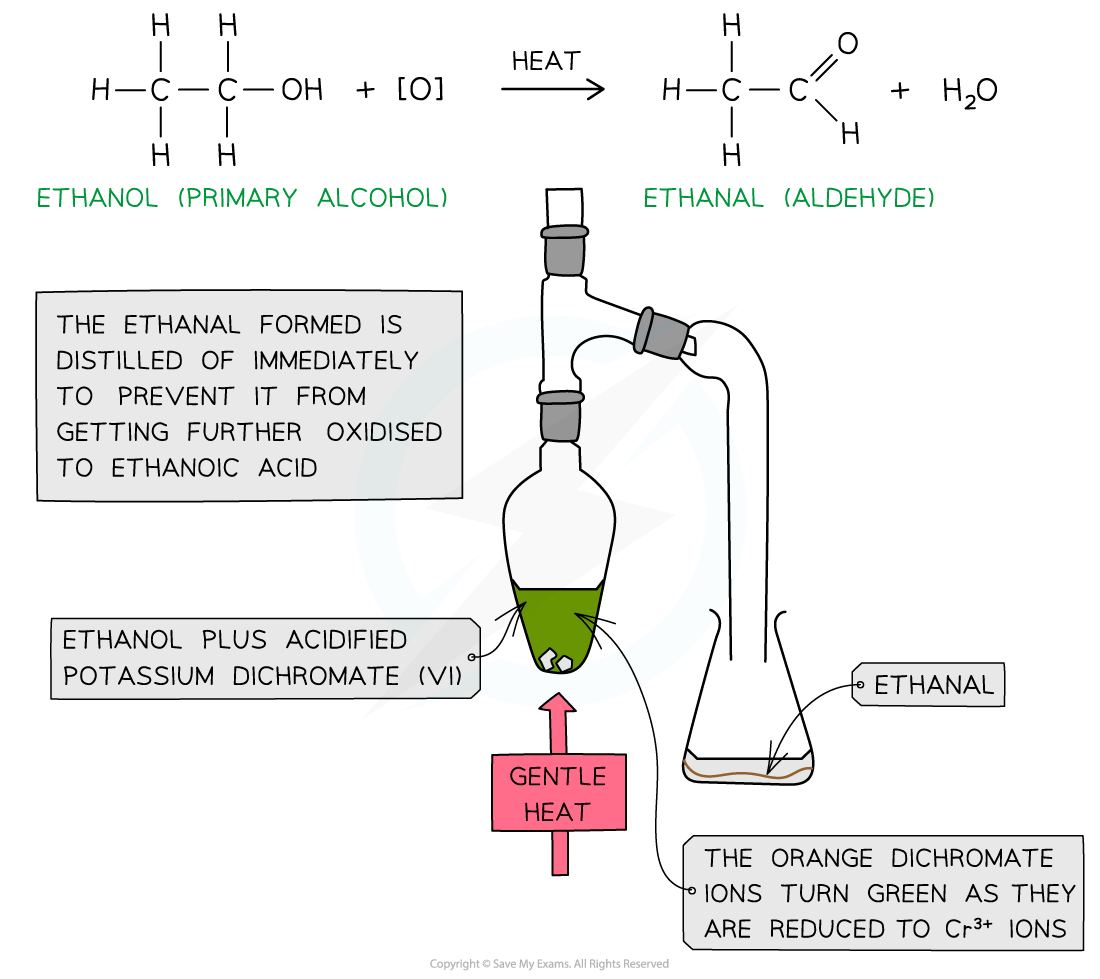
Oxidation of ethanol by acidified K2Cr2O7 to form an aldehyde by distillation and carboxylic acid by refluxing
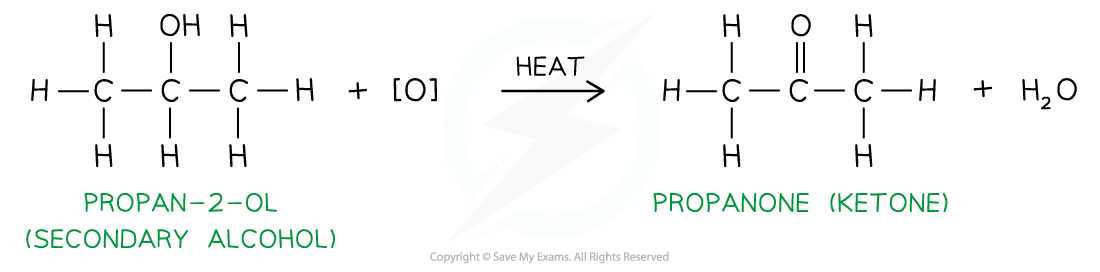
Oxidation of propan-2-ol by acidified K2Cr2O7?to form a ketone by distillation
Dehydration of alcohols
- Alcohols can also undergo?dehydration?to form alkenes
- Dehydration is a reaction in which a water molecule is removed from a larger molecule
- A dehydration reaction is a type of?elimination?reaction
- Alcohol vapour is passed over a?hot catalyst?of aluminium oxide (Al2O3) powder OR pieces of porous pot or pumice as well as concentrated acid can be used as catalysts
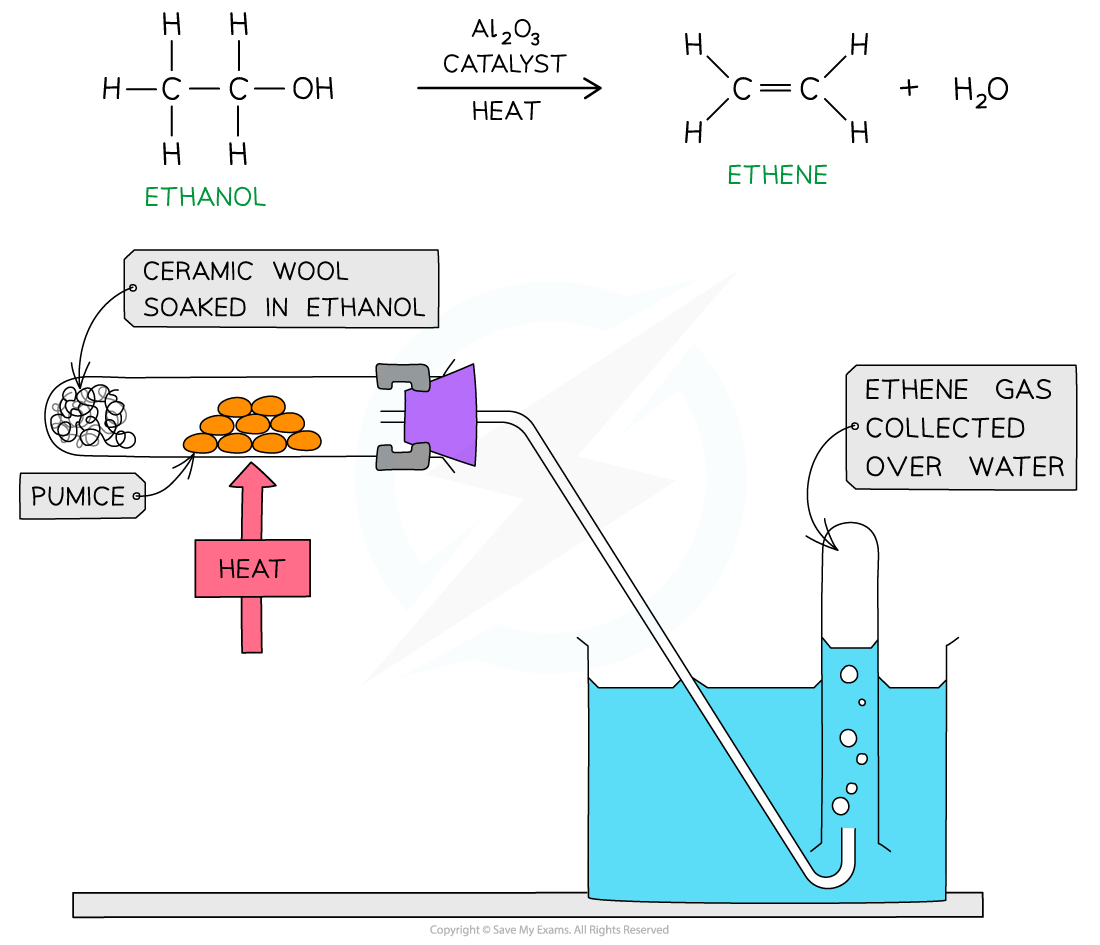
Dehydration of ethanol using aluminium oxide as a catalyst forms ethene gas, which can be collected over water
Esterification of Alcohols
- Esterification is a?condensation?reaction between a carboxylic acid and an alcohol to form an?ester?and a water molecule
- For esterification to take place, the carboxylic acid and alcohol are?heated under reflux?with a?strong acid catalyst?(such as H2SO4?or H3PO4)
Carboxylic acid + alcohol → ester + water
- The reaction is reversible so an equilibrium mixture can be established with all the reactants and products
- Esters have?sweet,?fruity smells
 Esterification of ethanol and ethanoic acid using a strong acid catalyst to form ethyl ethanoate and water
Exam Tip
The first part of an ester’s name comes from the alcohol, whereas the second part comes from the carboxylic acid.So, if ethanol and propanoic acid react together, this will make the ester?ethyl propanoate.
轉載自savemyexams
以上就是關于【CIE A Level Chemistry復習筆記3.4.2 Reactions of Alcohols】的解答,如需了解學校/賽事/課程動態,可至翰林教育官網獲取更多信息。
往期文章閱讀推薦:
MIT官方發布【2026年夏季推薦閱讀書單】!橫跨科學/人文/經濟...
全網破防!ALevel CIE數學M1疑似錯題?經濟P2難度飆升?5月6日大考考情分析必看!


翰林AMC8視頻課重磅上線!

國際競賽真題資源免費領取






