IB DP Physics: SL復習筆記4.1.2 Simple Harmonic Oscillations

Simple Harmonic Oscillations
- Simple harmonic motion (SHM) is defined as follows:
The motion of an object whose acceleration is directly proportional but opposite in direction to the object's displacement from a central equilibrium position
- An object is said to perform?simple harmonic oscillations?when all of the following apply:
- The oscillations are?isochronous
- There is a central equilibrium point
- The object's displacement, velocity and acceleration change continuously
- There is a?restoring force?always directed towards the equilibrium point
- The magnitude of the restoring force is proportional to the displacement
Conditions for SHM
- The defining conditions of simple harmonic oscillations are that the?restoring force?and the?acceleration?must always be:
- Directed towards the equilibrium position, and hence, is always in the?opposite?direction to the?displacement
- Directly?proportional?to the?displacement
a?∝ ?x
- Where:
- a?= acceleration (m s?2)
- x?= displacement (m)
The Restoring Force
- One of the defining conditions of simple harmonic motion is the existence of a restoring force
- Examples of restoring forces are:
- The component of the weight of a pendulum's bob that is parallel and opposite to the displacement of the bob
- The force of a spring, whose magnitude is given by?Hooke's law
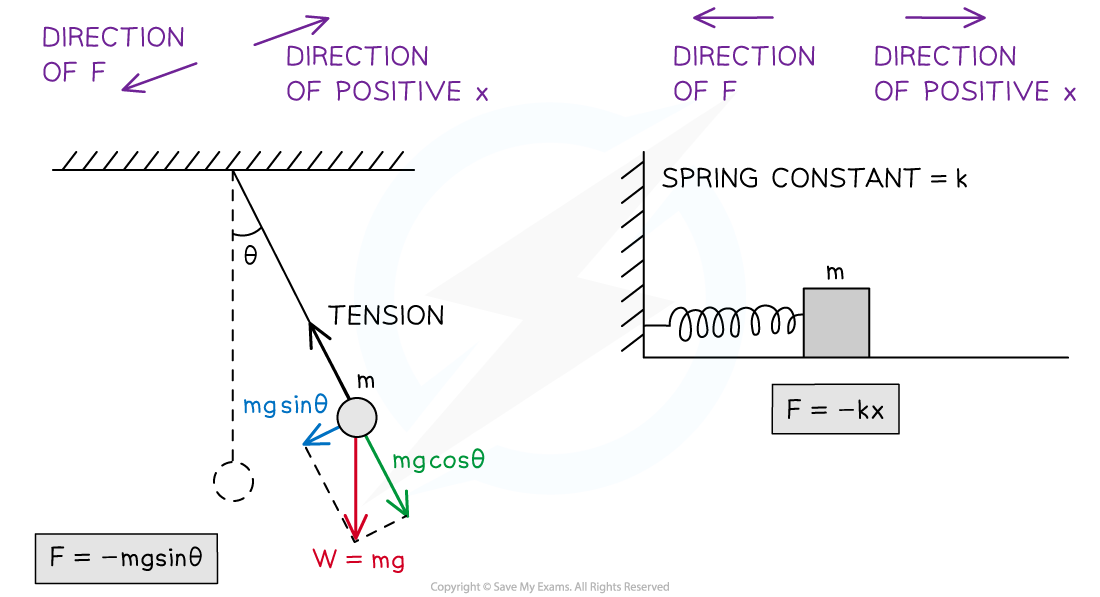
For a pendulum, the restoring force is provided by the component of the bob's weight that is perpendicular to the tension in the pendulum's string. For a mass-spring system, the restoring force is provided by the force of the spring.
- For a mass-spring system in simple harmonic motion, the relationship between the restoring force and the displacement of the object can be written as follows:
F = – kx
- Where:
- F?= restoring force (N)
- k?= spring constant (N m–1)
- x?= displacement from the equilibrium position (m)
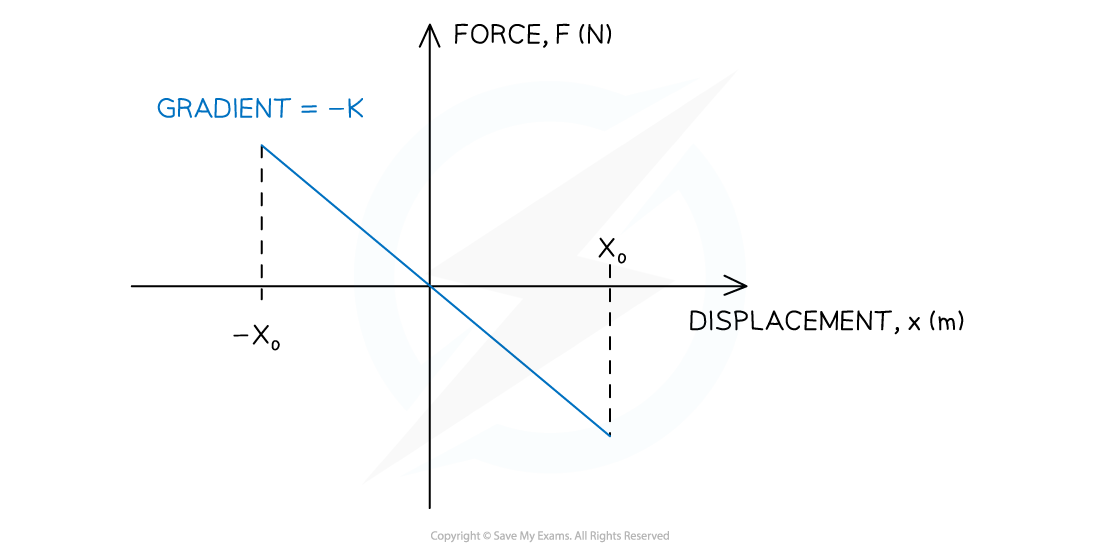
Graph of force against displacement for an object oscillating with SHM
- Force and displacement in SHM have a?linear?relationship where the gradient of the graph represents the constant
- In this case, the spring constant?k
- An object in SHM will also have a restoring force to return it to its equilibrium position
- This restoring force will be directly proportional, but in the?opposite direction, to the displacement of the object from its equilibrium position
Acceleration & Displacement
- According to?Newton's Second Law, the net force on an object is directly proportional to the object's acceleration,?F?∝?a?for a constant mass
F?=?ma
- Where
- F?= force (N)
- m?= mass (kg)
- a?= acceleration (m s?2)
- Since?F?=?ma?(Newton's second law), and?F?= ?kx?(Hooke's law), the equations can be set as equal to one another:
ma = – kx
- Rearranging to show the relationship between acceleration and displacement gives:
 This equation shows that
- There is a?linear?relationship between the?acceleration?of the object moving with simple harmonic motion and its?displacement?from its equilibrium position
- The?minus?sign shows that when the mass on the spring is displaced to the?right
- The direction of the acceleration is to the?left?and vice versa
- In other words,?a?and?x?are always in opposite directions to each other
- This equation shows acceleration is?directly proportional?but in the?opposite direction?to displacement for an object in SHM
a?∝ ?x
- Therefore, it can be stated that:
a?= ?kx
- Where
- a?= acceleration
- k?= is a constant but in this instance?not?the spring constant
- x?= displacement
- Note that in physics,?k?is the standard letter used for an?undefined constant
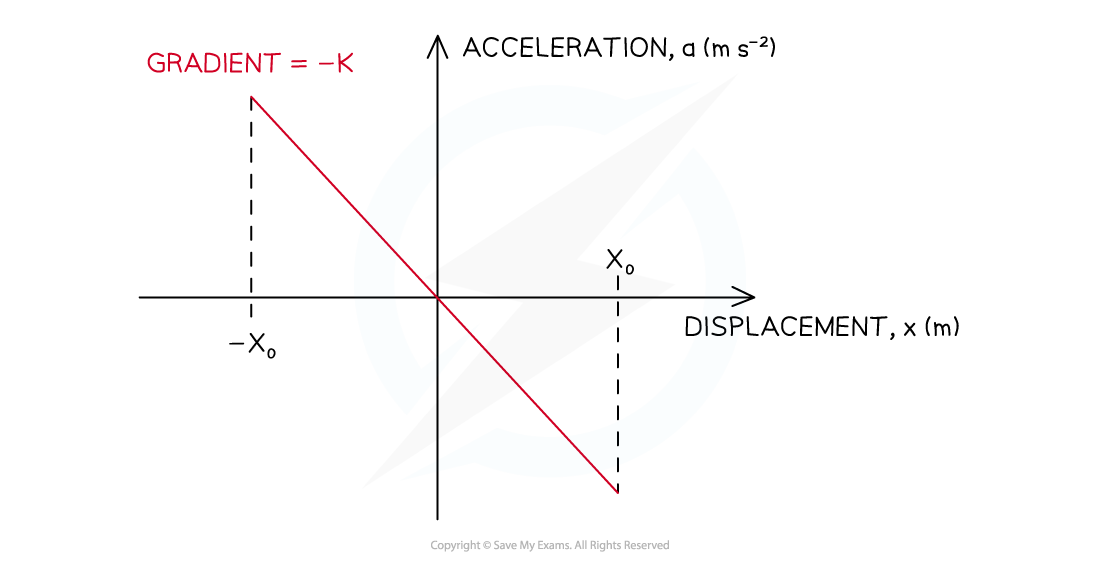
Graph of acceleration against displacement for an object oscillating with SHM
Worked Example
A pendulum's bob oscillates about a central equilibrium position. The amplitude of the oscillations is 4.0 cm. The maximum value of the bob's acceleration is 2.0 m s–2.
Determine the magnitude of the bob's acceleration when the displacement from the equilibrium position is equal to 1.0 cm.
You may ignore energy losses.
Step 1: List the known quantities
-
- Amplitude of the oscillations,?x0?= 4.0 cm = 0.04 m
- Maximum acceleration,?a?= 2.0 m s–2
- Displacement,?x?= 1.0 cm = 0.01 m
Remember to convert the amplitude of the oscillations and the displacement from centimetres (cm) into metres (m)
Step 2: Recall the relationship between the maximum acceleration?a?and the displacement?x
-
- The maximum acceleration?a?occurs at the position of maximum displacement?x?=?x0
a = – kx0
Step 3: Rearrange the above equation to calculate the constant of proportionality?k

Step 4: Substitute the numbers into the above equation

k?= – 50 s–2
Step 5: Use this value of?k?to calculate the acceleration?a'?when the displacement is?x?= 0.01 m
a'?= –?kx
a'?= – (– 50) s–2× 0.01 m
a'?= 0.50 m s–2
轉載自savemyexams
以上就是關于【IB DP Physics: SL復習筆記4.1.2 Simple Harmonic Oscillations】的解答,如需了解學校/賽事/課程動態,可至翰林教育官網獲取更多信息。
往期文章閱讀推薦:
翰林獨家 | 經濟學競賽核心精講,一冊打通NEC/IEO/USAEBO!
2026 AMC10/12美國數學競賽新賽季!【翰林教育 × 清華大學出版社】獨家教材全面發售!


翰林AMC8視頻課重磅上線!

國際競賽真題資源免費領取






