IB DP Biology: SL復習筆記3.2.3 Genetic Variation

Genetic Variation & Meiosis
Crossing over and random orientation promote genetic variation
- Having?genetically different offspring?can be?advantageous?for natural selection and therefore increase the survival chances of a species
- Meiosis?has several mechanisms that?increase the genetic variation of gametes?produced
- Both?crossing over?and?random orientation?result in?different combinations of?alleles?in gametes
Crossing over
- Crossing over is the process by which?non-sister chromatids exchange alleles
- Process:
- During prophase I of meiosis homologous chromosomes pair up and are in very close proximity to each other
- A pair of homologous chromosomes can be referred to as a?bivalent
- At this point, there can be an exchange of genetic material?(alleles)?between?non-sister chromatids?in the bivalent
- The crossing points are called?chiasmata
- This results in a?new combination of alleles on the two chromosomes?(these can be referred to as?recombinant chromosomes)
- During prophase I of meiosis homologous chromosomes pair up and are in very close proximity to each other
- This swapping of alleles is a significant source of genetic variation because it can occur at multiple random positions along the chromosome
- Crossing over can happen anywhere along the chromosome but is more likely to occur further down the chromosome away from the centromere
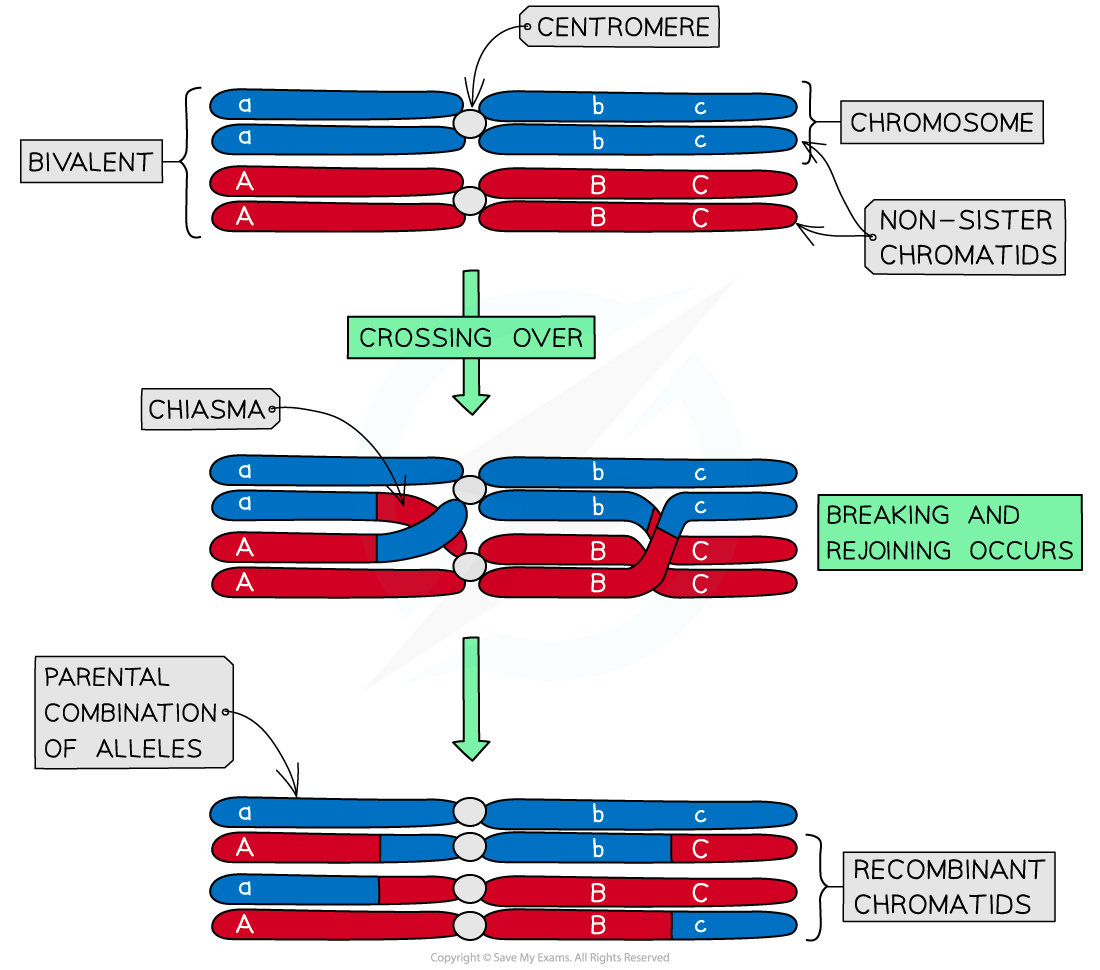
Crossing over occurring between two non-sister chromatids
Random orientation
- The?random orientation of homologous pairs along the equator of the cell?during?metaphase I?result in the production of?different allele combinations in daughter cells
- In prophase I, homologous chromosomes pair up and in metaphase I, they align along the equator of the cell
- Each pair can be arranged with?either chromosome on top, this is completely random
- The?orientation of each homologous pair?is?random/independent?(unaffected by the orientation of any other pair)
- In anaphase I the homologous chromosomes are?separated?and pulled apart to different poles
- The combination of alleles that end up in each daughter cell depends on how the pairs of homologous chromosomes were lined up
- The different combinations of chromosomes in daughter cells increases genetic variation between gametes
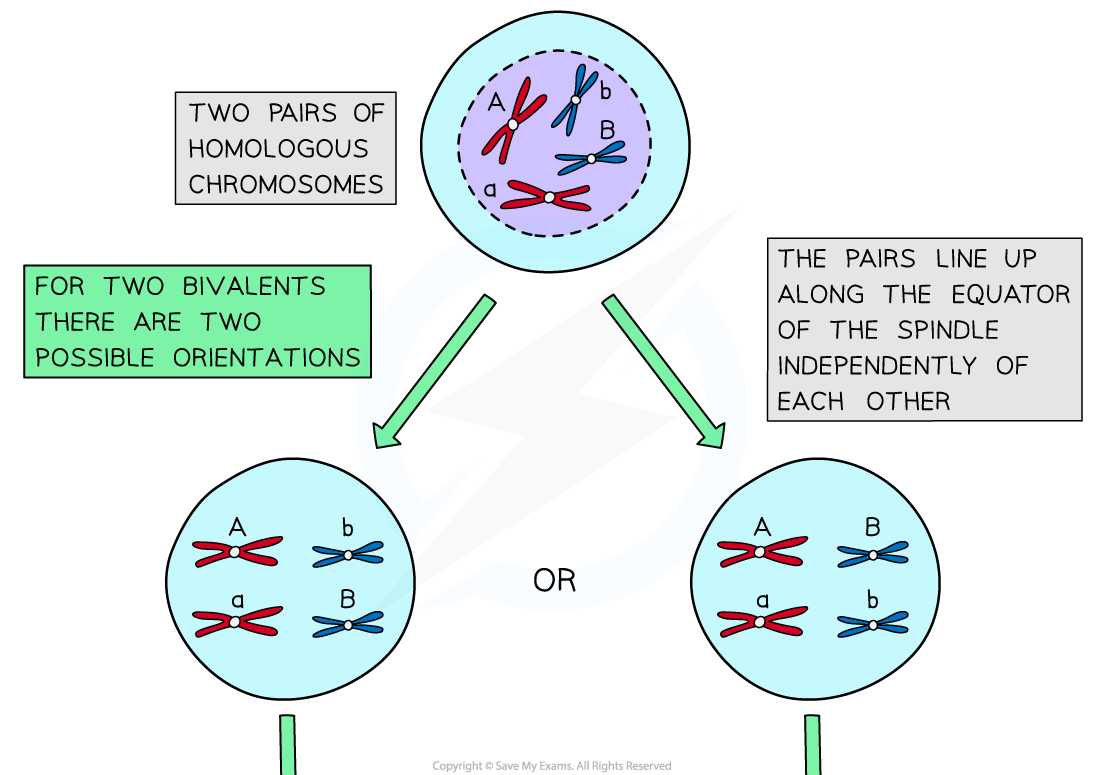
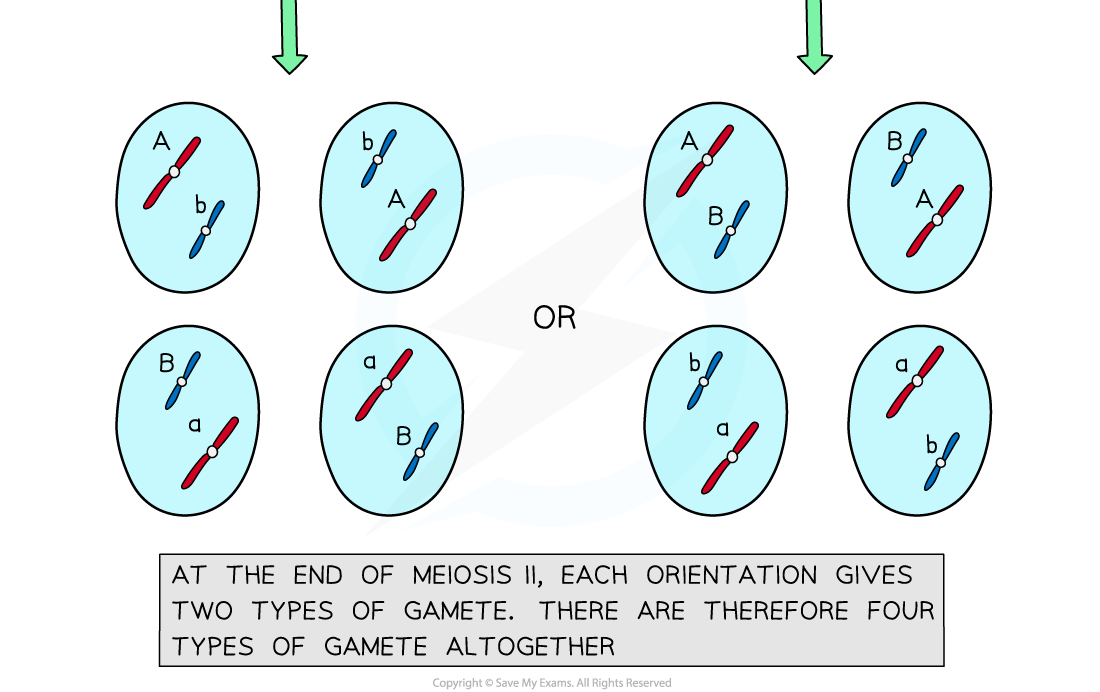
The random orientation of homologous chromosomes leads to different genetic combinations in daughter cells
The different combinations of chromosomes following meiosis
- The number of possible chromosomal combinations resulting from random assortment is equal to?2n
- n?is the number of homologous chromosome pairs or haploid number
- For humans: the number of chromosomes is 46 meaning the number of homologous chromosome pairs is 23 so the calculation would be:
- 223?= 8,388,608 possible chromosomal combinations
Worked Example
Calculate how many different chromosomal combinations can result from meiosis in a plant species which has a diploid number of 16. Assume no crossing over occurs.[1 mark]
Step 1: Use the relevant formula
2n
Step 2: Calculate the haploid number
Diploid number (2n) = 16
Haploid number (n) =?16?÷?2 = 8
Step 3: Substitute in figures
28?= 256
There are?256 different chromosomal combinations that can occur.
Genetic Variation & Fertilisation
Fusion of gametes from different parents promotes genetic variation
- Meiosis?creates genetic variation?between the gametes?produced by an individual through crossing over and random orientation
- This means each gamete carries substantially?different alleles
- During fertilisation, any male gamete can fuse with any female gamete to form a?zygote
- This?random fusion of gametes?at fertilisation creates genetic variation?between zygotes?as each will have a unique combination of alleles
The different combinations of chromosomes following fertilisation
- In random fertilisation,?any two gametes may fuse together
- Therefore the formula to calculate the number of combinations of chromosomes after the random fertilisation of two gametes is?(2n)2
- n?is the haploid number and?2?is the number of gametes
- Therefore in humans, when the haploid number is 23, the number of combinations following fertilization is (223)2--??= 70,368,744,177,664
- This explains why relatives can differ so much from each other. Even with the same parents, individuals can be genetically distinct due to variation at the meiosis and fertilization stage (as well as other possible mutations and crossing-over)
Worked Example
Calculate the number of different possible chromosome combinations after the random fertilization of an ovule and pollen nuclei from the same plant species (Diploid number = 16).[2 marks]
Step 1: State?formula for random fertilisation between any two gametes
(2n)2
Step 2:?Use information from question to state haploid number
n = 8
Step 3:?Substitute in figures
(2n)2
(28)2
Answer ?65,536
Exam Tip
These sources of genetic variation explain why relatives can differ so much from each other. Even with the same parents, individuals can be genetically distinct due to the processes outlined above.While we can calculate the number of chromosomal combinations that result from random orientation and random fertilisation, the number of combinations from crossing over is infinite, or as good as!
轉載自savemyexams
以上就是關于【IB DP Biology: SL復習筆記3.2.3 Genetic Variation】的解答,如需了解學校/賽事/課程動態,可至翰林教育官網獲取更多信息。
往期文章閱讀推薦:
翰林獨家 | 經濟學競賽核心精講,一冊打通NEC/IEO/USAEBO!
2026 AMC10/12美國數學競賽新賽季!【翰林教育 × 清華大學出版社】獨家教材全面發售!


翰林AMC8視頻課重磅上線!

國際競賽真題資源免費領取






