IB DP Physics: HL復(fù)習(xí)筆記4.2.4 Sound Waves

Sound Waves
- Sound waves are?longitudinal waves?and, as such, require a?medium?in which to propagate
- Sound waves are generated by oscillating sources, which produce a change in?density?of the surrounding medium
- The sound wave then travels with a series of?compressions?and?rarefactions
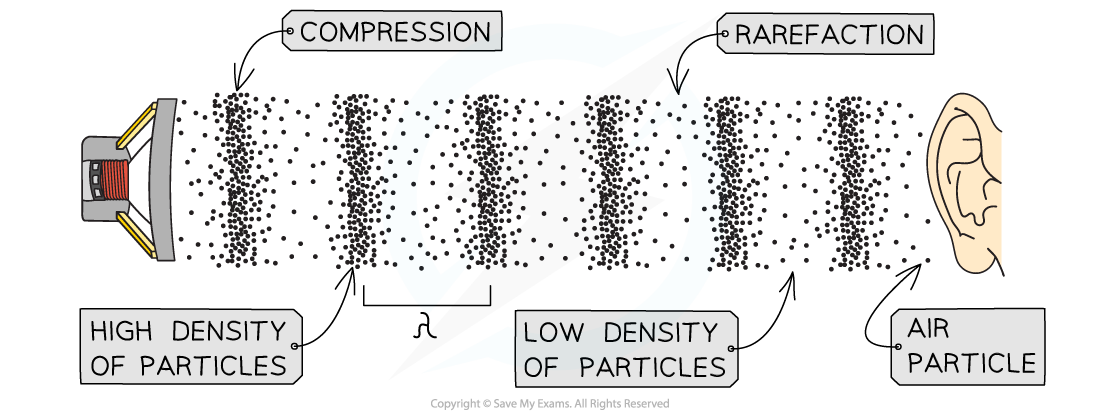
A sound wave travelling through air
- Sound waves form a continuous?spectrum?based on their frequency
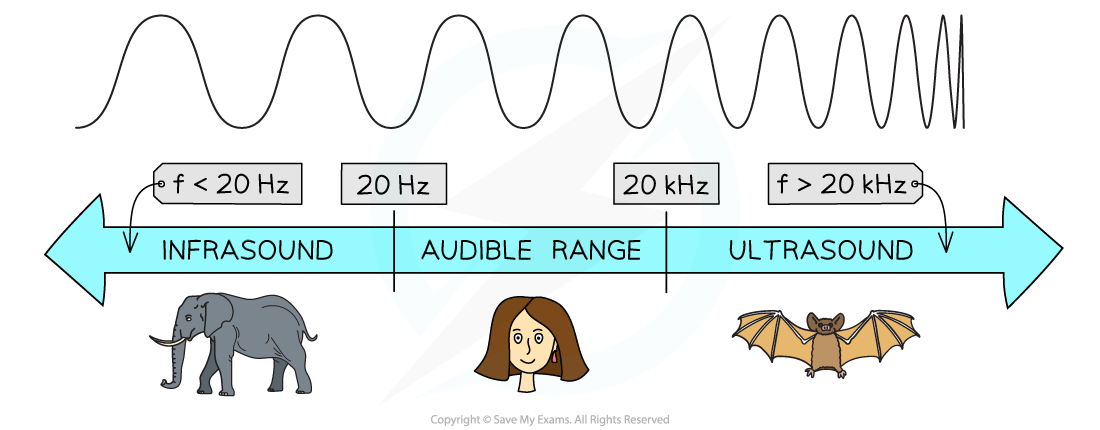
The spectrum of sound waves
- Humans can only hear sounds with frequencies in the range 20 Hz - 20 kHz, known as the?audible range?
- Sounds with frequencies below and above this range cannot be detected by the human ear
Pitch and Volume
- The?frequency?of a sound wave is related to its?pitch
- Sounds with a?high?pitch have a?high?frequency (or short wavelength)
- Sounds with a?low?pitch have a?low?frequency (or long wavelength)
- The?amplitude?of a sound wave is related to its?volume
- Sounds with a?large?amplitude have a?high?volume
- Sounds with a?small?amplitude have a?low?volume
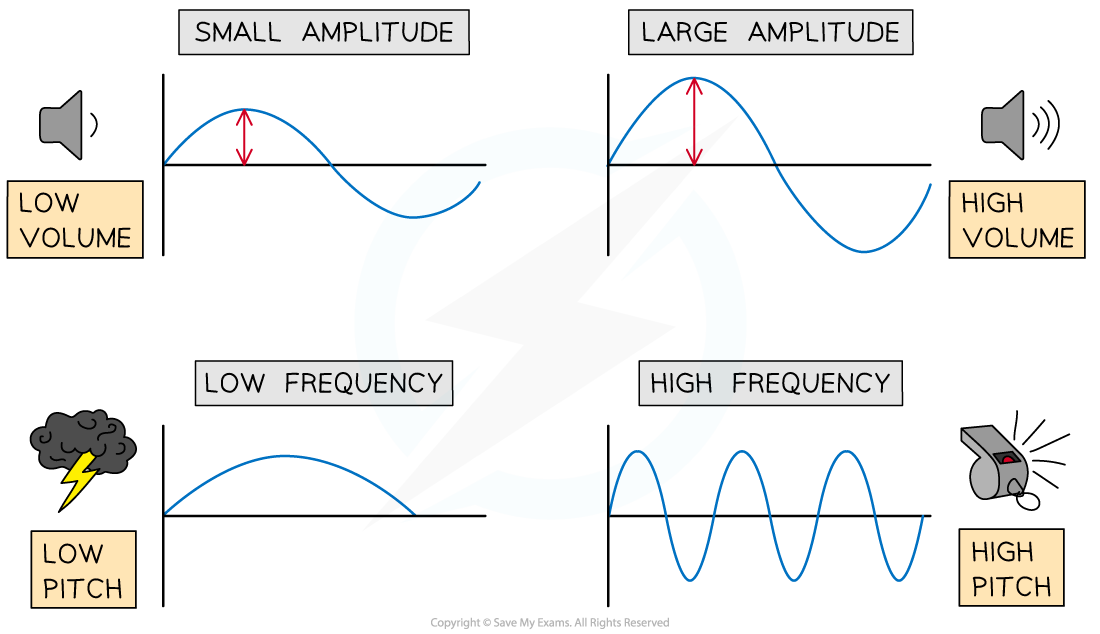
Pitch and amplitude of sound
Speed of Sound
- Sound waves travel at a speed of about 340 m s–1?in air at room temperature
- The higher the air temperature, the greater the speed of sound
- The is because the average kinetic energy of the particles is higher
- Sound travels the?fastest?through?solids, since solid particles are closely packed and can pass the oscillations onto their neighbours much faster
- Sound travels the?slowest?in?gases, since gas particles are spread out and less efficient in transferring the oscillations to their neighbours
Echo
- Sound waves?reflect?off hard surfaces
- This phenomenon is known as?echo
- Echo can be used to obtain an experimental value of the speed of sound. This is calculated using the equation

- Where:
- v?= speed of sound in metres per second (m s–1)
- d?= distance between the sound source and the hard surface (m)
- t?= time taken to travel from the source to the hard surface and back (s)
Measuring the Speed of Sound Experimentally - Fast Timer
- The speed of sound can be measured using a fast timer (one which can measure to the nearest millisecond or even microsecond)
- Two microphones separated 1 m apart are connected to a fast timer
- The first microphone triggers the timer to start
- The second microphone triggers the timer to stop
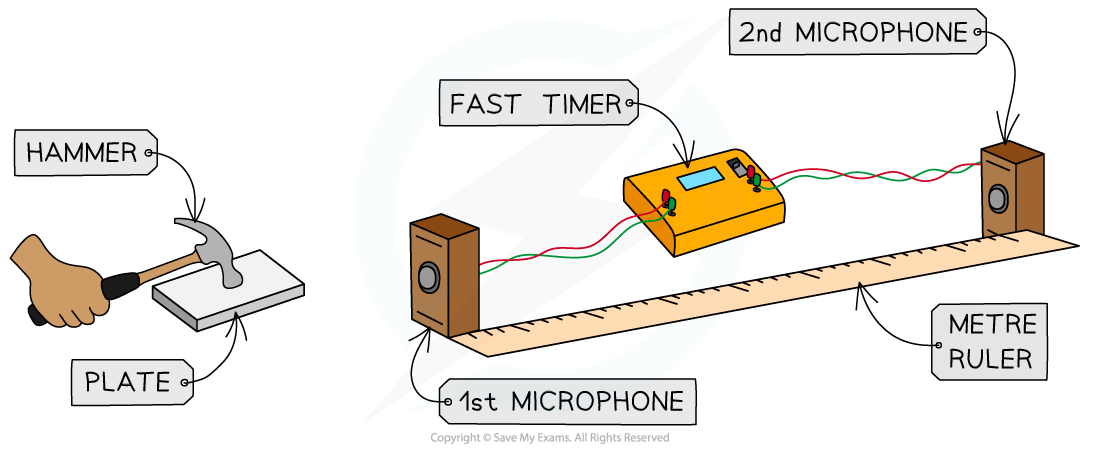
- A hammer is made to strike a plate
- The sound waves from the plate travel to the two microphones triggering the first and then the second
- The time delay will be around 3.2 ms
- The speed of the waves can be calculated by rearranging the equation:?distance = speed?×?time
Measuring the Speed of Sound Experimentally - Double Beam Oscilloscope
- Two microphones are connected to the input of a double beam oscilloscope
- A signal generator is connected to a loudspeaker and set to a frequency between 500 Hz and 2.0 kHz
- One of the microphones is close to the loud speaker
- The other microphone is 1 m away
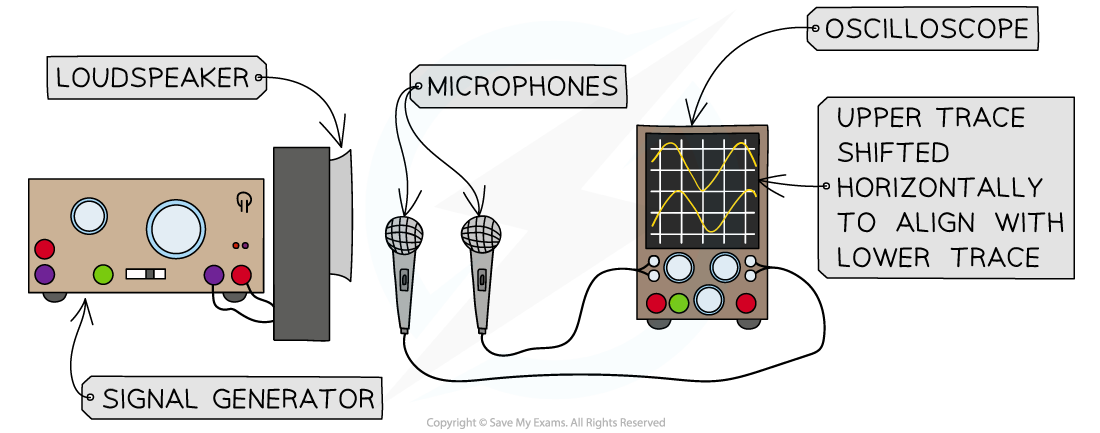
- There will be two traces that appear on the screen
- The traces are compared as the second microphone is moved back and forth in line with the first microphone and the speaker
- Use a ruler to measure the distance that the second microphone needs to move for the traces to be in phase then out and phase and back in phase again
- This distance is equal to the wavelength of the wave
- The speed of the waves are therefore calculated using?c?=?fλ
Worked Example
A person stands 50 m from a wall. The person claps their hands repeatedly, and changes the clapping frequency until the echoes are synchronised with the claps. A mobile phone application measures the time between the claps, which is?t = 0.30 s. Determine the speed of sound.
Step 1: Write down the known quantities
-
- Distance between the person and the wall,?d?= 50 m
- Time between the claps,?t?= 0.30 s
Step 2: Write down the "echo equation"?
Step 3: Substitute the numbers into the above equation and calculate the speed of sound?v

v?= 330 m s–1
轉(zhuǎn)載自savemyexams
以上就是關(guān)于【IB DP Physics: HL復(fù)習(xí)筆記4.2.4 Sound Waves】的解答,如需了解學(xué)校/賽事/課程動態(tài),可至翰林教育官網(wǎng)獲取更多信息。
往期文章閱讀推薦:
翰林獨家 | 經(jīng)濟學(xué)競賽核心精講,一冊打通NEC/IEO/USAEBO!
2026 AMC10/12美國數(shù)學(xué)競賽新賽季!【翰林教育 × 清華大學(xué)出版社】獨家教材全面發(fā)售!


翰林AMC8視頻課重磅上線!

國際競賽真題資源免費領(lǐng)取






