IB DP Chemistry: HL復(fù)習(xí)筆記15.1.3 Born-Haber Cycle Calculations

Born-Haber Cycle Calculations
- Once a Born-Haber cycle has been constructed, it is possible to calculate the lattice energy (ΔHlat?) by applying Hess’s law and rearranging:
ΔHf??= ΔHat??+ ΔHat??+?IE?+?EA?+ ΔHlat?
- If we simplify this into three terms, this makes the equation easier to see:
- ΔHlat?
- ΔHf?
- ΔH1??(the sum of all of the various enthalpy changes necessary to convert the elements in their standard states to gaseous ions)
- The simplified equation becomes:
ΔHf??= ΔH1??+ ΔHlat?
- So, if we rearrange to calculate the lattice energy, the equation becomes
ΔHlat??= ΔHf??- ΔH1?
- When calculating the ΔHlat?, all other necessary values will be given in the question
- A Born-Haber cycle could be used to calculate any stage in the cycle
- For example, you could be given the lattice energy and asked to calculate the enthalpy change of formation of the ionic compound
- The principle would be exactly the same
- Work out the?direct?and?indirect route?of the cycle (the stage that you are being asked to calculate will always be the direct route)
- Write out the equation in terms of enthalpy changes and rearrange if necessary to calculate the required value
- Remember:?sometimes a value may need to be doubled or halved, depending on the ionic solid involved
- For example, with MgCl2?the value for the first electron affinity of chlorine would need to be doubled in the calculation, because there are two moles of chlorine atoms
- Therefore, you are adding?2 moles?of electrons to?2 moles?of chlorine atoms, to form?2 moles?of chloride ions, i.e. 2Cl-
Worked Example
Calculating the lattice energy of KClGiven the data below, calculate the ΔHlat??of potassium chloride (KCl) ?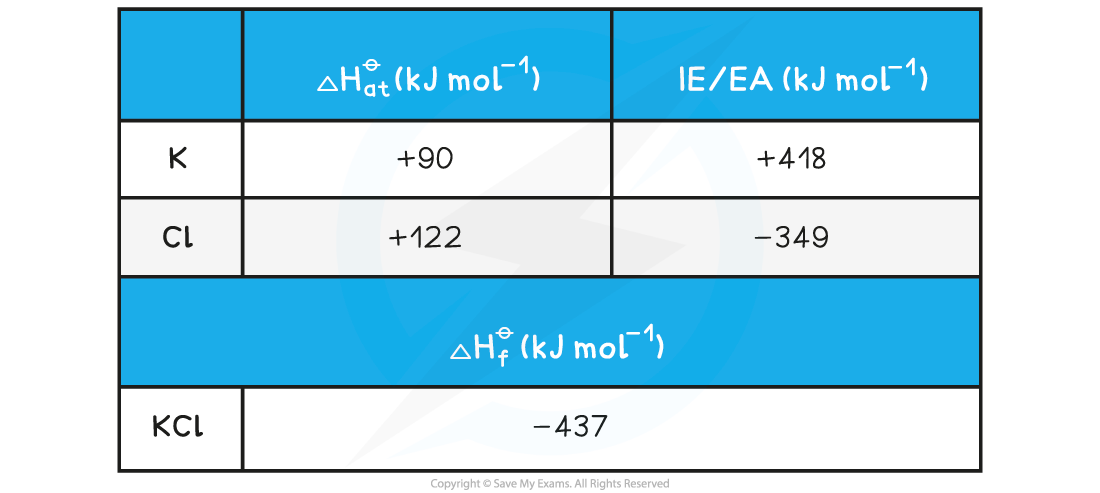
Answer
Step 1: Construct the Born-Haber cycle
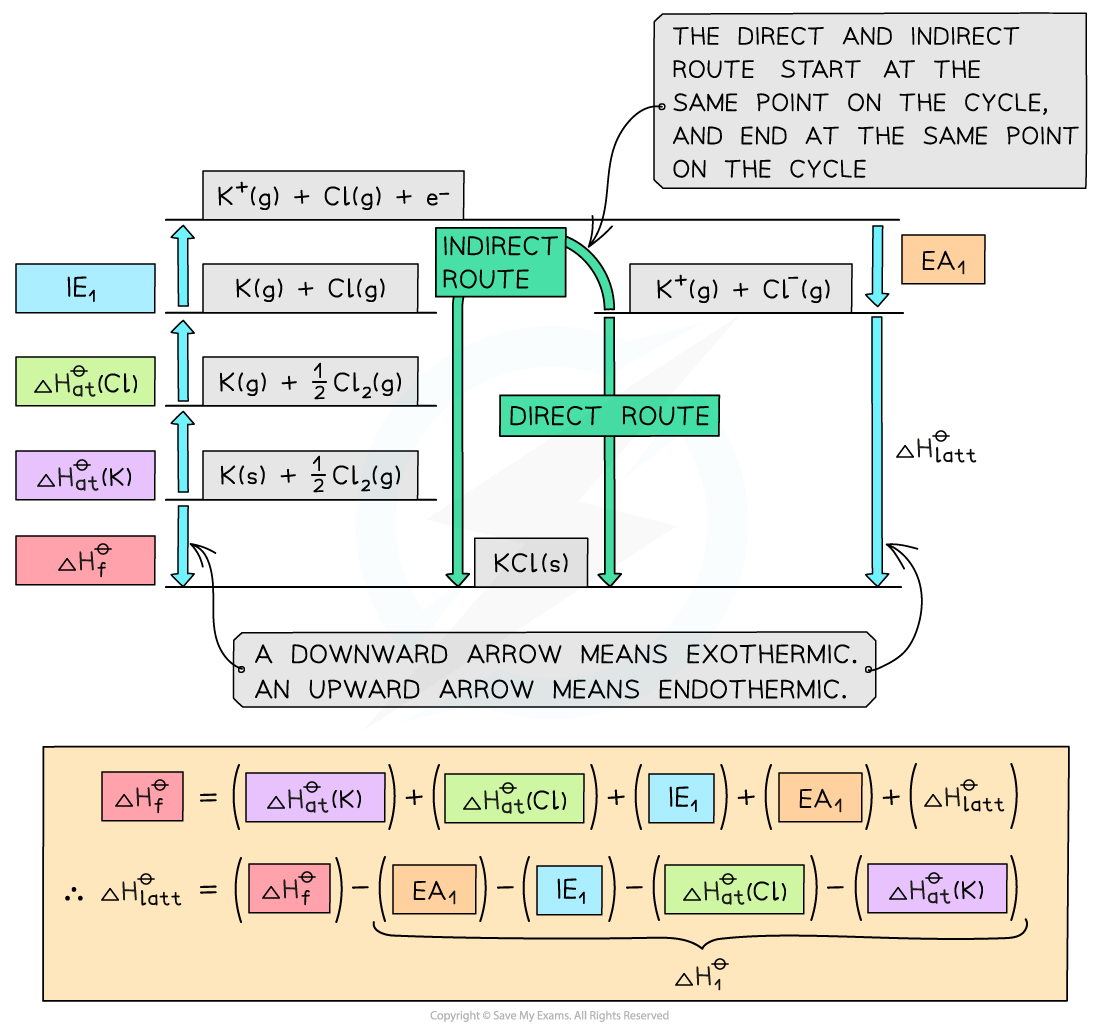
Step 2:?Applying Hess’ law, the lattice energy of KCl is:
ΔHlat??= ΔHf??- ΔH1?
ΔHlatt??= ΔHf??- [(ΔHat??K) + (ΔHat??Cl) + (IE1?K) + (EA1?Cl)]
Step 3:?Substitute in the numbers:
ΔHlat??= (-437) - [(+90) + (+122) + (+418) + (-349)]?= -718 kJ mol-1
Worked Example
Calculating the lattice energy of MgOGiven the data below, calculate the of ΔHlat??magnesium oxide of magnesium oxide (MgO)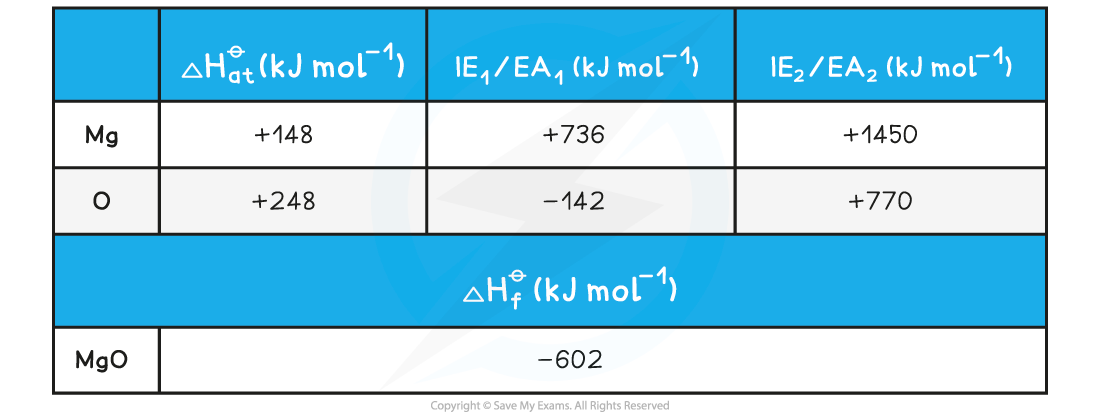
Answer
Step 1: Construct the Born-Haber cycle
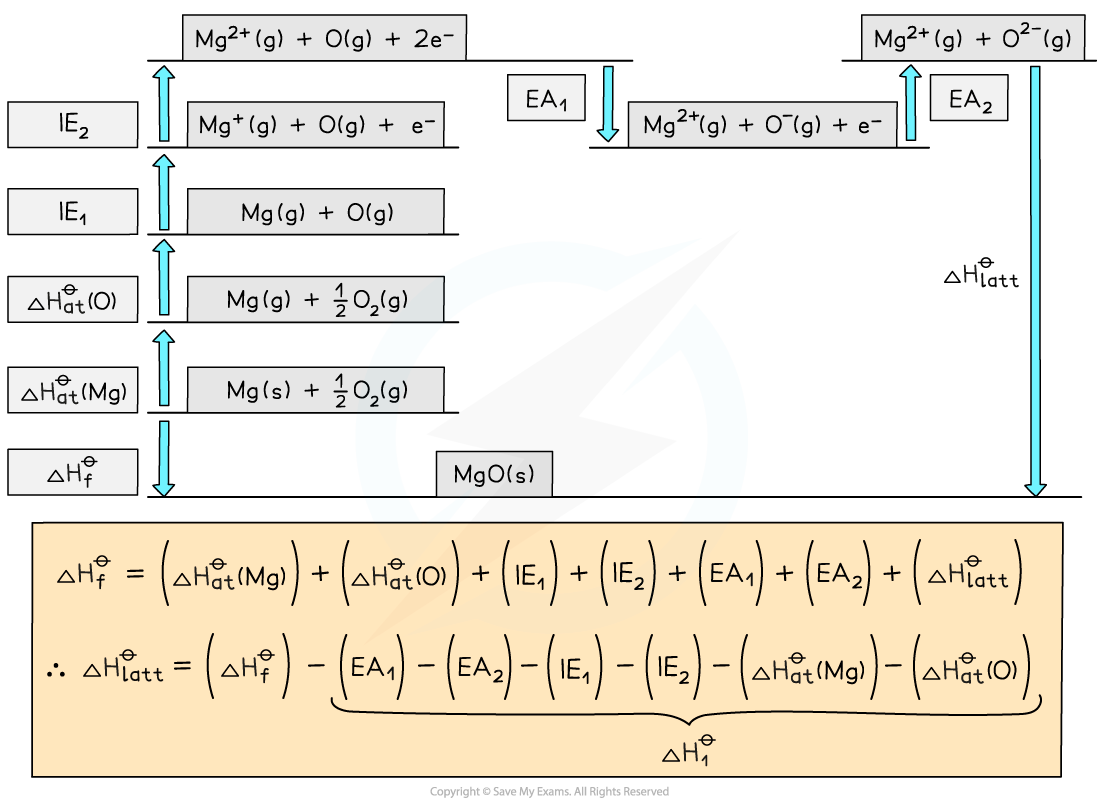
Step 2:?Applying Hess’ law, the lattice energy of MgO is:
ΔHlatt??= ΔHf??- ΔH1?
ΔHlat??= ΔHf??- [(ΔHat??Mg) + (ΔHat??O) + (IE1?Mg) + (IE2?Mg) + (EA1?O) + (EA2?O)]
Step 3:?Substitute in the numbers:
ΔHlat??= (-602) - [(+148) + (+248) + (+736) + (+1450) + (-142) + (+770)]
= -3812 kJ mol-1
Size & Charge of Ions & Lattice Enthalpy
Factors affecting lattice enthalpy
- The two key factors which affect lattice energy, ΔHlat?, are the?ionic charge?and?ionic?radii?of the ions that make up the?crystalline lattice
Ionic Radius
- The radius of the anion increases as you move down a group
- As the distance between the bonded ions increases, the strength of the electrostatic attraction decreases
- This is reflected by a decrease in the lattice enthalpy
- The lattice enthalpy becomes?more negative?or?more exothermic?as the?ionic?radius?of the ions?increases
- This is because the charge on the ions is more?spread?out?over the ion when the ions are?larger
- The ions are also further apart from each other in the lattice
- The attraction between ions is between the centres of the ions involved, so the bigger the ions the bigger the distance between the centre of the ions
- Therefore, the?electrostatic forces of?attraction?between the oppositely charged ions in the lattice are?weaker
- For example, down group 17, the ionic radii increases which directly influences the lattice enthalpy
Lattice enthalpies of sodium halides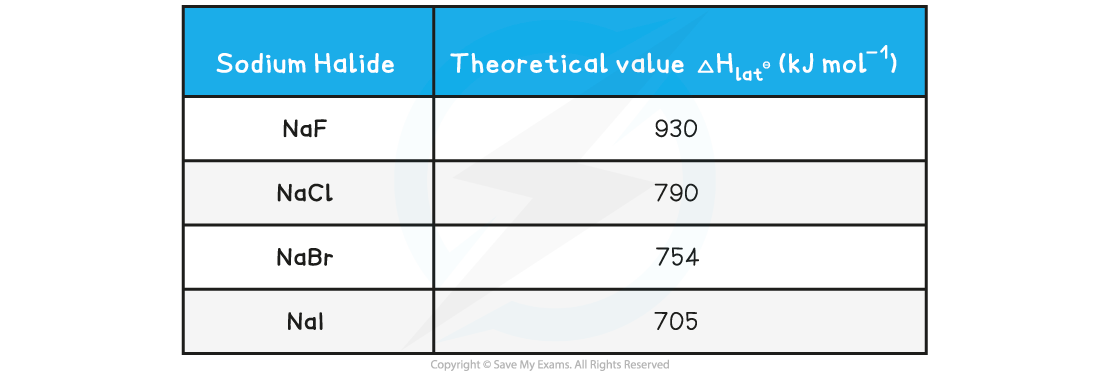
Ionic Charge
- Increasing the ionic charge will result in an increased attraction between oppositely charged ions
- This will increase the energy required to break the lattice apart, and therefore increase the lattice enthalpy (becomes?more positive?or?more endothermic)
- The greater the ionic charge, the?higher the charge density
- This results in?stronger electrostatic attraction?between the oppositely charged ions in the lattice
- As a result, the lattice enthalpy is more endothermic
- For example, the lattice energy of calcium oxide (CaO) is?more endothermic than the lattice energy of potassium chloride (KCl)
Lattice enthalpies with varying ionic charges and radii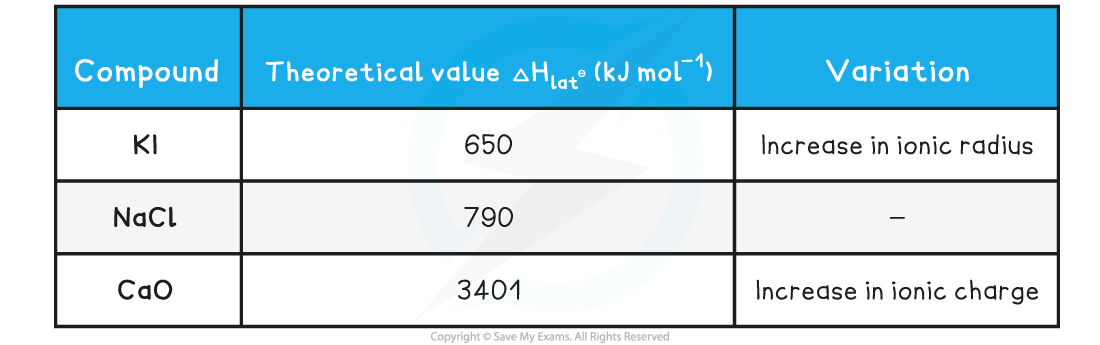
Exam Tip
The answers for these calculations are given as negative values, which shows they are exothermicWe discussed earlier that values for lattice enthalpy are positive values as the lattice is being broken. Essentially this is lattice dissociation enthalpy and is an endothermic process.Lattice formation enthalpy will give a negative value which has been calculated using the Born-Haber cycles. This gives us the energy released when a lattice is formed from its scattered gaseous ions.
轉(zhuǎn)載自savemyexams
以上就是關(guān)于【IB DP Chemistry: HL復(fù)習(xí)筆記15.1.3 Born-Haber Cycle Calculations】的解答,如需了解學(xué)校/賽事/課程動態(tài),可至翰林教育官網(wǎng)獲取更多信息。
往期文章閱讀推薦:
翰林獨家 | 經(jīng)濟學(xué)競賽核心精講,一冊打通NEC/IEO/USAEBO!
2026 AMC10/12美國數(shù)學(xué)競賽新賽季!【翰林教育 × 清華大學(xué)出版社】獨家教材全面發(fā)售!


翰林AMC8視頻課重磅上線!

國際競賽真題資源免費領(lǐng)取






