IB DP Biology: HL復習筆記2.5.2 DNA Replication

DNA Replication
- The replication of DNA is semi-conservative and depends on complementary base pairing
- Semi-conservative means that?one strand of the 'parent' DNA is kept?in the 'daughter' molecule
- This is called the?template strand
- The other half is determined by the code on the template strand and is built up from?free nucleotides?in the nuclear space around the chromosomes
- This takes place in the?nucleus
- Nucleotides are added?one by one?to the new strand according to the rules of?complimentary?base-pairing
- If an?adenine?is the next exposed base on the original strand, a?thymine?nucleotide is added and?vice versa
- If a?cytosine?is the next exposed base on the original strand, a?guanine?nucleotide is added and?vice versa
Hydrogen bonds?can only form between the template strand and the new strand if the?correct bases?are paired up
- Therefore, the new DNA molecule has?kept half?of the parent DNA and then used this to create a new, daughter strand
Exam Tip
Make sure you don’t confuse ‘parent cell’ with ‘parent organism’. A?parent cell?is any cell in the body that divides into two cells and the terminology is used to refer to the?‘original’ cell?that the DNA came from before it was split and replicated semi-conservatively.
Enzymes Involved in Replication
- Helicase unwinds the double helix and separates the two strands by breaking hydrogen bonds
- DNA replication occurs in preparation for?mitosis,?when DNA must be?doubled?before the parent cell can divide to produce two genetically identical daughter cells
- The enzyme?helicase?first?unwinds the DNA, by flattening out its helical structure
- Analogy - think about?untwisting a rope ladder
Helicase?then causes the?hydrogen bonds to break?between pairs of bases, exposing bases on either strand
- Analogy -?unzipping a zipper
Each of these single polynucleotide DNA strands acts as a template?for the formation of a?new strand?made from free nucleotides that are attracted to the exposed DNA bases by?base pairing
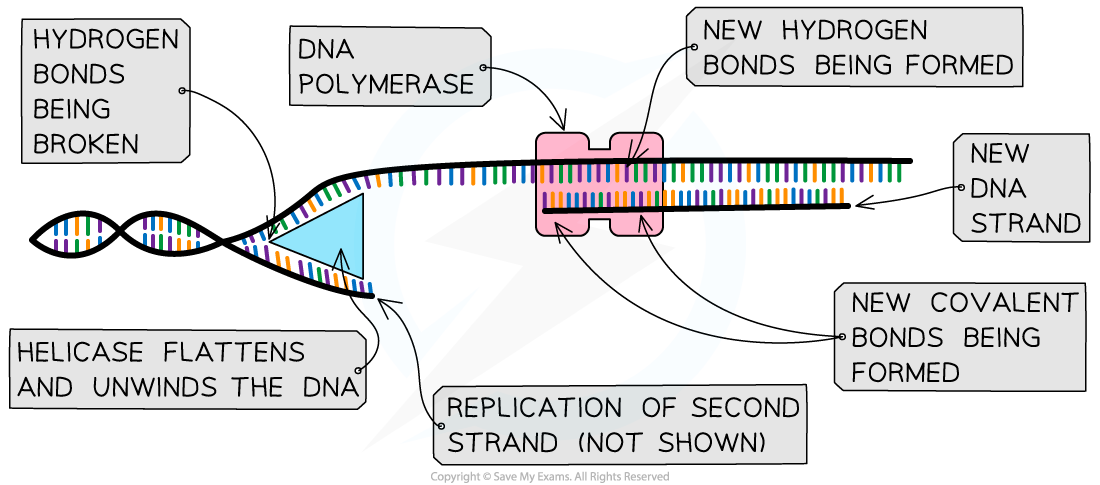
Helicase and DNA polymerase work together to replicate each strand of DNA
- DNA polymerase links nucleotides together to form a new strand, using the pre-existing strand as a template
- Following the action of helicase, the template strand is exposed and new nucleotides are?joined together by DNA polymerase,?which catalyses?condensation reactions,?to form a new strand
- The original strand and the new strand?join together through hydrogen bonding?between base pairs to form the new DNA molecule
- This method of replicating DNA is known as?semi-conservative replication?because?half of the original?DNA molecule is kept (conserved) in each of the two new DNA molecules
- The enzyme?DNA polymerase?synthesises new DNA strands?from the two template strands
- It does this by?catalysing condensation reactions?between the?deoxyribose sugar and phosphate groups?of adjacent nucleotides within the new strands, creating the?sugar-phosphate backbone?of the new DNA strands
- DNA polymerase always works?in the same direction?along a strand of DNA, the 5' to 3' direction
- Adding the?5' terminal?of the new nucleotide to the?3' terminal?of the strand being built
- Hydrogen bonds?then form between the?complementary base pairs?of the template and new DNA strands
- The?copying accuracy?of DNA polymerase is?very high
- Very few copying errors are made in DNA replication
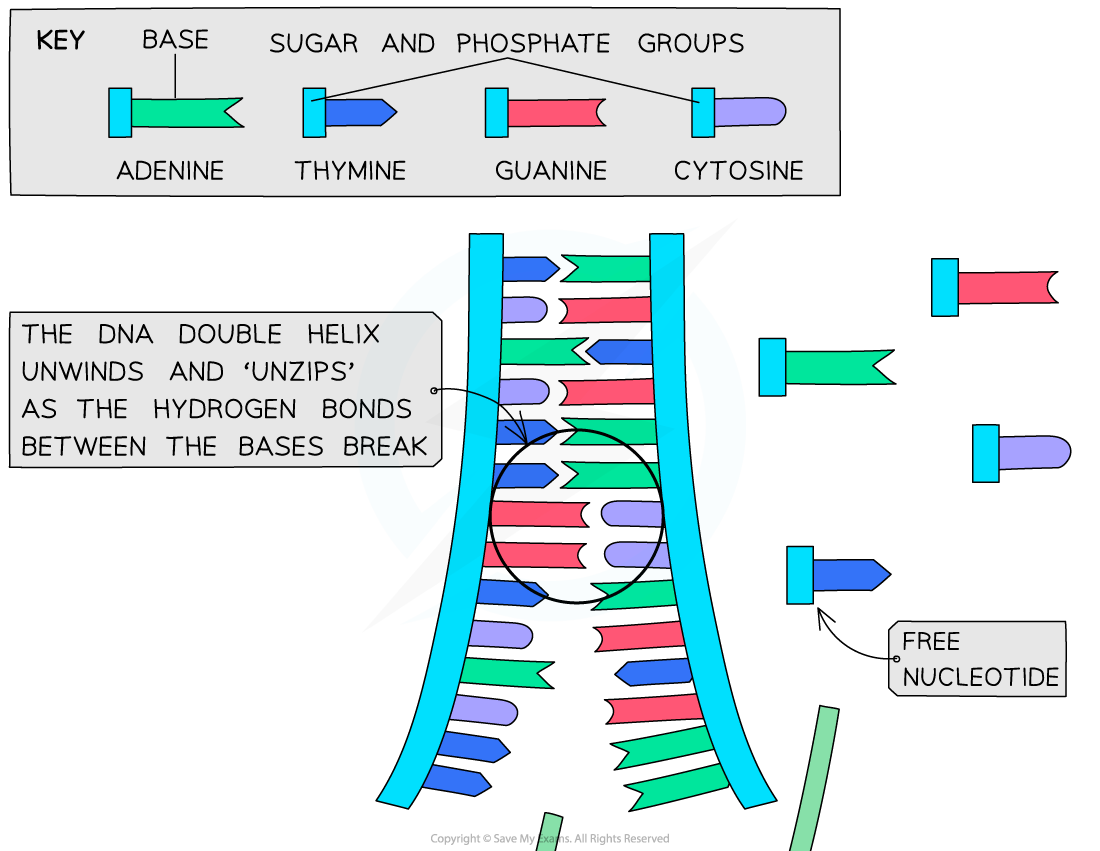
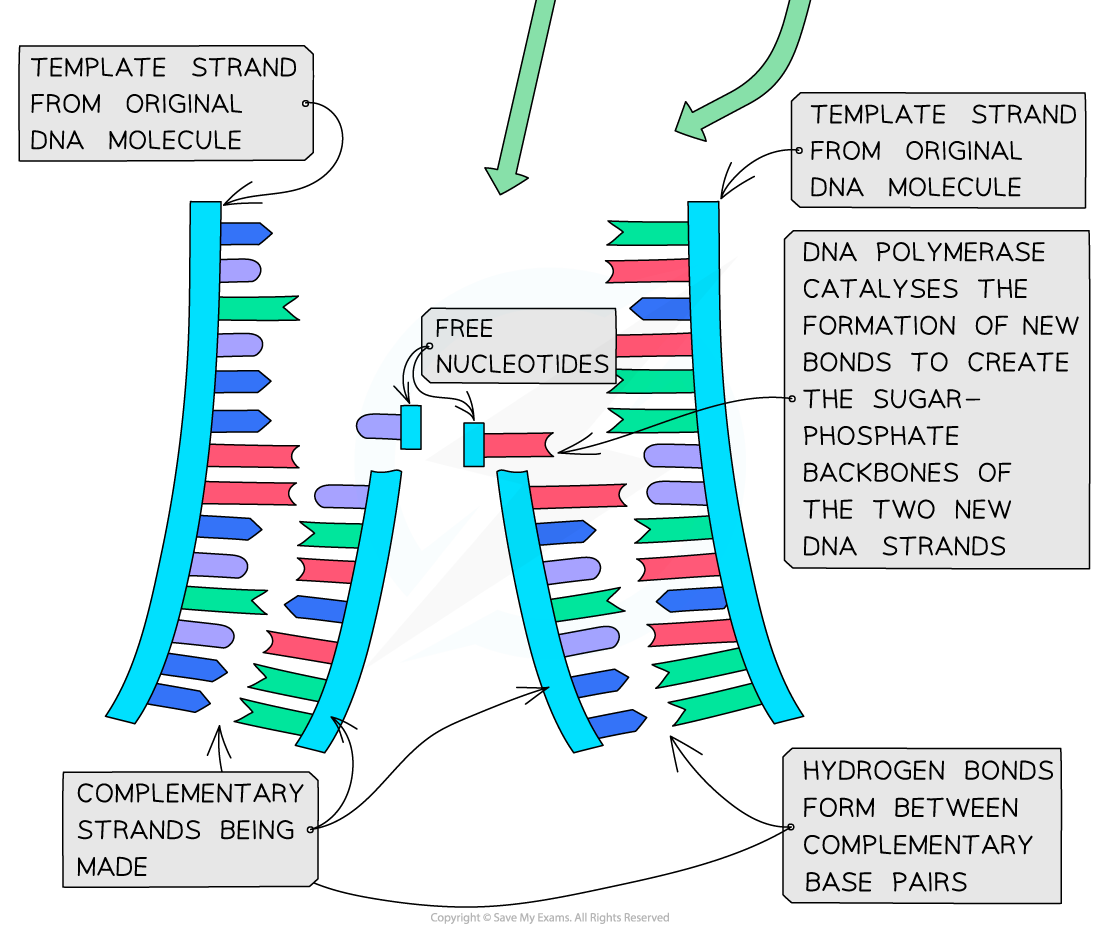
The combined actions of helicase and DNA polymerase create new complementary DNA strands
Semi-Conservation Replication
- DNA polymerase links nucleotides together to form a new strand, using the pre-existing strand as a template
- Before?a (parent) cell?divides, it needs to?copy the DNA?contained within it
- This is so that the two new (daughter) cells produced will both receive the?full copies of the parental DNA
The DNA is copied via a process known as semi-conservative replication?(half the DNA is kept)
- The process is called so because?in each new DNA molecule?produced, one of the polynucleotide DNA strands (half?of the new DNA molecule) is?from the original DNA molecule?being copied
- The other polynucleotide DNA strand (the other half of the new DNA molecule) has to be?newly created by the cell
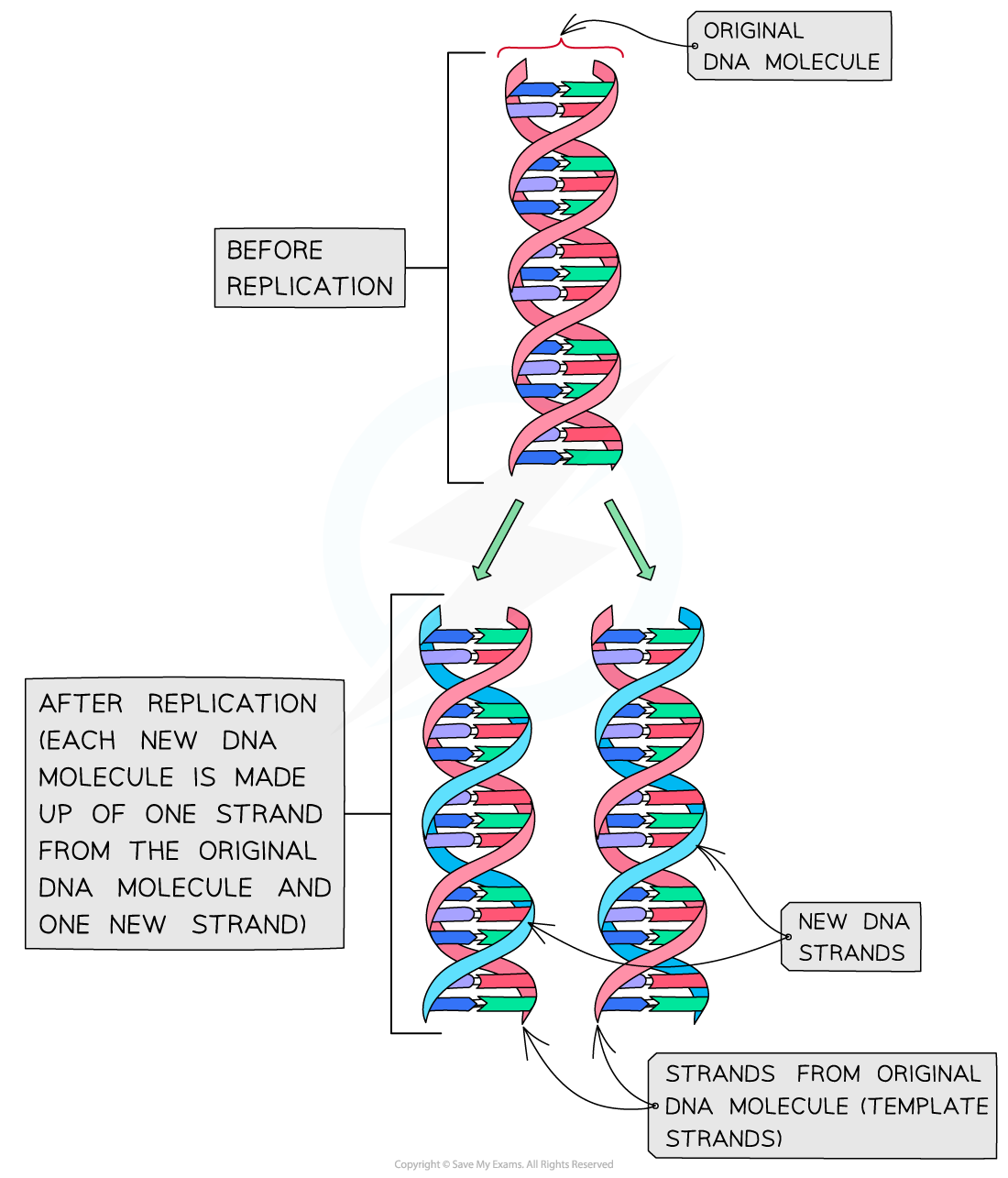
Semi-conservative replication of DNA
The importance of keeping one original DNA strand
- It?ensures?there is?genetic continuity?between generations of cells
- In other words, it ensures that the new cells produced during cell division?inherit all their genes?from their parent cells
This is important because cells in our body are replaced regularly?and therefore we need the new cells to be able to do the same role as the old ones
- Replication of DNA and cell division also occurs during?growth
Crick and Watson proposed semi-conservative replication
- As part of their discovery of the double-helix structure of DNA, Crick and Watson?made a hypothesis about how DNA copies?during cell growth
- They proposed a?semi-conservative?model, but had?not provided the evidence
- This was provided by two later scientists,?Meselson?and?Stahl, in another award-winning piece of research
- Analysis of Meselson and Stahl’s results?gave the necessary support for Crick & Watsons' hypothesis?of semi-conservative replication of DNA
轉載自savemyexams
以上就是關于【IB DP Biology: HL復習筆記2.5.2 DNA Replication】的解答,如需了解學校/賽事/課程動態,可至翰林教育官網獲取更多信息。
往期文章閱讀推薦:
翰林獨家 | 經濟學競賽核心精講,一冊打通NEC/IEO/USAEBO!
2026 AMC10/12美國數學競賽新賽季!【翰林教育 × 清華大學出版社】獨家教材全面發售!


翰林AMC8視頻課重磅上線!

國際競賽真題資源免費領取






