IB DP Biology: HL復習筆記2.3.1 Proteins

Amino Acids & Polypeptides
Proteins
- Proteins are polymers (and macromolecules) made of monomers called?amino acids
- The?sequence, type?and?number?of the amino acids within a protein determines its shape and therefore its function
-
- Enzymes
- Cell membrane proteins (eg. carrier)
- Hormones
- Immunoproteins (eg. immunoglobulins)
- Transport?proteins (eg. haemoglobin)
- Structural?proteins (eg. keratin, collagen)
- Contractile?proteins (eg. myosin)Proteins?are extremely important in cells because they form all of the following:
- Because all genes code for proteins,?all of the reactions necessary for life?are dependent on the function of proteins
Amino acids
- Amino acids are the?monomers?of polypeptides
- There are?20 amino acids?found in polypeptides common to all living organisms
- The general structure of all amino acids is a central carbon atom bonded to:
- An?amine?group -NH2
- A?carboxylic acid?group -COOH
- A?hydrogen?atom
- An?R?group (which is how each amino acid differs and why amino acid properties differ e.g. whether they are acidic or basic or whether they are polar or non-polar)
- The?R group can be as simple as another hydrogen atom (glycine), right through to complex aromatic ring structures? (eg. phenylalanine)
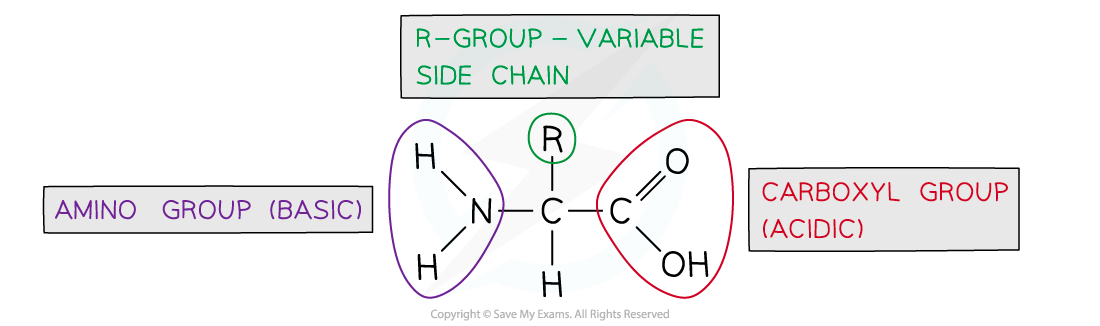
The generalised structure of an amino acid
Peptide bond
- In order to form a?peptide bond?a hydroxyl group (-OH) is lost from the carboxylic group (-COOH) of one amino acid and a hydrogen atom is lost from the amine group (-NH2) of another amino acid
- The remaining carbon atom (with the double-bonded oxygen) from the first amino acid bonds to the nitrogen atom of the second amino acid
- This is a?condensation?reaction so water is released
- Dipeptides?are formed by the condensation of?two?amino acids
- Polypeptides?are formed by the condensation of?many?(3 or more) amino acids
- A protein may have only one polypeptide chain or it may have multiple chains interacting with each other
- During?hydrolysis?reactions, the addition of water?breaks the peptide bonds?resulting in polypeptides being broken down into amino acids
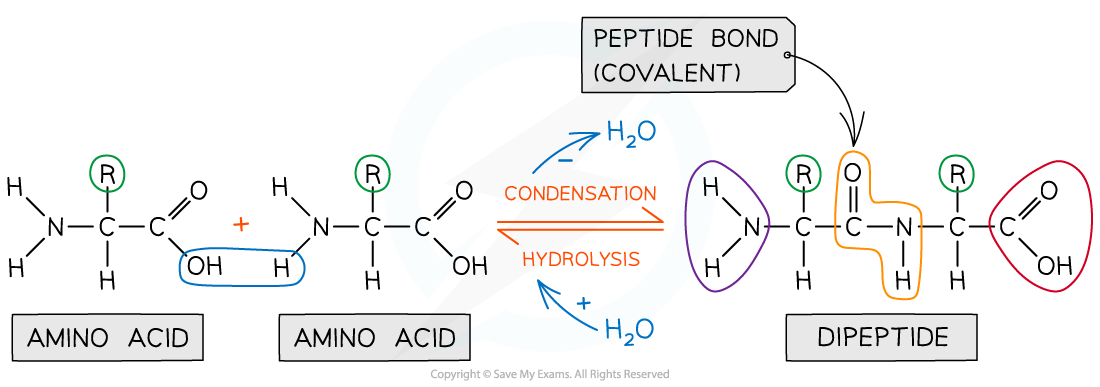
Amino acids are bonded together by covalent peptide bonds to form a dipeptide in a condensation reaction
Exam Tip
You will be expected to recognise whether an unfamiliar molecule is an amino acid or polypeptide so look for the functional groups (amine and carboxyl). When asked to identify the location of the peptide bond, look for where nitrogen is bonded to a carbon that has a double bond with an oxygen atom, note the R group is not involved in the formation of a peptide bond.
Amino Acid Diversity
- The same 20 amino acids make up most of the proteins found on Earth
- Around 500 amino acids have been found in nature, but only?20 are commonly found in proteins
- Eleven?of these can be naturally synthesised within cells by humans
- The other nine amino acids are?essential?(have to be in the human diet)
- You don't need to remember the names of the amino acids, but it's useful to see their names, which are usually?abbreviated to three letters
- Ala, Arg, Asn, Asp, Cys, Gln, Glu, Gly, His*, Ile*, Leu*, Lys*, Met*, Phe*, Pro, Ser, Thr*, Trp*, Tyr, Val*
- *? indicates the essential amino acids
Because the R groups vary so much between the 20 amino acids, there is a?lot of chemical diversity between the amino acids
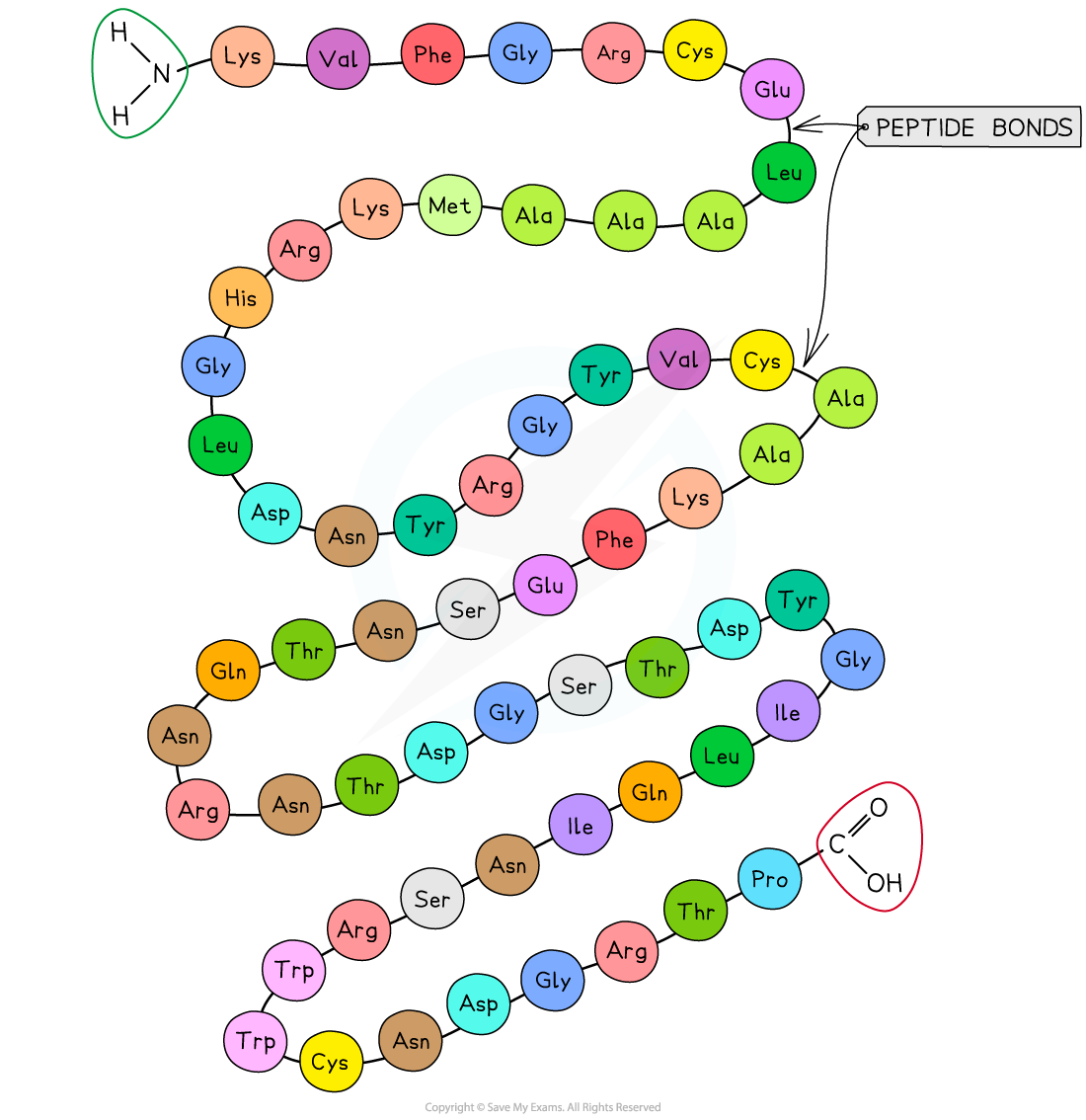
An amino acid sequence of a short polypeptide. The three-letter abbreviations indicate the specific amino acid (there are 20 commonly found in cells of living organisms).
NOS: Looking for patterns, trends and discrepancies; most (but not all) organisms build proteins from the same amino acids.
- All life?except for a few species use these 20 amino acids
- The reason why only 20 amino acids are used has been the subject of a lot of differing hypotheses
- That only these 20 were available at the origins of life, so have remained ever since,?OR
- That these 20 amino acids are diverse enough to give the wide range of functions that proteins possess,?OR
- Because of the theory that all organisms share a common ancestor, the link between the genetic code and amino acid sequence is fixed and is not easily altered, even by mutations
The almost infinite number of amino acid combinations?make polypeptides suitable to determine?all the characteristics of life
- Only a few primitive, single-celled organisms use other amino acids
- One unusual amino acid includes the trace element?selenium?and is found in many polypeptides, though at?very low frequencies
- A discrepancy is that in some organisms, the stop codon UAG codes for this unusual amino acid containing selenium
All life goes by the Central Dogma?that?all genes code for proteins?and the actions of proteins determine all of an organism's characteristics
Polypeptide Diversity
- 20 amino acids can give an almost infinite number of polypeptides
- Polypeptides are assembled at a ribosome by condensing?individual amino acids?onto a growing chain,?one by one
- This allows a?choice of 20 amino acids?each time one is added
- The?mRNA codon?determines which amino acid is added
- For a polypeptide chain of 50 amino acids in length (considered a very?short protein), there would be?2050?possible combinations of amino acids
- This gives 1.13 x 1065?combinations
- Standard form?is preferable for showing such a large number, but writing it out in full shows its size, which is
- 113,000,000,000,000,000,000,000,000,000,000,000,000,000,000,000,000,000,000,000,000,000 combinations!
Given that the average length of a protein is 300 amino acids, the number of possible combinations is so large, we can consider it to be?infinite
Genes & Polypeptides
- The amino acid sequence of polypeptides is coded for by genes
- Despite the huge number of amino acid sequences that could be produced, only a?small fraction?of these are produced in nature
- Nevertheless,?many thousands of different polypeptide sequences?are synthesised
- The code for the sequence in which amino acids are joined together is the?genetic code, held in a sequence of DNA bases in the?genome
- The?expression?of a gene always results in the production of a polypeptide
- Three consecutive DNA bases?are required to code for?each amino acid?in a polypeptide
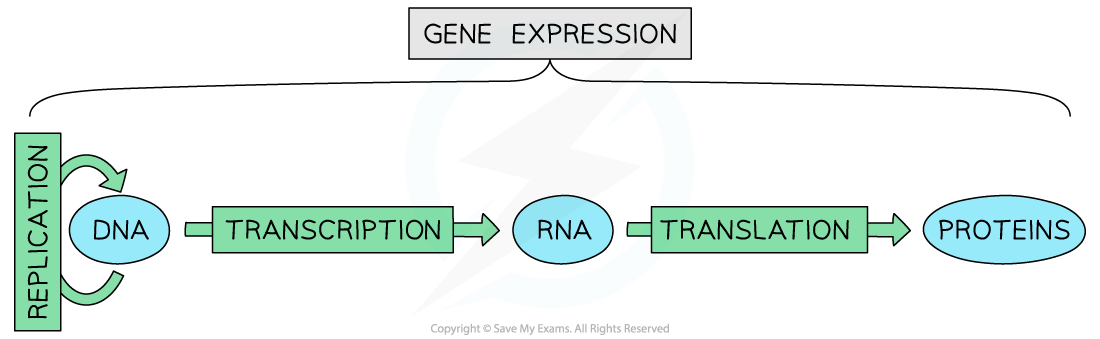
The central dogma of gene expression. All genes code for proteins; proteins carry out the genes’ instructions.
轉載自savemyexams
以上就是關于【IB DP Biology: HL復習筆記2.3.1 Proteins】的解答,如需了解學校/賽事/課程動態,可至翰林教育官網獲取更多信息。
往期文章閱讀推薦:
翰林獨家 | 經濟學競賽核心精講,一冊打通NEC/IEO/USAEBO!
2026 AMC10/12美國數學競賽新賽季!【翰林教育 × 清華大學出版社】獨家教材全面發售!


翰林AMC8視頻課重磅上線!

國際競賽真題資源免費領取






