AQA A Level Physics復(fù)習(xí)筆記8.4.3 Nuclear Fusion & Fission

Nuclear Fusion & Fission
Nuclear Fusion
- Fusion is defined as:
The fusing together of two small nuclei to produce a larger nucleus
- Low mass nuclei (such as hydrogen and helium) can undergo fusion and release energy
- When two protons fuse, the element?deuterium?is produced
- In the centre of stars, the deuterium combines with a?tritium?nucleus to form a helium nucleus, plus the release of energy, which provides fuel for the star to continue burning
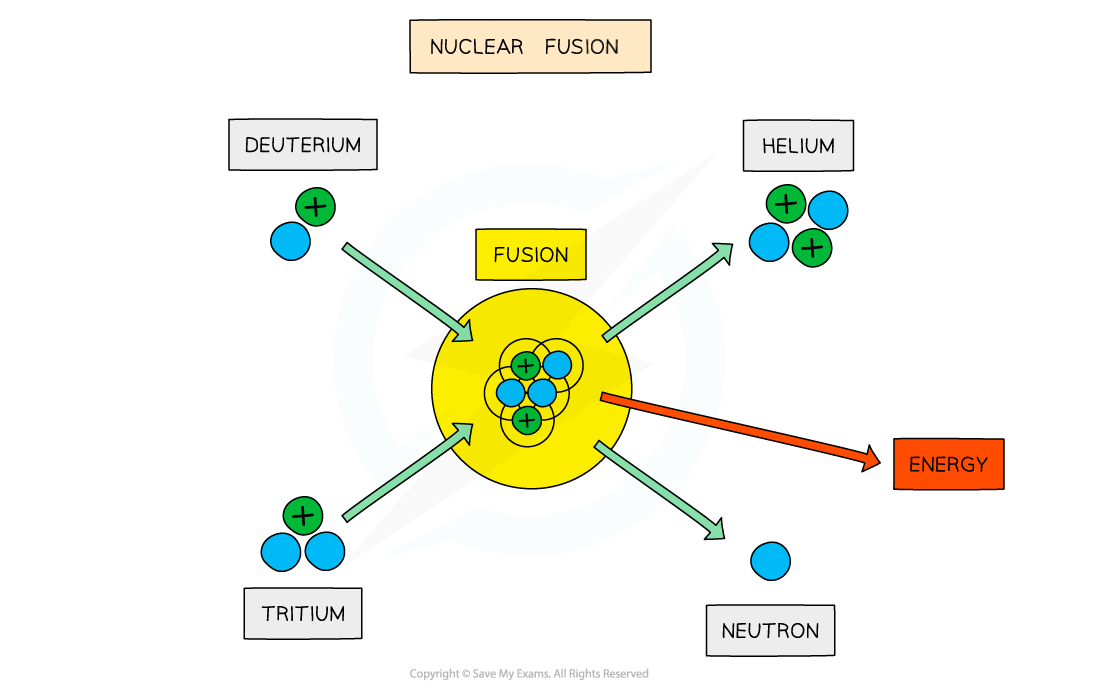
The fusion of deuterium and tritium to form helium with the release of energy
- For two nuclei to fuse, both nuclei must have?high kinetic energy
- This is because nuclei must be able to get close enough to fuse
- However, two forces acting within the nuclei make this difficult to achieve
- Electrostatic Repulsion
- Protons inside the nuclei are positively charged, which means that they?electrostatically?repel one another
- Strong Nuclear Force
- The strong nuclear force, which binds nucleons together, acts at very short distances within nuclei
- Therefore, nuclei must get very close together for the strong nuclear force to take effect
- It takes a great deal of energy to overcome the electrostatic and strong nuclear forces, hence fusion can only be achieved in an?extremely hot?environment, such as the core of a star
Nuclear Fission
- Fission is defined as:
The splitting of a large atomic nucleus into smaller nuclei
- High mass nuclei (such as uranium) can undergo fission and release energy
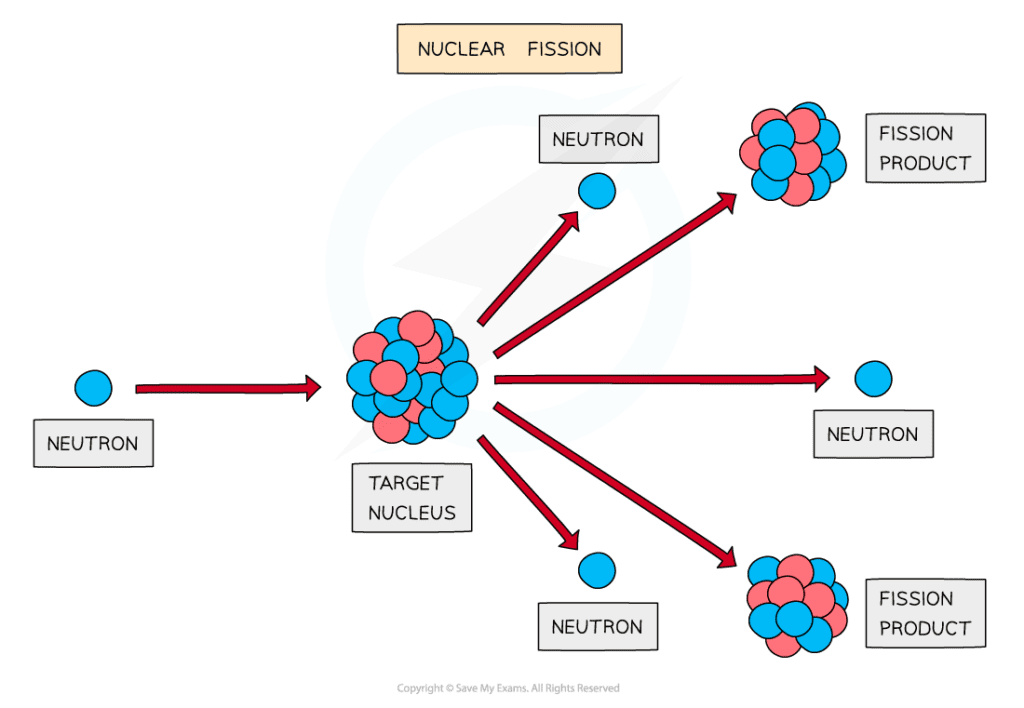
The fission of a target nucleus, such as uranium, to produce smaller daughter nuclei with the release of energy
- Fission must first be induced by firing neutrons at a nucleus
- When the nucleus is struck by a neutron, it splits into two, or more, daughter nuclei
- During fission, neutrons are ejected from the nucleus, which in turn, can collide with other nuclei which triggers a cascade effect
- This leads to a chain reaction which lasts until all of the material has undergone fission, or the reaction is halted by a moderator
- Nuclear fission is the process which produces energy in nuclear power stations, where it is well controlled
- When nuclear fission is not controlled, the chain reaction can cascade to produce the effects of a nuclear bomb
Exam Tip
When an atom undergoes nuclear fission, take note that extra neutrons are ejected by the?nucleus?and not from the fission products
Calculating Energy Released in Nuclear Reactions
- The binding energy is equal to the amount of energy released in forming the nucleus, and can be calculated using:
E?= (Δm)c2
- Where:
- E?= Binding energy released (J)
- Δm?=?mass defect?(kg)
- c?=?speed of light?(m s-1)
- The daughter nuclei produced as a result of both fission and fusion have a higher binding energy per nucleon than the parent nuclei
- Therefore, energy is released as a result of the mass difference between the parent nuclei and the daughter nuclei
Worked Example
When a uranium-235 nucleus absorbs a slow-moving neutron and undergoes fission one possible pair of fission fragments is technetium-112 and indium-122. The equation for this process and the binding energy per nucleon for each isotope is shown below.
Binding energy per nucleon of U-235 = 7.59 MeV
Binding energy per nucleon of Tc-112 = 8.36 MeV
Binding energy per nucleon of In-122 = 8.51 MeV
When a uranium-235 nucleus undergoes fission in this way, calculate:a) The energy released, in MeV
b) The mass defect
Part (a)
Step 1: Determine the binding energies on each side of the equation
Binding energy = Binding Energy per Nucleon × Mass Number
-
- Binding energy before (U) = 235 × 7.59 = 1784 MeV
- Binding energy after (Tc + In) = (112 × 8.36) + (122 × 8.51) = 1975 MeV
Step 2: Find the difference between the energies
-
- Energy released = 1975 – 1784 = 191 MeV
Part (b)
Method 1
Step 1: Convert the energy released from MeV to J
-
- 1 MeV = 1.60 × 10?13?J
- Energy released = 191 × (1.60 × 10?13) = 3.06 × 10?11 J
Step 2: Write down the equation for mass-energy equivalence
E?= Δmc2
-
- Where?c?=?speed of light
Step 3: Rearrange and determine the mass defect, Δm

Δm?= 3.4 × 10?28?kg
Method 2
Step 1: Convert the energy released from MeV to u

Step 2: Calculate the mass defect, Δm
-
- 1 u = 1.66 × 10?27 kg
Δm?= 0.205 × (1.66 × 10?27) = 3.4 × 10?28?kg
Exam Tip
Both methods for calculating mass defect are perfectly valid. It is highly recommended that you practice both ways and see which method you are most comfortable using.
轉(zhuǎn)載自savemyexams
以上就是關(guān)于【AQA A Level Physics復(fù)習(xí)筆記8.4.3 Nuclear Fusion & Fission】的解答,如需了解學(xué)校/賽事/課程動(dòng)態(tài),可至翰林教育官網(wǎng)獲取更多信息。
往期文章閱讀推薦:
翰林獨(dú)家 | 經(jīng)濟(jì)學(xué)競(jìng)賽核心精講,一冊(cè)打通NEC/IEO/USAEBO!
2026 ALEVEL 夏考A率出爐!愛德思vs牛津AQA,哪些科目真的“好出分”?


翰林AMC8視頻課重磅上線!

國際競(jìng)賽真題資源免費(fèi)領(lǐng)取






