2002 AMC12B 真題及答案詳細(xì)解析

2002 AMC 12B 真題
答案詳細(xì)解析請(qǐng)參考文末
Problem 1
The arithmetic mean of the nine numbers in the set? ?is a?
 -digit number?
 , all of whose digits are distinct. The number??does not contain the digit

Problem 2
What is the value of![[(3x - 2)(4x + 1) - (3x - 2)4x + 1]](https://latex.artofproblemsolving.com/c/3/3/c3388d6d8fdf9173e0e6afd2a7b62c91c95ae836.png)
when? ?
?

Problem 3
For how many positive integers? ?is?
?is? ?a prime number?

Problem 4
Let??be a positive integer such that? ?is an integer. Which of the following statements is?not?true:

Problem 5
Let? ?and?
?and? ?be the degree measures of the five angles of a pentagon. Suppose that?
 ?and??and??form an arithmetic sequence. Find the value of?
 .
.

Problem 6
Suppose that? ?and?
?and? ?are nonzero real numbers, and that the equation?
 ?has solutions??and?. Then the pair?
 ?is
?is

Problem 7
The product of three consecutive positive integers is? ?times their sum. What is the sum of their squares?

Problem 8
Suppose July of year? ?has five Mondays. Which of the following must occur five times in August of year?? (Note: Both months have 31 days.)

Problem 9
If? ?are positive real numbers such that??form an increasing arithmetic sequence and?
 ?form a geometric sequence, then?
 is
is

Problem 10
How many different integers can be expressed?as?the sum of three distinct members of the set? ?
?

Problem 11
The positive integers? ?and?
?and? ?are all prime numbers. The sum of these four primes is

Problem 12
For how many integers??is? ?the square of an integer?

Problem 13
The sum of? ?consecutive positive integers is a perfect square. The smallest possible value of this sum is

Problem 14
Four distinct circles are drawn in a plane. What is the maximum number of points where at least two of the circles intersect?

Problem 15
How many four-digit numbers??have the property that the three-digit number obtained by removing the leftmost digit is one ninth of??

Problem 16
Juan rolls a fair regular octahedral die marked with the numbers? ?through?. Then Amal rolls a fair six-sided die. What is the probability that the product of the two rolls is a multiple of 3?

Problem 17
Andy’s lawn has twice as much area as Beth’s lawn and three times as much area as Carlos’ lawn. Carlos’ lawn mower cuts half as fast as Beth’s mower and one third as fast as Andy’s mower. If they all start to mow their lawns at the same time, who will finish first?

Problem 18
A point? ?is randomly selected from the rectangular region with vertices?
 . What is the probability that??is closer to the origin than it is to the point?
 ?
?

Problem 19
If? ?and?
?and? ?are positive real numbers such that?
 ?and?
?and? , then?
 ?is
?is

Problem 20
Let? ?be a right-angled triangle with?
 . Let??and??be the midpoints of legs?
 ?and?
?and? , respectively. Given that?
 ?and?
?and? , find?
 .
.

Problem 21
For all positive integers??less than? , let
, let

Calculate? .
.

Problem 22
For all integers??greater than?, define? . Let?
 ?and?
?and? . Then?
 equals

Problem 23
In? , we have?
 ?and?
?and? . Side?
 ?and the median from?
 ?to??have the same length. What is?
 ?
?

Problem 24
A convex quadrilateral? ?with area??contains a point??in its interior such that?
 . Find the perimeter of?.
 ?
?
Problem 25
Let? , and let?
 ?denote the set of points?
 ?in the coordinate plane such that
![[f(x) + f(y) le 0 qquad text{and} qquad f(x)-f(y) le 0]](https://latex.artofproblemsolving.com/a/c/c/acc8ac26f16b1cda3bb82ba42bc6622a0feca8c5.png) The area of??is closest to?
The area of??is closest to?
2002 AMC12 B 真題答案詳細(xì)解析
- Solution 1
We wish to find? , or?
, or? . This does not have the digit 0, so the answer is?
 Solution 2
Notice that the final number is guaranteed to have the digits? ?and that each of these digits can be paired with an even number adding up to 9.??can be taken out, with the other digits fulfilling divisibility by 9.
 - By the distributive property,
![$(3x-2)[(4x+1)-4x] + 1 = 3x-2 + 1 = 3x-1 = 3(4) - 1 = boxed{mathrm{(D)} 11}$](https://latex.artofproblemsolving.com/a/a/0/aa01f3de68b8e5cb8901b61622119f3327d4c7e0.png) .
. -
Solution 1
Factoring, we get?
 . Either?
 ?or?
?or? ?is odd, and the other is even. Their product must yield an even number. The only prime that is even is?
 , which is when??is?
 . The answer is?
 .
.Solution 2
Considering parity, we see that?
?is always even. The only even prime is?, and so? ?whence?
 .
. - Since?
 ,
,![[0 < lim_{n rightarrow infty} left(frac{41}{42} + frac{1}{n}right) < frac {41}{42} + frac 1n < frac{41}{42} + frac 11 < 2]](https://latex.artofproblemsolving.com/0/a/1/0a117286e3f8f0f84a7cbc59b1204f101146fc51.png) From which it follows that?
From which it follows that? ?and?
?and? . The only answer choice that is not true is?
 .
. -
Solution 1
The sum of the degree measures of the angles of a pentagon (as a pentagon can be split into?
 ?triangles) is?
 . If we let?
 , it follows that
![[(x-2d)+(x-d)+x+(x+d)+(x+2d) = 5x = 540 Longrightarrow x = 108 mathrm{(D)}]](https://latex.artofproblemsolving.com/2/a/0/2a03fa9f8fc2b8f56860f65f81e93bfc3b933f99.png)
Note that since?
?is the middle term of an arithmetic sequence with an odd number of terms, it is simply the average of the sequence.You can always assume the values are the same so?

Solution 2
Let?
 ,?
,? ,?,?
,?,? ,??be?,?
 ,?
,? ,?
,? ,?
,? , respectively. Then we have
![[v + w + x + y + z = 5v + 10d = 180^{circ} (5 - 2) = 540^{circ}]](https://latex.artofproblemsolving.com/b/3/9/b39bdd7d2dc26e54954af8dbd765bf22fb080ab0.png) Dividing the equation by?
Dividing the equation by? , we have
![[v + 2d = x = 108^{circ} mathrm {(D)}]](https://latex.artofproblemsolving.com/f/e/d/fedaf1b53101b80f4a59cff8d7b99979fd9bc9c5.png)
-
Solution 1
Since?
 , it follows by comparing?coefficients?that?
 ?and that?
 . Since??is nonzero,?
 , and?
 . Thus?
 .
.Solution 2
Another method is to use?Vieta's formulas. The sum of the solutions to this polynomial is equal to the opposite of the?
?coefficient, since the leading coefficient is 1; in other words,? ?and the product of the solutions is equal to the constant term (i.e,?
 ). Since??is nonzero, it follows that??and therefore (from the first equation),?
 . Hence,?
Solution 3 (Using the Answer Choices)
Note that for roots?
?and?,?. This implies that??is?, and there is only one answer choice with??in the position for?, hence,? - Let the three consecutive positive integers be?
 ,?, and?
 . So,?
 .?
.? , so?
, so? . Hence, the sum of the squares is?
 .
. - If there are five Mondays, there are only three possibilities for their dates:?
 ,?
,? , and?
 .In the first case August starts on a Thursday, and there are five Thursdays, Fridays, and Saturdays in August.In the second case August starts on a Wednesday, and there are five Wednesdays, Thursdays, and Fridays in August.In the third case August starts on a Tuesday, and there are five Tuesdays, Wednesdays, and Thursdays in August.The only day of the week that is guaranteed to appear five times is therefore?
 .
. -
Solution 1
We can let?
 ,?
,? ,?
,? , and?
 .?
.?
Solution 2
As?
 ?is a geometric sequence, let?
 ?and?
?and? ?for some?
 .
.Now,?
 ?is an arithmetic sequence. Its difference is?
 . Thus?
 .
.Comparing the two expressions for?
 ?we get?
 . The positive solution is?
 , and?
 .
.Solution 3
Letting?
?be the common difference of the arithmetic progression, we have? ,?
,? ,?
,? . We are given that?
 ?=?
?=? , or
, or![[frac{a + n}{a} = frac{a + 3n}{a + n}.]](https://latex.artofproblemsolving.com/5/d/0/5d048c478d3ca0b242e47b5621c7d854827cbf34.png) Cross-multiplying, we get
Cross-multiplying, we get![[a^2 + 2an + n^2 = a^2 + 3an]](https://latex.artofproblemsolving.com/5/3/6/53646d5adaf792f94b95c1d9f0b0d4148a1b6a59.png)
![[n^2 = an]](https://latex.artofproblemsolving.com/5/6/4/5642d779ac0ea9621db97907b6908c51276813e5.png)
![[n = a]](https://latex.artofproblemsolving.com/f/0/3/f03bdc2df1bf326925e364582a4a26ca2c5483a0.png) So?
So? .
. -
Solution 1
Subtracting 10 from each number in the set, and dividing the results by 3, we obtain the set?
 . It is easy to see that we can get any integer between?
 ?and?
?and? ?inclusive?as?the sum of three elements from this set, for the total of?
 ?integers.
Solution 2
The set is an arithmetic sequence of numbers each?
?more than a multiple of?. Thus the sum of any three numbers will be a multiple of?. All the multiples of??from? ?to?
?to? ?are possible, totaling to??integers.
 -
Solution1
Since?
 ?and??must have the same?parity, and since there is only one even prime number, it follows that??and??are both odd. Thus one of?
 ?is odd and the other even. Since?
 , it follows that??(as?a prime greater than?) is odd. Thus?
 , and?
 ?are consecutive odd primes. At least one of??is divisible by?, from which it follows that?
 ?and?
?and? . The sum of these numbers is thus?
 , a prime, so the answer is?
 .
.Solution 2
In order for both?
 ?and?
?and? ?to be prime, one of??must be 2, or else both?,??would be even numbers.
If?
 , then?
 ?and?
?and? , which is not possible. Thus?.
Since?
?is prime and? , we can infer that?
 ?and thus??can be expressed?as?
 ?for some natural number?.
However in either case, one of?
?and??can be expressed?as? ?which is a multiple of 3. Therefore the only possibility that works is when?
 ?and
?and![[A + B + (A - B) + (A + B) = 5 + 2 + 3 + 7 = 17]](https://latex.artofproblemsolving.com/0/0/9/009d79e62fcb86d45c7d973d181b0c3b8d45bb69.png)
Which is a prime number.?

-
Solution 1
Let?
 , with?
 ?(note that the solutions?
 ?do not give any additional solutions for?). Then rewriting,?
 . Since?
 , it follows that?
 ?divides?
 . Listing the factors of?, we find that?
 ?are the only?
 ?solutions (respectively yielding?
 ).
).Solution 2
For?
 ?and?
?and? ?the fraction is negative, for?
 ?it is not defined, and for?
 ?it is between 0 and 1.
Thus we only need to examine?
 ?and?
?and? .
.For?
?and? ?we obviously get the squares?
 ?and??respectively.
For prime?
?the fraction will not be an integer,?as?the denominator will not contain the prime in the numerator.This leaves?
 , and a quick substitution shows that out of these only?
 ?and?
?and? ?yield a square. Therefore, there are only??solutions (respectively yielding?).
Solution 3
If?
 , then?
 ?and?
?and? , otherwise?
 ?will be negative. Thus?
 ?and
?and![[0 = frac{0}{20-(0)} le frac{n}{20-n} le frac{19}{20-(19)} = 19]](https://latex.artofproblemsolving.com/9/f/e/9feb430d115aea0e9e86b02cdd2ae225b49642b5.png) Checking all?
Checking all? ?for which?
 , we have?,?,?,??as?the possibilities.?
-
Solution 1
Let?
 ?be the consecutive positive integers. Their sum,?
 , is a perfect square. Since??is a perfect square, it follows that?
 ?is a perfect square. The smallest possible such perfect square is?
 ?when?
 , and the sum is?
 .
.Solution 2
Notice that all five choices given are perfect squares.
Let?
?be the smallest number, we have![[a+(a+1)+(a+2)+...+(a+17)=18a+sum_{k=1}^{17}k=18a+153]](https://latex.artofproblemsolving.com/2/4/b/24ba9a08041a00d74638a06c236e5ee189a8420e.png)
Subtract?
 ?from each of the choices and then check its divisibility by?, we have?
 ?as?the smallest possible sum.?
-
Solution 1
For any given pair of circles, they can intersect at most?
?times. Since there are? ?pairs of circles, the maximum number of possible intersections is?
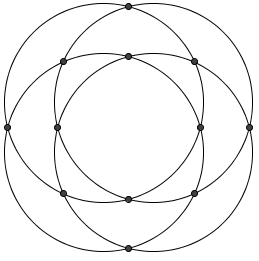
 . We can construct such a situation?as?below, so the answer is?
 .
.
Solution 2
Because a pair or circles can intersect at most?
?times, the first circle can intersect the second at??points, the third can intersect the first two at? ?points, and the fourth can intersect the first three at??points. This means that our answer is?
Solution 3
Pick a circle any circle-?
?ways. Then, pick any other circle-??ways. For each of these circles, there will be??intersections for a total of? ?=?
?=? ?intersections. However, we have counted each intersection twice, so we divide for overcounting. Therefore, we reach a total of?
 , which corresponds to?
 .
. -
Solution
Let?
 , such that?
 . Then?
 . Since?
 , from?
 ?we have?
 ?three-digit solutions, and the answer is?
 .
.Solution 2
Since N is a four digit number, assume WLOG that?
 , where a is the thousands digit, b is the hundreds digit, c is the tens digit, and d is the ones digit. Then,?
 , so?
, so? ?Set these equal to each other:
![[1000a + 100b + 10c + d = 900b + 90c + 9d]](https://latex.artofproblemsolving.com/b/7/2/b72664c9c2d440b53307369eea6d6aaa6ecec06b.png)
![[1000a = 800b + 80c + 8d]](https://latex.artofproblemsolving.com/f/2/f/f2f8a153a5faae42c32c8d0148d02754d6467809.png)
![[1000a = 8(100b + 10c + d)]](https://latex.artofproblemsolving.com/c/9/a/c9a42e8825cd2fc03cafaecc6ebbb3e5c13655bc.png) Notice that?
Notice that? , thus:
![[1000a = 8(N - 1000a)]](https://latex.artofproblemsolving.com/5/a/6/5a6fd31a085282a10152f9253eb01d53febf2acf.png)
![[1000a = 8N - 8000a]](https://latex.artofproblemsolving.com/3/1/c/31c64a6abfacee012c060f51e9a642b78ce719e8.png)
![[9000a = 8N]](https://latex.artofproblemsolving.com/6/7/3/673099001a81a45b956ace6fd3d59d764495b69c.png)
![[N = 1125a]](https://latex.artofproblemsolving.com/f/b/5/fb5290b31d5c6fbc376e01e35889de01a86ccbae.png)
Go back to our first equation, in which we set?
, Then:![[1125a = 1000a + 100b + 10c + d]](https://latex.artofproblemsolving.com/b/a/c/bacb4d586331e9c422106c7686f127b30f7b3fbc.png)
![[125a = 100b + 10c + d]](https://latex.artofproblemsolving.com/c/1/4/c149c7cf80e812d27d60a2b13b8ae3e6a26d7ab6.png) The upper limit for the right hand side (RHS) is?
The upper limit for the right hand side (RHS) is? ?(when?
 ,?
,? , and?
 ). It's easy to prove that for an??there is only one combination of?
 ?and??that can make the equation equal. Just think about the RHS?as?a three digit number?
 . There's one and only one way to create every three digit number with a certain combination of digits. Thus, we test for how many?as?are in the domain set by the RHS. Since?
 ?which is the largest??value, then??can be??through?, giving us the answer of?
-
Solution 1
On both dice, only the faces with the numbers?
 ?are divisible by?. Let?
 ?be the probability that Juan rolls a??or a?, and?
 ?that Amal does. By the?Principle of Inclusion-Exclusion,
![[P(a cup b) = P(a) + P(b) - P(a cap b) = frac{1}{4} + frac{1}{3} - frac{1}{4} cdot frac{1}{3} = frac{1}{2} Rightarrow mathrm{(C)}]](https://latex.artofproblemsolving.com/c/c/2/cc29f83d1e2747949dccdb55b4eb258c113092a4.png)
Alternatively, the probability that Juan rolls a multiple of?
?is? , and the probability that Juan does not roll a multiple of??but Amal does is?
 . Thus the total probability is?
 .
.Solution 2
The probability that neither Juan nor Amal rolls a multiple of?
?is? ; using?complementary counting, the probability that at least one does is?
 .
. - We say Andy's lawn has an area of?. Beth's lawn thus has an area of?
 , and Carlos's lawn has an area of?
 .We say Andy's lawn mower cuts at a speed of?. Carlos's cuts at a speed of?
 , and Beth's cuts at a speed?
 .Each person's lawn is cut at a speed of?
 , so Andy's is cut in?
 ?time,?as?is Carlos's. Beth's is cut in?
 , so the first one to finish is?
 .
. -
Solution 1
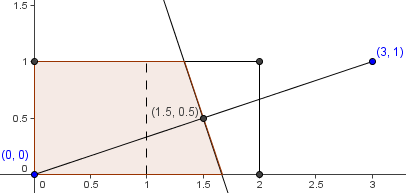
The region containing the points closer to?
 ?than to??is bounded by the?perpendicular bisector?of the segment with endpoints?
 . The perpendicular bisector passes through midpoint of?, which is?
 , the center of the?unit square?with coordinates?
 . Thus, it cuts the unit square into two equal halves of area?
 . The total area of the rectangle is?, so the area closer to the origin than to??and in the rectangle is?
 . The probability is?
 .
.Solution 2
Assume that the point?
?is randomly chosen within the rectangle with vertices?,? ,?,?
,?,? . In this case, the region for??to be closer to the origin than to point??occupies exactly?
 ?of the area of the rectangle, or?
 ?square units.
If?
?is chosen within the square with vertices? ,?,?,?
 ?which has area??square unit, it is for sure closer to?.
Now if?
?can only be chosen within the rectangle with vertices?,?,?,?, then the square region is removed and the area for?to be closer to??is then decreased by??square unit, left with only? ?square unit.
Thus the probability that?
?is closer to? ?is?
?is? ?and that of??is closer to the origin is?
 .?
.?
- Adding up the three equations gives?
 . Subtracting each of the above equations from this yields, respectively,?
 . Taking their product,?
 .
. 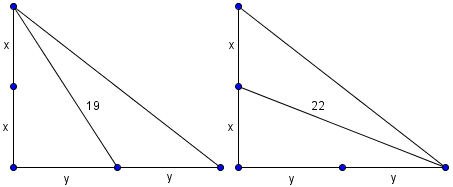 Let?
Let? ,?
,? . By the?Pythagorean Theorem?on?
 ?respectively,
 Summing these gives?
 .By the Pythagorean Theorem again, we have
![[(2x)^2 + (2y)^2 = XY^2 Longrightarrow XY = sqrt{4(x^2 + y^2)} = sqrt{4(169)} = sqrt{676} = boxed{mathrm{(B)} 26}]](https://latex.artofproblemsolving.com/f/1/6/f16445ea2f3d51273e055db6c290c3f43c9d12d2.png) Alternatively, we could note that since we found?
Alternatively, we could note that since we found? , segment?
 . Right triangles?
 ?and??are similar by Leg-Leg with a ratio of?, so?
- Since?
 , it follows that
 Thus?
Thus? .
. - By the?change of base?formula,?
 . Thus
-
Solution 1
![[asy] unitsize(4cm); pair A, B, C, D, M; A = (1.768,0.935); B = (1.414,0); C = (0,0); D = (1.768,0); M = (0.707,0); draw(A--B--C--cycle); draw(A--D); draw(D--B); draw(A--M); label("$A$",A,N); label("$B$",B,S); label("$C$",C,S); label("$D$",D,S); label("$M$",M,S); label("$x$",(A+D)/2,E); label("$y$",(B+D)/2,S); label("$a$",(C+M)/2,S); label("$a$",(M+B)/2,S); label("$2a$",(A+M)/2,SE); label("$1$",(A+B)/2,SE); label("$2$",(A+C)/2,NW); draw(rightanglemark(B,D,A,3)); [/asy]](https://latex.artofproblemsolving.com/2/0/5/20552f4dac85af4806831750082aae9773f6b706.png)
Let?
 ?be the foot of the altitude from??to??extended past?
 . Let?
 ?and?
?and? . Using the Pythagorean Theorem, we obtain the equations
Subtracting?
 ?equation from?
 ?and?
?and? , we get
Then, subtracting?
 ?from?
 ?and rearranging, we get?
 , so?
, so?
Solution 2

Let?
?be the foot of the median from??to?, and we let? . Then by the?Law of Cosines?on?
 , we have
Since?
 , we can add these two equations and get
![[5 = 10a^2]](https://latex.artofproblemsolving.com/b/7/e/b7ef5bf2a35df8f95e354145fc0ffc141e39ae7a.png)
Hence?
 ?and?
?and? .
.Solution 3
From?Stewart's Theorem, we have?
 ?Simplifying, we get?
- We have
![[[ABCD] = 2002 le frac 12 (AC cdot BD)]](https://latex.artofproblemsolving.com/6/8/4/68414870d9584f78410cfea4874a58e80bd8a5ce.png) (This is true for any convex quadrilateral: split the quadrilateral along?
(This is true for any convex quadrilateral: split the quadrilateral along? ?and then using the triangle area formula to evaluate?
![$[ACB]$](https://latex.artofproblemsolving.com/6/3/a/63a0c06761ee664f3ab0910bbf3336158cbf1645.png) ?and?
?and?![$[ACD]$](https://latex.artofproblemsolving.com/f/a/1/fa16d5df87a703864688635578a8f358b31ad6ef.png) ), with equality only if?
), with equality only if? . By the?triangle inequality,
 with equality if??lies on?
 ?and?
?and? ?respectively. Thus
![[2002 le frac{1}{2} AC cdot BD le frac 12 cdot 52 cdot 77 = 2002]](https://latex.artofproblemsolving.com/7/6/3/763500d2bade003bb04e8fe0bcba8cc118de1a63.png) Since we have the equality case,??at point?,?as?shown below.
Since we have the equality case,??at point?,?as?shown below.![[asy] size(200); defaultpen(0.6); pair A = (0,0), B = (40,0), C = (25.6 * 52 / 24, 19.2 * 52 / 24), D = (40 - (40-25.6)*77/32,19.2*77/32), P = (25.6,19.2), Q = (25.6, 18.5); pair E=(A+P)/2, F=(B+P)/2, G=(C+P)/2, H=(D+P)/2; draw(A--B--C--D--cycle); draw(A--P--B--P--C--P--D); label("(A)",A,WSW); label("(B)",B,ESE); label("(C)",C,ESE); label("(D)",D,NW); label("(P)",Q,SSW); label("24",E,WNW); label("32",F,WSW); label("28",G,ESE); label("45",H,ENE); draw(rightanglemark(C,P,D,50)); [/asy]](https://latex.artofproblemsolving.com/b/e/0/be0cac31118507011fcd067dec64c89d4f9eee03.png)
 The perimeter of??is?
 .
. - The first condition gives us that
![[x^2 + 6x + 1 + y^2 + 6y + 1 le 0 Longrightarrow (x+3)^2 + (y+3)^2 le 16]](https://latex.artofproblemsolving.com/b/b/8/bb8ffbea5beac4d271409e70b039ab3fd7fc571a.png) which is a?circle?centered at?
which is a?circle?centered at? ?with?radius?. The second condition gives us that
![[x^2 + 6x + 1 - y^2 - 6y - 1 le 0 Longrightarrow (x^2 - y^2) + 6(x-y) le 0 Longrightarrow (x-y)(x+y+6) le 0]](https://latex.artofproblemsolving.com/d/c/f/dcfbc59e8ec63aca25e470670be7d5deb5925eca.png) Thus either
Thus either![[x - y ge 0,quad x+y+6 le 0]](https://latex.artofproblemsolving.com/e/6/5/e652e0c8f0c71d919631f0f09e73783e50ad2cae.png) or
or![[x - y le 0,quad x+y+6 ge 0]](https://latex.artofproblemsolving.com/e/e/2/ee27e9853791cc1fc519b576ce48f7f479902128.png)
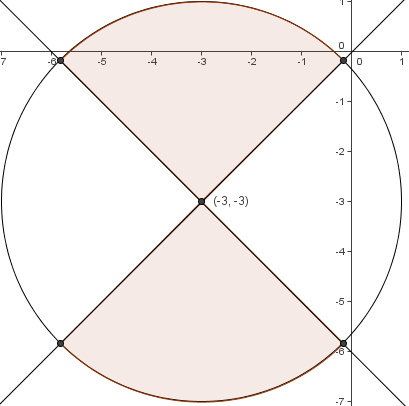
Each of those lines passes through?
?and has slope? ,?as?shown above. Therefore, the area of??is half of the area of the circle, which is?
 .
.
學(xué)術(shù)活動(dòng)報(bào)名掃碼了解!免費(fèi)領(lǐng)取歷年真題!
以上就是關(guān)于【2002 AMC12B 真題及答案詳細(xì)解析】的解答,如需了解學(xué)校/賽事/課程動(dòng)態(tài),可至翰林教育官網(wǎng)獲取更多信息。
往期文章閱讀推薦:
AMC/BPhO/UKChO…下半年20+賽事集中開考!抓住競(jìng)賽"黃金備賽期"!
【重要通知】國(guó)內(nèi)AIME數(shù)學(xué)考試安排已定!


翰林AMC8視頻課重磅上線!

國(guó)際競(jìng)賽真題資源免費(fèi)領(lǐng)取






