
北美熱門的創(chuàng)意寫作大賽Scholastic Art & Writing終于一改往年的傳統(tǒng)提交,上了新系統(tǒng),全面實現(xiàn)線上支付!
咱們可以遠離郵寄支票,打印簽字表的日子了!
但是不出意外的話
就要有意外了
由于這次啟用了新系統(tǒng)
出現(xiàn)了各種提交系統(tǒng)崩潰
以至于不同地區(qū)的截止日期一延再延
......
01 / 突發(fā)狀況 /
官方系統(tǒng)出現(xiàn)問題,注意提交可能延遲!
繼今年官方更新系統(tǒng)后,頻頻出現(xiàn)突發(fā)問題,多地提交出現(xiàn)網(wǎng)頁錯誤,如無法提交、無法付款、上傳失敗等狀況。
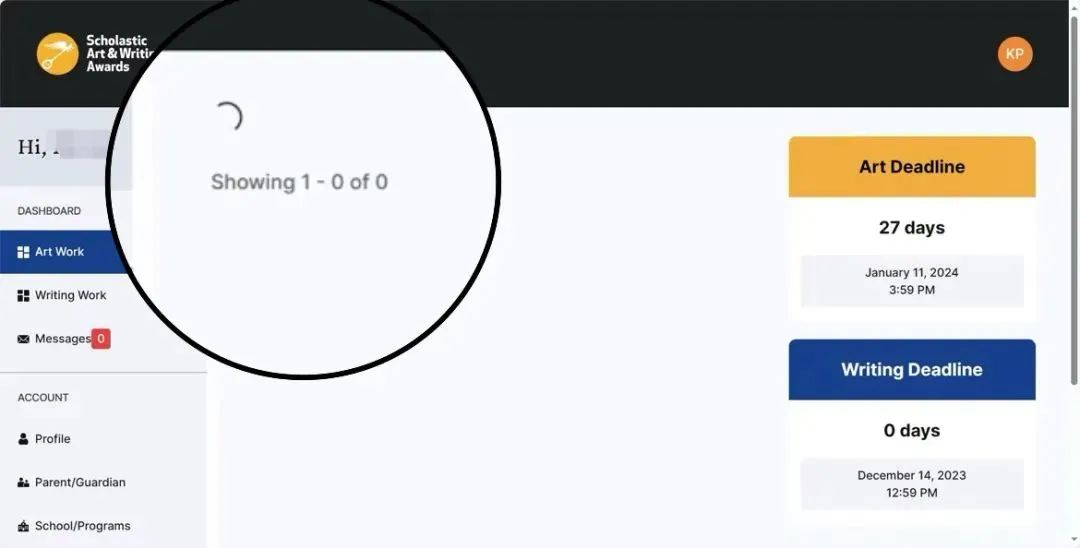 無法提交
無法提交
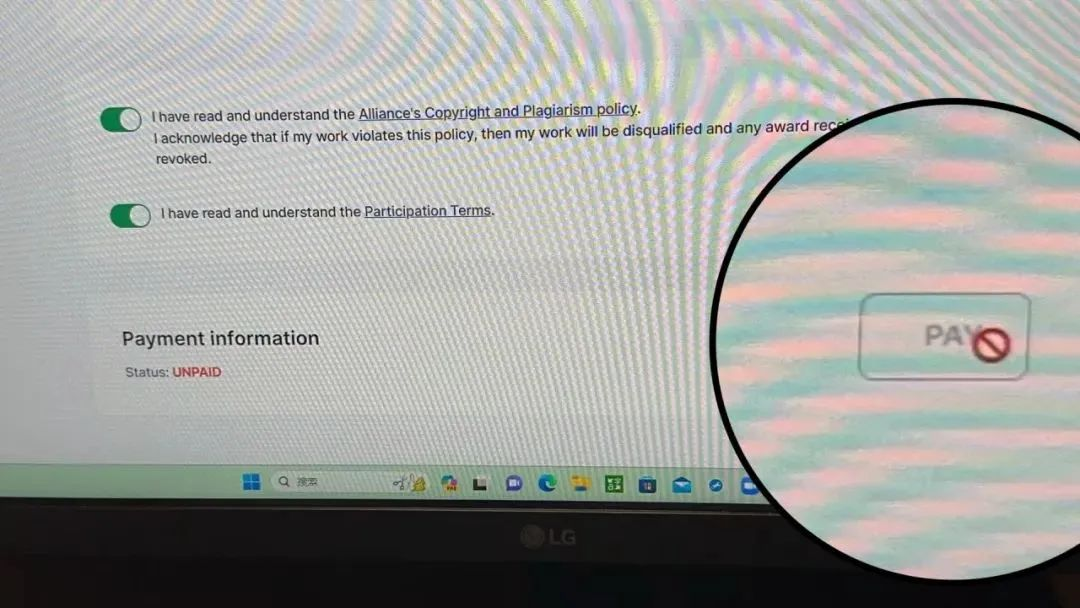 無法付款
無法付款
針對這次的系統(tǒng)問題
官方給出了提交截止日期延遲的消息
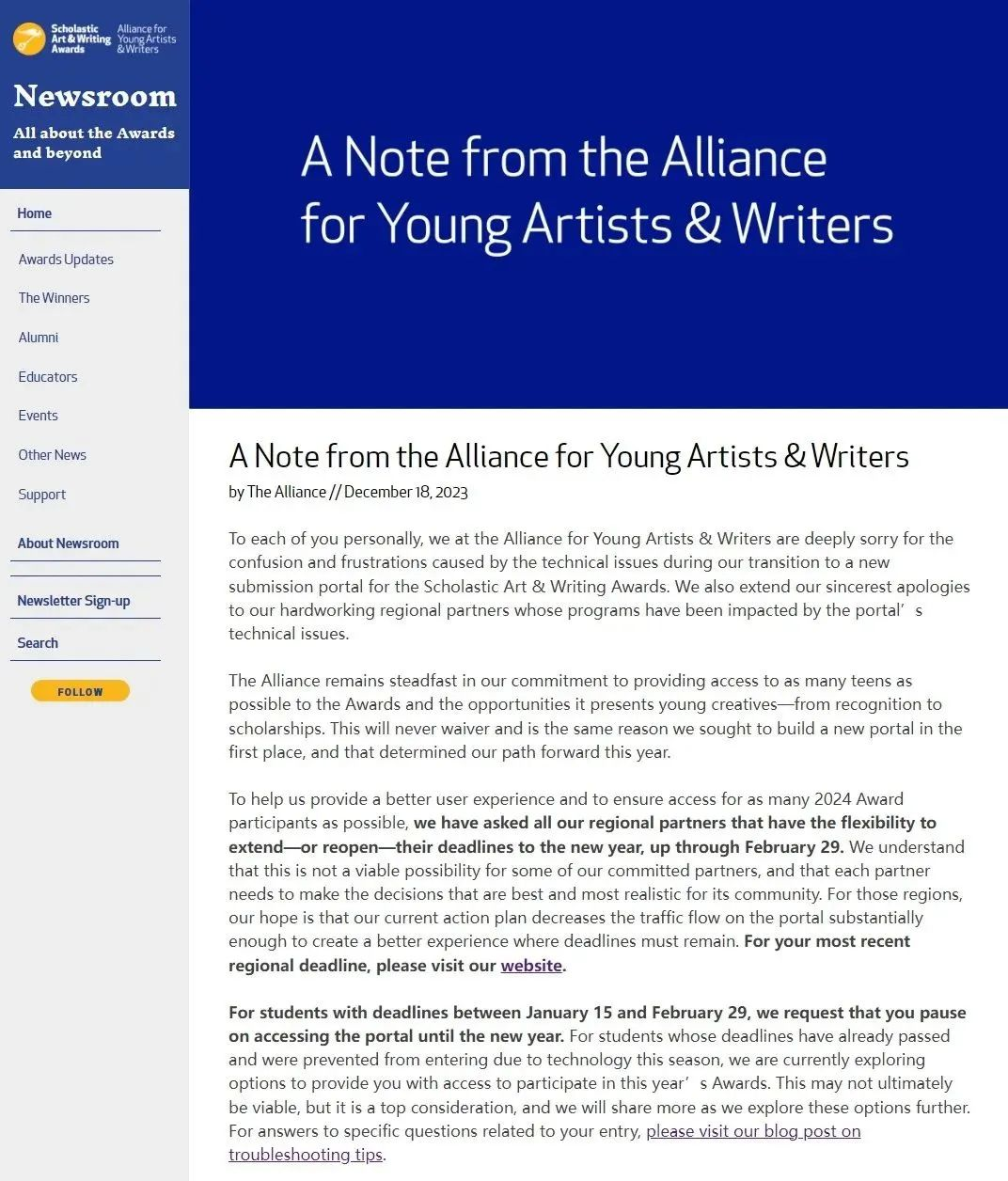 (具體根據(jù)官網(wǎng)最新信息為準)
據(jù)官網(wǎng)消息,新系統(tǒng)存在技術(shù)問題。
▶目前提交截止日期延至2024.2.29(具體因地區(qū)而異)
對于截止日期原本在2024.1.15-2024.2.29的學生,在2024年1月1日前,需要暫停訪問網(wǎng)站,暫時先不要提交,至24年1月起關(guān)注官網(wǎng)信息再進行相關(guān)操作。
面對這一情況
我們有幾個應(yīng)對措施建議給到大家👇
👉 盡早上傳
已經(jīng)準備好提交稿的學生建議盡早上傳,有問題可以提前和官方聯(lián)系。
👉 有備無患
已經(jīng)明確延期的同學可以趁此機會考慮多投一投作品,也可聯(lián)系我們,請導師幫助大家梳理、優(yōu)化可投作品~
👉 緊急優(yōu)化
危機即轉(zhuǎn)機,面對突發(fā)狀況,更應(yīng)抓住機會,做好最后優(yōu)化!
時間緊急!把握機會!我們有豐富經(jīng)驗的導師團隊協(xié)助你,并對你的論文進行修改指導,幫助你在短時間內(nèi)提升作品質(zhì)量!
如果對【Scholastic Art & Writing】感興趣,歡迎掃碼咨詢!
02 Scholastic Art & Writing Awards
學生優(yōu)秀案例分析
獎項:銀獎
類別:短篇小說

👉 備賽評析
1、這位同學成功地講述了一個引人入勝的故事。故事使用了一些高級的手法,尤其對于人物和畫作的刻畫,使故事的核心思想更凸顯。
2、作品沒有獲得金獎,原因可能在與寫作風格。這個故事的想法很有創(chuàng)意,但散文式的敘事風格讓作品想要表達的意義不夠穩(wěn)固。
H同學
獎項:榮譽獎
類別:科幻小說
👉 備賽評析
H同學在開始創(chuàng)作時僅僅是有一個想寫科幻小說的想法:通過玩具的視角去構(gòu)建一個世界,隱喻社會中的不公正。K導師通過設(shè)定主角形象、與其他故事人物的關(guān)系、發(fā)生了哪些事等一步步引導H同學完成了這部小說。
小說講述了一個人某天醒來變成了不倒翁玩具,當他和社會上其他被變成物品的人交朋友時,他發(fā)現(xiàn)了不公正。最終H同學獲得榮譽獎。
W同學
類別:微小說
👉 備賽評析
W同學的創(chuàng)作思路與H同學截然不同,在與她剛接觸時,已經(jīng)有一份完整的草稿,講述的是關(guān)于一個女孩鬼魂的故事——在她被謀殺后,她只能眼睜睜地看著她的社區(qū)里的人繼續(xù)他們的生活。
K導師引導W同學去思考這個故事的意義,將其中的一些細節(jié)背后的深意進行提煉突出,使作品得到質(zhì)的提升。
03 賽事特色
Scholastic究竟有何特別之處?
高含金量
根據(jù)官方統(tǒng)計,每年美國各地的學生提交超30萬件原創(chuàng)作品,僅僅2000多名學生獲得榮譽獎項,獲獎率不足0.6%,其的難度和價值是不言而喻的,同時也意味著,這將是申請名校和獎學金的加分項!
多維能力培養(yǎng)
美國大學在選擇學生時選取的審核標準是“綜合全面評審”(Holistic Review)。這意味著標化成績并不是錄取的唯一條件,高校們更關(guān)注學生的綜合能力。
就綜合能力而言,其中最重要的莫過于學術(shù)能力。而Scholastic競賽對學生學術(shù)能力的培養(yǎng)不僅是多樣化的,更是專業(yè)化的,尤其是學術(shù)寫作相關(guān)的能力。
04 Scholastic Art & Writing Awards
賽事詳情
關(guān)于學樂藝術(shù)與寫作獎
Scholastic美國學術(shù)藝術(shù)與寫作獎由美國青年藝術(shù)家、作家聯(lián)盟于1923年設(shè)立,是全美國歷史最悠久、最負盛名的文學藝術(shù)競賽。賽事每年與美國100多個詩句藝術(shù)和文學藝術(shù)組織合作,旨在發(fā)現(xiàn)最有創(chuàng)意與靈感的青少年藝術(shù)與文學作品。
優(yōu)秀獲獎?wù)卟粌H可以參加全美巡回展覽,更有機會獲得現(xiàn)金獎勵和高達10,000美金的獎學金。
寫作類別
大賽分類諸多,其中包括11種寫作類別,在全美范圍內(nèi)評選出最具創(chuàng)意、技巧和個人特色的佳作。
1.Critical Essay評論文章
2.Dramatic Script劇本
3.Flash Fiction微小說
4.Humor喜劇
5.Journalism新聞稿
6.Novel Writing小說
7.Personal Essay&Memoir個人陳述&自傳
8.Poetry詩歌
9.Science Fiction&Fantasy科幻小說
10.Short Story短篇小說
11.Writing Portfolio寫作作品集
參賽資格
7-12年級13歲以上,對文學、藝術(shù)創(chuàng)作感興趣的美國或加拿大地區(qū)就讀的學生們均可參加。
提交時間
2024年2月29日比賽截止(具體根據(jù)官網(wǎng)最新信息為準),注意比賽截止日期因地區(qū)而異,考慮到今年的系統(tǒng)問題,建議同學們盡早準備!避免錯過機會哦!
05 Scholastic Art & Writing Awards
2023亞裔金獎作品賞析
Critical Essay
作者:Zoe Yu
“Unfortunately, students’ brains are not fully developed until they are 25 or 26 years old.”
I’m frantically combing through Facebook before the bell rings for class. My op-ed on Covid in schools had gone live that week, and it had become a sort of ritual to check the response on social media in between club meetings, quizzes, and homework. I had written about a highly politicized topic, so I was braced for scathing pushback—but scrolling through the thousands of comments, I realized that almost no one was discussing what I had written about, and almost everyone was discussing my age.
Under the article, someone had suggested that I get a summer job in the real world instead of typing up fake news, throwing in a “Don’t you have a math test to study for?” Another told me sympathetically that my young, impressionable mind had been brainwashed by my parents, peppering their advice with “sweetheart” and “child.” Some comments even questioned if I had written the article myself—“Middle-aged hands typed this,” “So what kid made money for this interview?”—and a far-right media organization called me a propagandist with a teenage persona. When I tapped into the comments section of someone who had shared the article with an angry emoticon, I saw that her friend had chimed in, too: “My sis-in-law owns a dance studio & says kids’ brains have definitely been affected . . . sad & scary as hell! . . . muzzled = lack of oxygen to the brain . . .”
As I saw my writing sabotaged by my age in real time, I wondered how many stories had gone untold because of responses like these. How many young writers had written a piece that was important to them, only to be met with scorn and condescension? How many valuable stories had been lost in the shuffle of “You’re just a kid”? And how many more would be?
When we aren’t being told that we lack the life experience and wisdom to write, we’re being dismissed as too childish, ignorant, or naive to know what’s going on, too influenced by outside forces to be able to think for ourselves. What on the surface may read like the casually cruel comments so often thrown around on the internet are symptomatic of a deeper issue: Young writers aren’t taken seriously. Our writing is routinely discounted—not because of the message, or the sources, or anything regarding the actual content of a piece—but simply because of our age. This is despite young writers’ covering topics that have a direct impact on us: At the same time that we’re growing up, navigating adolescence, and figuring out our place in the world, we’re also writing about it.
Who is best suited to write about the student debt crisis if not a low-income teen struggling to pay for his education? Whose story is it to tell of being five months pregnant at prom if not a teen mother’s? Who should be tasked with profiling the stories of victims of the school gun violence epidemic if not high school students who endure active-shooter drills every school year? The act of listening to young people and giving us the space to write doesn’t just let us vocalize our perspectives and validate our opinions; it also brings an authentic portrayal of the unique issues that we’re facing?as we face them. Whether we have a curfew or not, and even if our history project is due on Monday, we should be able to write without being written off.
From reporting on the coronavirus to dissecting culture and identity, we’re doing serious work. It’s exactly what we need: responsible coverage of what’s happening right now from the people living through it. We can’t brush these stories off, even if—especially?if—they’re told by teenagers.
Yet we are. In an industry where online harassment—especially of women— is expected, biting insults aren’t uncommon, but for many young writers, they hit hard. “A constant barrage of ageist comments can be really harmful,” Miceala Morano, a high school senior and an award-winning writer and slam poet, tells me. “I’ve had friends who have stopped writing completely because a comment was so rude that it destroyed their sense of confidence in themselves and their work.” Opening up my Twitter DMs, with readers questioning my credibility and declaring I was more fit to watch “Dora the Explorer,” I felt for young writers who face unnecessarily harsh critics. We can come across as self-assured, but in a time when many of us are just starting to summon up the courage to write publicly, it takes only one seemingly offhand remark to undermine days of writing, researching, and reporting.
Ageism also extends past patronizing comments into tangible consequences. In Kentucky, high school journalists were shut out of a 2019 roundtable discussion on, ironically, education. Unable to cover the event, they wrote an editorial instead, asking, “How odd is it that even though future generations of students’ experiences could be based on what was discussed, that we, actual students, were turned away?” It’s demoralizing, and all too familiar, to see seasoned writers and professional journalists entering an event as student journalists are held back, watching from the sidelines when we should be in the thick of the action. We’re expected to prove ourselves without ever being given the chance to do so.
Rainier Harris, a freshman at Columbia University who wrote for?The New York Times?in his senior year of high school, knows this frustration all too well: He says he’s been pushed aside by editors who deem young journalists too inexperienced to cover a story, and has been offered less than what he feels is deserved for the quality of his work. Somewhat contradictorily, it seems editors expect experience without ever allowing young writers to build it—which is the exact opposite mentality of what’s needed to allow young writers to bring their stories into the fray. “Young people have amazing stories to share, and we [should] be telling them,” Harris says.
Adding the word “teen” before “writer” or “student” before “journalist” shouldn’t condemn a piece of writing to be perceived as amateur or inane, and this attitude about age dictating worthiness is a disservice to the billions of young people across the globe. As we create important, meaningful work, our opinions and voices should be treated with respect, regardless of how old we might be. “Young writer” isn’t an oxymoron.
Short Story
作者:Nora Sun
She bore the journey alone. The jade waters which sloshed on a wooden deck beneath the swollen moon cast a lasting grayness on her skin. The torrential rain that tossed the ship’s ragged carcass about opened sores in her body that never truly closed. The briny scent of sea clung to her long after she set foot on land, and the white men regarded it like an exotic perfume, like she was one of their Western fish-tailed women. Day by day, she inched forward towards the other coast, a fragile singular star traversing the velvety sea in a wind-blown arc.
After twenty days hidden in the storage ship, a pale figure clutching a shimmering brocade emerged in the harbor. In the Lunar calendar, it was an inauspicious date for big changes. In the American calendar, it was a Tuesday in 1988. She stood on that shore, her clothes dirty and hair ragged, regarding the American world around her. No gold bubbled from the ground. No fish fell from the sky. The sun was neither brighter nor warmer than it was in Hong Kong. But it did not matter. Her little island had long been swallowed by the sunset. This was her homeland now.
—
Sima Buming was the name she had been given, but the Needle Mistress was the name she earned. Her practice sat in a strip mall at the center of Chinatown, the vermillion heart of a sprawling city that wore a skirt of gray skyscrapers. The entrance was marked by a plain plastic sign in the window that read “Pain Relief Acupuncture PLLC 針灸止痛” and printed a few prices for different services in Chinese and English. She was neighbors with a hair salon and a Chinese grocery.
The interior was as humble as the exterior. The 120 square-foot room contained a soft-bellied black-leather treatment table for the patient, a rattling metal table to hold supplies, and a faded second-hand couch where two waiting customers could sit. Most conspicuously, at the back of the office behind the medical table, there hung a beautiful golden brocade with a delicately embroidered Qilin leaping across its surface. Each scale of the Qilin was woven with glistening silver and blue thread, and its claws were dyed a shade of black that swallowed all light.
During the first few months when she hardly had any customers, she considered selling this priceless brocade many times. In the end, she could not bring herself to. The Qilin brocade was passed down from generation to generation, a gift at sixteen for mastering the Sima family art of acupuncture. It hung like a haunting from her past, reminding her of her duty to carry on and pass down her legacy. No matter how hungry she was, she would not sell her family.
Fortunately, her prices were cheap, and her skill was good. Eventually, a few customers trickled in, speaking only Chinese and complaining of back pain. One by one, they lay down on the treatment table, faces marked by skepticism.
She knew the flow of?qi?through the human body better than any other living soul. The?jīngmài?(經(jīng)脈) and?luòmài?(絡(luò)脈) were stationed like gates to a body’s vital force, which overflowed along the twenty major pathways within the body. She had memorized the standard and extraordinary meridians when she was a child of seven years, running barefoot in her mother’s clinic.
One by one, she diagnosed the source of their pain. She selected a configuration of the 950 acupuncture points passed down in the tablets of the Sima family and inserted the delicate needles into them, relieving tension and blockages of?qi?flow. Delighted by the miraculous effects of what they had believed to be a pseudoscience, her customers went to tell their friends, and soon, stories of the Needle Mistress working miracles ran like wild geese among the hottest gossip tables in Chinatown.
—
It was the Needle Mistress’ gentleness that forged her into a heroine. She was new to Chinatown with a mysterious background.? She was eighteen but with no signs of youth on her face, and her strangely ageless appearance had its charm. Her skin had cooked into a leathery brown in the California sun. She was fluent in?pǔtōnghuà?(普通話) and?guǎngdōnghuà?(廣東話). Soft wrinkles piled up on her forehead when she concentrated. She played music of the patient’s choice from the record player that an especially wealthy customer gifted her after she relieved her of her joint pain. She was well-read and told fascinating stories to customers afraid of needles. For those with chronic pain, her soapy touch became a second home.
The Mistress saved most of her earnings and used them to slowly upgrade her clinic over the next decade. When the hair salon next door went bankrupt, she bought it, adding another 2000 square feet to her office. She purchased handsome wood and leather furniture and magazines for waiting clients to enjoy. She hired a college student to work at the front desk keeping track of patients and payments. Besides the brocade, American paintings whose style she had grown to appreciate hung on the wall in the treatment room.
On a good day, which came more and more often, she worked twelve hours and saw half a dozen customers an hour. The thin needles danced as though possessed by witchcraft at her fingertips. She began to cure cases that professional physicians and expensive medications could not. She even began to experience a slight gratification at her job, watching a decade-long ache diminish and flicker out between her fingers, accepting the repeated thanks of the client. There was meaning and pride to be found in her work. She had finally become someone in this foreign land that was no longer foreign to her.
—
Soon, the Needle Mistress’ reputation spread beyond the borders of Chinatown. Westerners from across the city also wanted to see her. She was proud—the West had traditionally upturned its nose towards the art of acupuncture if they knew what it was, but now they needed it to resolve their pain.
It was because of this that she decided to cut her hair short.
In her mother’s culture, the body was a gift from the parents—those who hurt the skin, bones, nails, and hair cooked in their mothers’ wombs were sinful and unfilial. In her family, hair was always well-maintained at the same waist length with regular small trims. But there was no such idea in this country. Altering the body was fashion. Even women from the most traditional Chinese families in Chinatown sometimes wore short hairstyles. Hair was merely a symbol of filial piety; cutting it in a trendy style would increase her appeal to Western customers, she reasoned with herself, thus growing the acupuncture business, and fulfilling her true duty to her parents.
With her hair swishing by her ears, her shoulders felt much lighter.
—
She made her first true friend in this country: a white woman from uptown named Megan. Megan was a slight, flaxen-headed housewife with a smattering of orange freckles about her nose.
In the harsh world of business, this friendship kept her warm through early winter mornings and cold meals. When summer storms loomed, Megan helped her board up windows. If there were business forms she did not know how to fill, Megan used her accounting background to explain them. They spoke of travel and escape, books they enjoyed, and the meals they cooked. Megan introduced to her what it was like to start a family. Megan’s husband and children sat in the lobby as she saw to Megan’s back pain.
She began to consider it because of Megan—starting a family. Her business was big enough. It was time to pass it down.
She heard the rumors half a year too late, the distaste that the Needle Mistress had turned her back on Chinatown and was kowtowing at the feet of the wealthy Americans. The ladies from the teahouse glared at her as she passed their window. Her favorite noodle stall spilled the soup, scalding her hands and pretending it was an accident, leaving her unable to work for a week. A traitor received no sympathy. Loyal Chinese customers who had visited her for years stopped showing, so she peddled some of the furniture and decor. Without the comfortable American couches, her uptown customers quickly left too. Megan moved away a few months later. Decades of the Mistress’s kingdom evaporated with her.
—
Perhaps the date she cut her hair was inauspicious. Perhaps the heavens were punishing her for defying her parents’ will. Perhaps the red line of interest which ticked lower and lower collapsed the mortgage market and caused banks to tighten their nooses around lending.
Everything slid apart in the bitter winter of 2008. The victories she had sown and harvested fell away. Days passed without a single ring of the doorbell, and dust fell over the treatment table. She sold everything she could, all except that Qilin brocade, and what she did not spend on rent she spent on beer. Days passed in a colorless haze as the cheap alcohol created warmth inside her. She had risen so high and fallen so quickly; she could not bear it. Her drunkenness chased away her last faithful customers.
In the final week, they stopped providing electricity. It was January, six days away from Lunar New Year. Through the fogged glass, she saw mirages of Hong Kong’s festivities. She watched dragons and night parades and tasted lotus roots and prawns in the cracks of her teeth. Empty bottles glittered between the beige tiles like fireworks growing from the earth. Meanwhile, the needles rusted away, tips bitten by ginger rust.
On the first day of the Year of the Ox, a curious neighbor drunkenly wandered into the clinic to check on the disgraced Mistress. He found her sitting at her table, a frozen half-bottle of beer beside her. Her last breaths lingered above her cracked lips in shallow wisps long after she was gone, her hair turned the color of ice. Broken needles were scattered around her like decapitated thorns.
The brocade had been taken down, leaving the yellowish wall barren. All that remained of it was the scrap of gold fabric clutched in her fist, edges singed black.
—
A few years later, a twenty-three-year-old girl with tanned skin from the mainland arrived alone on the plane. She bought an office in a strip mall at the center of Chinatown. With it came an old treatment table that she modified into her first pedicure chair. Business might be difficult at first, but her unique designs were sure to attract Chinese and American clientele alike. Carrying many fears and hopes, she opened her nail salon.
針灸止痛: pain relief acupuncture
Qilin: a mythical horned, four-legged Chinese creature that symbolizes luck and prosperity
qi: vitality, life force
jīngmài?(經(jīng)脈): meridian channels
luòmài?(絡(luò)脈): associated vessels
pǔtōnghuà?(普通話): Mandarin
guǎngdōnghuà?(廣東話): Cantonese
了解到突發(fā)消息的備考生們面對這樣的狀況,一定要做好最后優(yōu)化!剛剛接觸賽事的同學也不要著急,可以看看更多的賽事規(guī)則賽事內(nèi)容,提前為下個賽季做準備!
想了解更多背景提升項目
可掃上文二維碼一對一咨詢!









