2006COMC加拿大數(shù)學(xué)公開賽真題答案免費(fèi)下載

歷年 Canadian Open Mathematics Challenge加拿大數(shù)學(xué)公開賽
真題與答案下載

翰林國際教育全網(wǎng)首發(fā)
力爭超快速發(fā)布最全資料
助你在升學(xué)路上一帆風(fēng)順
為你
千千萬萬遍
2006 COMC真題答案免費(fèi)下載
共計(jì)2.5小時(shí)考試時(shí)間
此套試卷由兩部分題目組成
Part A共8題,每題5分
Part B共4題,每題10分
共計(jì)12題,滿分80分
不可使用任何計(jì)算器
完整版下載鏈接見文末
部分真題預(yù)覽:
Part A Solutions:
A6)Two Solutions:
Solution 1: Since 0 < n < 107, then n is a positive integer with fewer than 8 digits.
Since n is divisible by 6, then n is even. Since each digit of n is either 1 or 0, then n must end with a 0.
Since n is divisible by 6, then n is divisible by 3, so n has the sum of its digits divisible by 3.
Since each digit of n is 0 or 1 and n has at most 6 non-zero digits, then the sum of the digits of n must be 3 or 6 (that is, n contains either 3 or 6 digits equal to 1).
Since n has at most 7 digits, we can write n in terms of its digits as abcdef0, where each of a, b, c, d, e, f can be 0 or 1. (We allow n to begin with a 0 in this representation.)
If n contains 6 digits equal to 1, then there is no choice in where the 1’s are placed so n = 1111110.
If n contains 3 digits equal to 1, then 3 of the 6 digits a through f are 1 (and the other 3 are 0). The number of such possibilities is
Therefore, there are 20 + 1 = 21 such integers n.
Part B Solutions:
B1)
- Since the average of 3 and 19 is 1/2(3 + 19) = 11, then 11 goes between the 3 and 19. The number which goes below 8 is the number whose average with 3 is 8, so 13 goes below 8.
The average of 13 and 19, or 16, goes in the middle square.
The number which goes to the right of the 16 is the number whose average with 8 is 16, or 24.
The number which goes below 24 is the number whose average with 19 is 24, or 29.
The number which goes between 13 and 29 is their average, which is 21.
Therefore, the completed grid is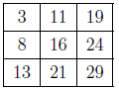 .
.
(We can check that each line obeys Piotr’s Principle.)
Note:There are other orders in which the squares can be filled. - Note: When we have the three numbers a, X, b on a line, then X is the average of a and b, so X = 1/2 (a + b).
When we have the three numbers a, b, X on a line, then b is the average of a and X, so b = 1/2 (a + X) or 2b = a + X or X = 2b ? a.
These facts will be useful as we solve (b) and (c).
Two Solutions:- Solution 1:The average of 5 and 23 is 1/2(5+23) = 14, which goes in the square between the 5 and 23. Since the average of the numbers above and below the 5 equals 5, then their sum is 2(5) = 10. (Note that we do not need to know the actual numbers, only their sum.)
Similarly, the sum of the numbers above and below the 14 is 2(14) = 28 and the sum of the numbers above and below the 23 is 2(23) = 46.
Therefore, the sum of the numbers in the whole grid is 5 + 10 + 14 + 28 + 23 + 46 = 126.
- Solution 1:The average of 5 and 23 is 1/2(5+23) = 14, which goes in the square between the 5 and 23. Since the average of the numbers above and below the 5 equals 5, then their sum is 2(5) = 10. (Note that we do not need to know the actual numbers, only their sum.)
- The centre square is the average of 9 and y and is also the average of x and 20.
Comparing these facts, 1/2(9 + y) = 1/2 (x + 20) or 9 + y = x + 20 or x ? y = ?11.
The number in the top right corner gives an average of 7 when combined with x (so equals 2(7) ? x = 14 ? x) and gives an average of y when combined with 20 (so equals 2y ? 20).
Therefore, 14 ? x = 2y ? 20 or x + 2y = 34.
Subtracting the first equation from the second, we obtain 3y = 45 or y = 15.
Substituting back into the first equation, we obtain x = 4.
We check by completing the grid. Starting with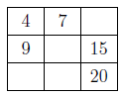 gives, after some work,
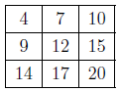 , which does obey Piotr’s Principle. Therefore, x = 4 and y = 15.
完整版真題資料可以底部二維碼免費(fèi)領(lǐng)取↓↓↓
[vc_btn title="查看更多COMC加拿大數(shù)學(xué)奧賽相關(guān)詳情" color="primary" align="center" i_icon_fontawesome="fa fa-globe" css_animation="zoomIn" button_block="true" add_icon="true" link="url:http%3A%2F%2Fwww.linstitute.net%2Farchives%2F99767||target:%20_blank|"]
以上就是關(guān)于【2006COMC加拿大數(shù)學(xué)公開賽真題答案免費(fèi)下載】的解答,如需了解學(xué)校/賽事/課程動態(tài),可至翰林教育官網(wǎng)獲取更多信息。
往期文章閱讀推薦:
競賽獲獎≠名校offer,但拿下哈佛、MIT、牛劍Offer的學(xué)霸履歷里,都有一個共同點(diǎn)……
【十問十答】別盲目刷競賽!10 個核心問答,理清國際賽事規(guī)劃底層邏輯!


翰林AMC8視頻課重磅上線!

國際競賽真題資源免費(fèi)領(lǐng)取






